Goldman Sachs Expects South Korean Stocks to Jump Another 50%. What Else Should Investors Keep an Eye On, Besides AI?

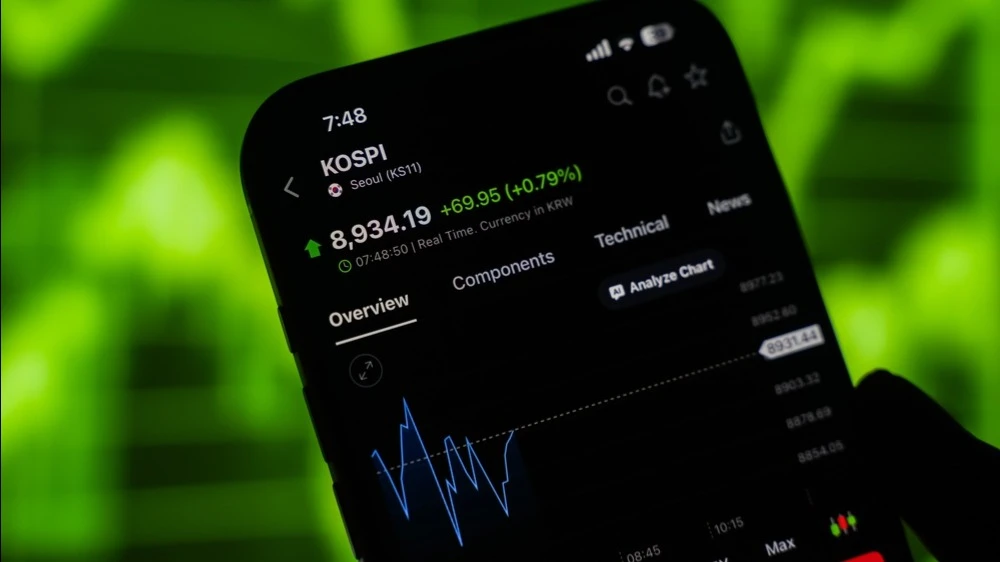
Analysts believe that in the second half of the year, the rally in the South Korean stock market will extend beyond chipmaker stocks / Photo: Stockinq / Shutterstock
Despite the South Korean stock market’s rise of more than 90% since the start of the year, Goldman Sachs maintains a “bullish” outlook on it. The bank’s analysts predict that, despite the recent sharp volatility in South Korean stocks, the KOSPI index will rise to 12,000 points over the next 12 months, according to Business Insider. This target implies a nearly 50% increase in the South Korean stock market relative to its most recent closing price.
Details
In the first half of 2026, South Korea’s stock market outperformed other Asian markets, with the KOSPI index nearly doubling, gaining more than 90% since the start of the year. However, this growth has come under pressure in recent months, notes Business Insider. The fact is that the South Korean market’s growth was largely driven by the surge in shares of chipmakers Samsung Electronics (up 165% since the start of 2026) and SK Hynix (up nearly 260%) against the backdrop of AI development. Now, however, shares of chipmakers are experiencing sharp volatility. Nevertheless, Goldman Sachs analysts believe that in the second half of the year, the rally will extend beyond the memory chip market: “Other sectors are showing increasingly robust earnings momentum,” they wrote in a Sunday note, pointing to the energy, commodities, and industrial sectors.
Goldman Sachs believes these changes are already beginning to show up in investors’ positioning. In particular, analysts are noting “additional inflows of foreign capital” into the securities of other South Korean AI beneficiaries, as well as into the stocks of “industrial companies” (the analysts did not specify any particular names). “We expect this trend to continue as investors seek exposure to the broader AI supply chain and [try] to find opportunities [in the market] that are not correlated with the AI theme,” Goldman Sachs noted.
The earnings outlook for South Korean companies remains strong: the bank’s analysts expect total corporate earnings in South Korea to grow by 320% this year and by another 35% in 2027. Goldman Sachs considers the market valuations of companies other than Samsung Electronics and SK Hynix to be moderate compared to their peers in the Asia-Pacific region.
What else are people saying in the market?
However, not everyone shares Goldman Sachs’ positive outlook on South Korean stocks. The Wall Street Journal points out the high volatility of the South Korean market in recent months. For example, over the past year, as of the close of trading on Thursday, the KOSPI index has fluctuated by at least 2% during a single trading session 77 times (by comparison, the S&P 500 showed such movements only five times during the same period), fluctuated by more than 3% on 44 occasions (U.S. stocks did not experience such movements during this period), and fluctuated by 5% or more on 23 occasions. To a large extent, these movements were driven by the performance of Samsung Electronics and SK Hynix shares.
Despite the Kospi’s overall rise since the start of the year, foreign capital outflows from the South Korean market exceeded $100 billion in the first half of the year—and amounted to $30 billion in June alone, the newspaper reports. Maxence Vissot, founder of the hedge fund Arkevium Capital, attributes this to foreign investors diversifying their portfolios (South Korean and Taiwanese stocks together account for half of the main emerging markets stock index, he says), rather than disappointment with the AI sector.
This article was AI-translated and verified by a human editor