Inflation data pushed the indices higher. Software developers are under pressure again
At the same time, chip developers have returned to growth

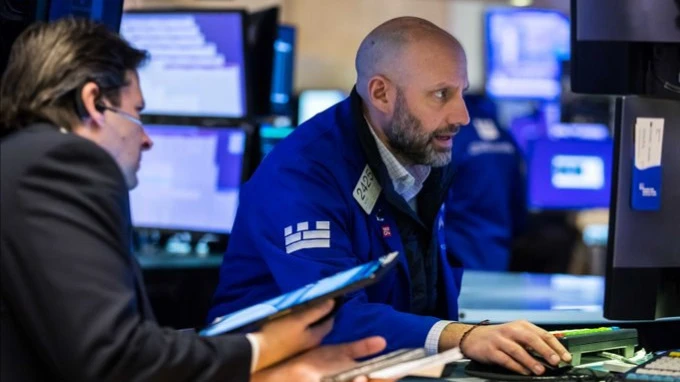
Photo: X / NYSE
All three major U.S. stock indices rose on Tuesday, July 14, following the release of weaker-than-expected inflation data for June. A rebound in semiconductor stocks provided additional support to the market, but software stocks are now under pressure following IBM’s warning of weak results.
Details
— The S&P 500 broad-market index rose 0.38%.
— The Dow Jones Industrial Average, a "blue-chip" index, barely managed to stay in positive territory, gaining a modest 0.02%.
— The Nasdaq Composite technology sector index posted the strongest gain, rising 0.9%.
— The Russell 2000 Small- and Mid-Cap Index rose 0.4%.
— Brent crude oil futures rose more than 2% to $84.73 per barrel, while WTI crude oil futures rose to $79.34 per barrel. Brent posted its strongest two-day gain since mid-March, according to MarketWatch.
— The dollar weakened by 0.29% against a basket of other world currencies.
— The price of gold rose by 1% — to about $4,050 per ounce.
— Bitcoin rose nearly 4% over the past day, reaching $64,500 per token.
What Influenced the Market
Oil prices retreated from their intraday highs after U.S. President Donald Trump abandoned the idea of charging 20% of the value of cargoes for the U.S. military’s assurance of safe passage through the Strait of Hormuz. However, oil prices still rose by the end of the day amid renewed tensions between the U.S. and Iran, according to CNBC.
IBM shares, which ultimately plummeted 25.2%, put pressure on the Dow Jones and the entire software development sector. This is the company’s largest single-day stock drop since at least 1968. IBM warned investors that second-quarter earnings would fall short of expectations due to weak demand in its software and infrastructure divisions. The official quarterly report is scheduled for release on July 22. This hit the stock prices of Microsoft, Workday, Salesforce, Autodesk, and Adobe. Even the American depositary receipts (ADRs) of the European company SAP were affected. By the end of the day, many companies had recovered from the decline—either partially or completely. The iShares Expanded Tech-Software Sector ETF, which is considered a barometer for the software sector, fell 2.7% on Tuesday but ended the day up 1%.
Semiconductor stocks rebounded on July 14 following the sell-off in the previous session. The VanEck Semiconductor ETF rose 2.5%. Applied Materials and Teradyne gained more than 3%, while Lam Research and Micron Technology each rose by about 5%. STMicroelectronics rose by more than 2%.
Goldman Sachs shares led the banking sector's gains, jumping 9% after the bank's results exceeded market expectations. JPMorgan Chase and Bank of America also reported their second-quarter earnings, and their shares rose by more than 2% and nearly 2%, respectively.
Consumer prices in the U.S. fell in June for the first time in six years, although on a core basis—excluding volatile food and energy prices—they remained virtually unchanged. The Consumer Price Index (CPI) fell 0.4% from the previous month, and annual inflation slowed to 3.5%. Economists surveyed by Dow Jones had expected a 0.2% monthly decline and a 3.8% annual increase. The actual data led to a reduction in expectations for a Fed rate hike this year. According to the CME FedWatch tool, the probability of a rate hike at the Fed’s July meeting fell from 42% the previous day to 17%. However, traders still expect a hike in September: the probability that the target rate will be 0.25 or 0.5 percentage points higher is estimated at nearly 60%.
Federal Reserve Chairman Kevin Warsh stated that the central bank’s leadership has no intention of tolerating high inflation, once again reaffirming its determination to curb price increases, which have remained elevated for five years now, according to Bloomberg. “The members of our committee are not prepared to tolerate persistently high inflation,” Warsh said Tuesday while testifying before Congress. “We are united in our firm commitment to restoring price stability.”
What Analysts Are Saying
— “Tuesday’s weaker-than-expected CPI report suggests that the surge in inflation caused by the war with Iran is subsiding, but this may prove to be only a temporary respite, as tensions have escalated again in recent days,” Skyler Wainand, chief investment officer at Regan Capital, told CNBC. — “These figures will likely allow the Fed to keep rates unchanged for now and reduce the likelihood of a rate hike, but we remind investors that nearly all of Chairman Warsh’s statements during his still-short tenure at the helm of the Fed have been hawkish.”
— “The market had expected weaker inflation data, and the actual figure came in slightly below forecasts,” Bloomberg quotes Subadru Rajappa, head of U.S. research at Societe Generale, as saying. — “I would pay more attention to tomorrow’s Producer Price Index report, as it is factored into the calculation of the core PCE, which will be released later this month.” This will provide a better assessment of the Fed’s preferred inflation measure—core PCE.”
This article was AI-translated and verified by a human editor