"It Will Be Too Late by Then": Why the Tenge's Devaluation Is Inevitable

The real reason for the currency's decline is the weakness of domestic production / Photo: Shutterstock.com
The tenge is fundamentally overvalued by nearly a quarter, said Bauyrzhan Tulepov, deputy chairman of the board at Halyk Finance, speaking at the Cbonds Capital Markets Kazakhstan conference held in Almaty. “I don’t consider devaluation a good thing; I’m not in favor of it. But in our case, it is inevitable, and even if it were to happen right now, it would already be too late,” he said in a subsequent interview with an Oninvest correspondent. We are publishing this article based on Tulepov’s remarks.
Inflation doesn't come for free
The concept of an appropriate exchange rate can be examined in terms of purchasing power parity and inflation—that is, money creation. Suppose we were able to buy a standard basket of goods for $100 in the U.S. and, say, for 15,000 tenge in Kazakhstan. So, we have a hypothetical exchange rate of 150 tenge per dollar. Exactly that amount of money was printed in each country per unit of goods.
A year later, let’s say inflation in Kazakhstan was 8%, and in the U.S., 2%. If production hasn’t increased, that means this money was printed and added to the cost of the sets. And we get a new price for the set: in the U.S., it now costs $102. In Kazakhstan, by the same logic, it will cost 16,200 tenge—and the new parity rate will be 158.8 tenge per dollar. A currency with high inflation depreciates.
If the real exchange rate remains unchanged at 150 tenge, then a Kazakhstani manufacturer selling its goods in the United States will receive $102—that is, 15,300 tenge—and will lose 5.6% compared to the local price. The foreign manufacturer gains an advantage: it can sell its goods here not for $102, but for $108, earning an additional 5.9%—and will lose nothing in terms of competitiveness. Or they could choose not to be greedy and sell their goods not for 16,200 tenge, but for 15,800, thereby reaping an additional profit while driving the local manufacturer out of the market. And this is the result of just one year of price disparity!
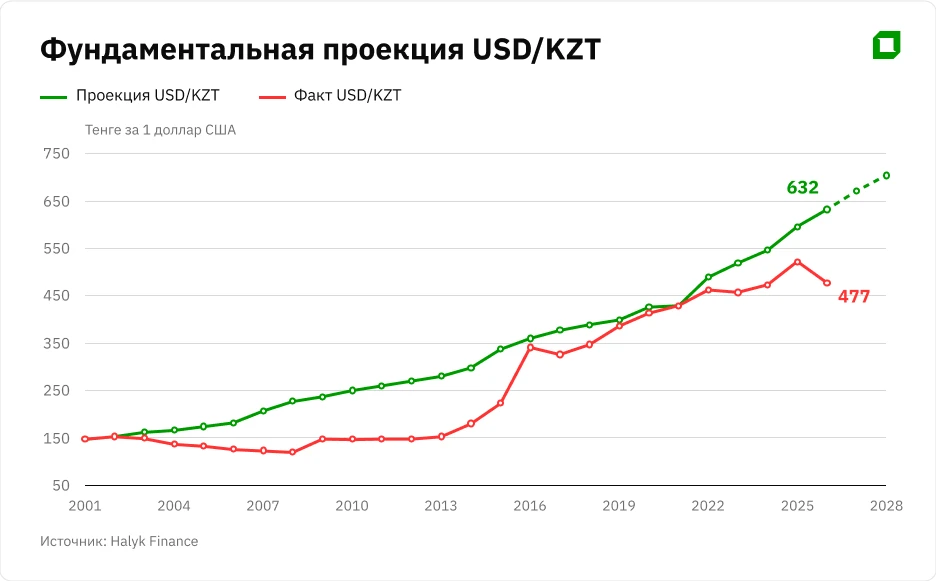
Kazakhstan has been experiencing high inflation for many years: on average, it has stood at 8.8% since 2001, compared to 2.6% in the United States. The graph shows how much the calculated tenge exchange rate diverges from the actual rate. And everyone remembers what happened as a result of the previous divergence in 2014–2015.
At the same time, it is important to understand that inflation—in the form of money printing—is always a decision made by the government. However, the currency exchange rate determines the path that money takes. If the newly printed money is directed toward the development of production, then—albeit with some time lag—we see a corresponding increase in supply. And a year later, 16,200 tenge will buy more goods, which means that both inflation and the exchange rate will decline.
Our domestic production almost always finds itself playing catch-up. When deciding to devalue the tenge, government agencies are guided primarily by the state of the budget and the current account of the balance of payments—taking into account the chronic deficits in both. Only then does the issue of competitive domestic production come into play. Although it creates jobs and, in the long term, generates budget revenue, it also substitutes for imports, improves the balance of payments, and, ultimately, ensures an inflow of foreign investment. And it is precisely the weakness of domestic production that is the true cause of the currency’s depreciation.
But the service sector—including government services—is also suffering from inflation. Wages are rising unevenly and with a lag, which hurts sales in the higher price segments. In competitive markets, rising operating costs are not adequately offset by price increases. Importers prefer low-quality goods. Taken together, this leads to a widening social gap, a narrowing of product ranges, and the deterioration and obsolescence of infrastructure—while, at the same time, consumption and consumer credit are growing at a faster rate.
The result is a vicious cycle: inflation, combined with a strengthening national currency, harms the economy as a whole and, at some point, makes a sharp devaluation inevitable, which in turn triggers a new round of inflation.
It is not the government that creates money in the economy
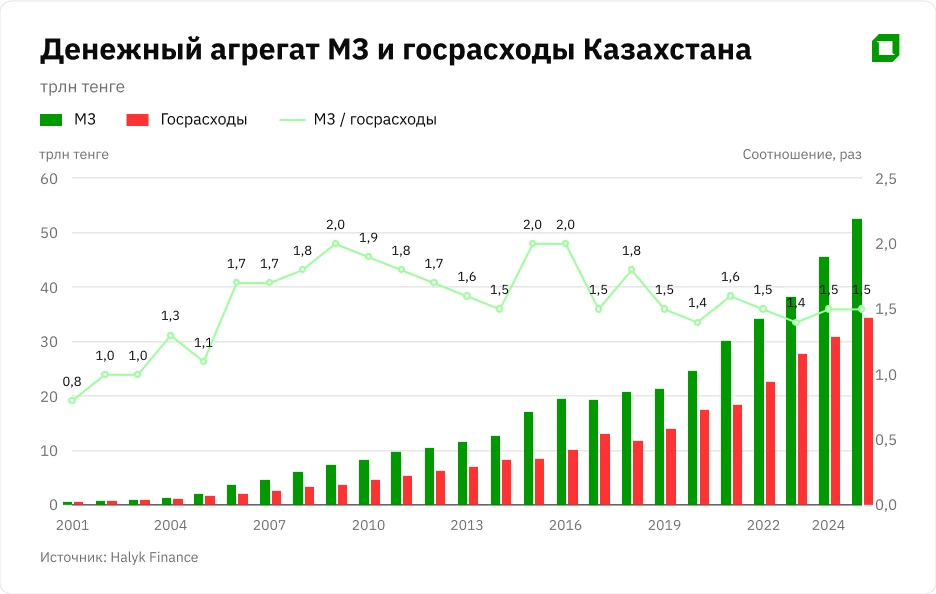
In a properly functioning economy, money creation generates fiscal inflation, but the money flows through households into banks and from there into production, offsetting the inflationary impulse. In Kazakhstan today, money from the government ends up in the wallets of households that do not contribute to the gross domestic product—and the flow stops at the bank. Since 2001, government spending has risen from 0.7 to 35 trillion tenge—a 50-fold increase! Has our economy grown by the same amount? The question is largely rhetorical. Instead of the effective rule of “tight fiscal policy—loose monetary policy,” we have the exact opposite.
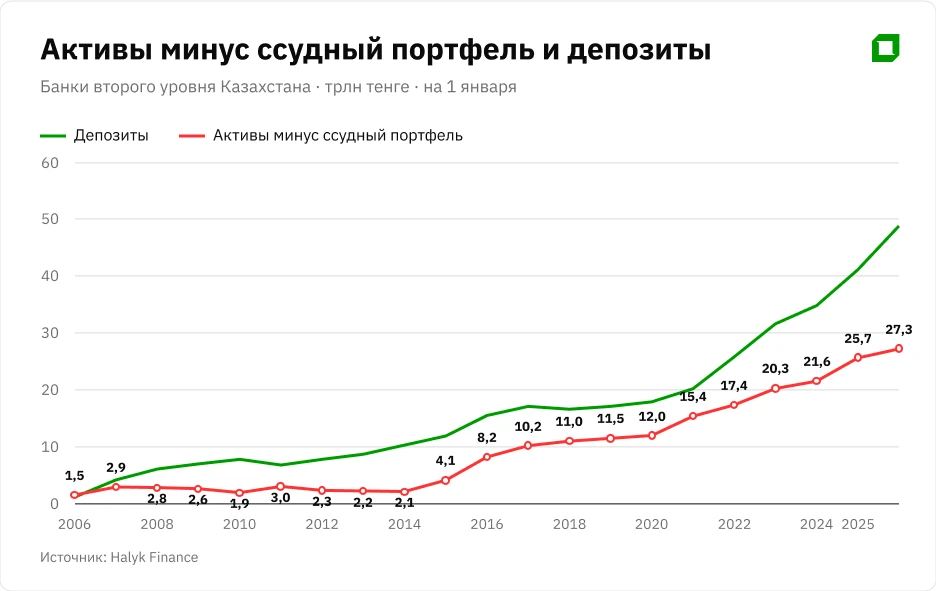
And against a backdrop of inflation and high interest rates, which make borrowing unaffordable for businesses, more than a third of banks’ assets—27.3 out of 70.8 trillion tenge—never reach borrowers. And this excess liquidity is growing at an accelerating pace.
Bank multipliers are becoming less effective: money—the lifeblood of the economy—is not flowing into it. The ratio of the M3 monetary aggregate (cash plus all customer deposits in banks) once peaked at 2 but has now fallen to 1.5. By comparison, in China, even for the narrower M2 aggregate, it currently stands at 11.8, and in a quarter of a century has never fallen below 7.8. In that economy, both banks and the stock market function effectively—and, as a result, it simply does not need foreign investment.
In accordance with the “Phillips curve” principle, the government uses inflation to combat unemployment and achieve economic growth. Keynes’s legacy is undoubtedly valuable—yet Milton Friedman demonstrated long ago and quite convincingly that, with this approach, a rise in unemployment can be delayed but not prevented. This is precisely what we are observing in our own economy: excess liquidity coexists with underfunding, and high demand for labor—driven by inflation and wage misalignment—generates unemployment—both real and structural—which further reduces the economy’s efficiency.
Stability Requires Change
There are only two ways out of the “high inflation/strong currency” scenario: either “high inflation/weak currency” or “low inflation/weak currency.” The question is not “Will the tenge be devalued?” The question is simply “When will it happen, and what will be the consequences?”
And the conclusions are quite simple: the inflation target must be lowered to 2%. This cannot be achieved overnight, but it is important to understand that “moving closer to the future target of 5%” is not yet a success. Since the budget is clearly cyclical—that is, it depends on natural resource prices—the introduction of an effective, workable fiscal rule is long overdue. Finally, an economy like this requires greater independence for the central bank so that it can do its job properly.
Now is the time to do so: Kazakhstan is neither Argentina nor Turkey. We have substantial international reserves, which, however, have fluctuated over the past five years almost exclusively due to rising gold prices. On the one hand, this stability should not only be appreciated but also put to use. Because stability without change, paradoxical as it may seem, guarantees a loss of stability. On the other hand, perhaps it is time to consider why reserves are barely growing in a growing economy.
This article was AI-translated and verified by a human editor