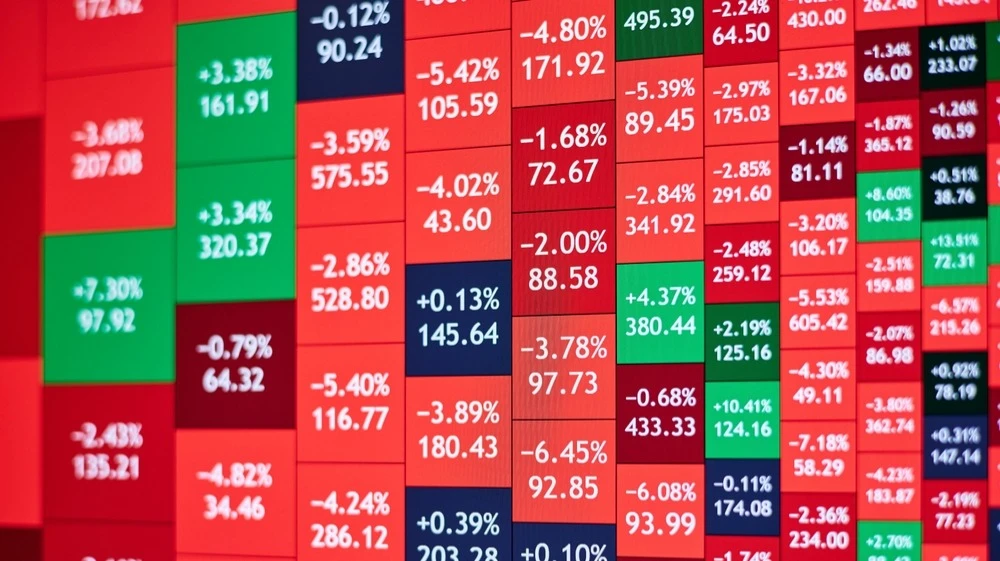
Nasdaq futures fell 2.6%. Why does Wall Street continue to believe in an AI rally?

Some investors remain optimistic about the outlook for the S&P 500 and AI-related stocks / Photo: cgst26 / Shutterstock
The sell-off in U.S. stocks continues for the second day in a row. Another round of disappointing earnings reports from major tech companies (Amazon and Intel reported their results yesterday) has heightened investors’ concerns about the return on large-scale investments in artificial intelligence, according to Bloomberg. Against this backdrop, Nasdaq 100 futures plummeted 2.6% in premarket trading on October 30, while S&P 500 futures fell 1%. Nevertheless, despite the sell-off, half of the professional investors and asset managers who participated in Barron’s Big Money fall survey remain optimistic and describe themselves as “bulls” regarding the outlook for U.S. stocks over the next 12 months.
Barron’s conducts the Big Money survey of professional investors twice a year in collaboration with Erdos Media Research of Ramsey, New Jersey. The fall survey was conducted from September 23 to October 15, with 81 portfolio managers participating.
Details
According to the survey, “bulls” are optimistic about the outlook for the S&P 500 and Nasdaq Composite indices: they predict that by the end of next year, these indices will rise by 8% and 13%, respectively. According to the optimists, the S&P 500 will end 2027 at 8,366 points, and the Nasdaq at 29,527 points. The Dow Jones Industrial Average, according to their average forecasts, will gain another 9% by the end of 2027.
However, this fall, the ranks of fund managers who are optimistic about stocks have thinned: in the spring, 54% were optimistic, compared with 50% now, according to Barron’s. The “bear” camp has grown and now stands at 24%, compared with 17% in April. About 26% of fund managers describe their stance on market prospects as neutral. Forty percent of those surveyed consider the market overvalued, while 10% consider it undervalued; these figures are roughly in line with the results of the spring survey.
31% of respondents consider information technology to be the most attractive sector in the stock market over the next 12 months, followed by healthcare at 26%. At the same time, 22% of those surveyed consider IT to be the least attractive sector.
37% of survey respondents are confident that current corporate spending on artificial intelligence infrastructure will pay for itself within the next two years. Another 32% expect the opposite outcome, while the rest believe it is too early to draw conclusions.
Nearly half of the fund managers who participated in the survey expect U.S. stocks to outperform other markets over the next 12 months. Nevertheless, 71% say they are optimistic about non-U.S. stocks, and 38% plan to increase the share of foreign securities in their portfolios next year. About a quarter of respondents believe that emerging markets will deliver the best returns in the coming year.
What Else Is Important to Know About the Study
Barron’s fall survey revealed that, in terms of investment performance, only 51% of respondents have outperformed the S&P 500 index this year—both in their personal investments and in their professional activities. This points to the challenges posed by market concentration in the technology sector and the shifting macroeconomic backdrop, the publication notes. Furthermore, this may explain the divergence in sentiment among participants in the latest Big Money survey.
What the Optimists Say
“The cycle of capital expenditures on artificial intelligence will continue into 2027. This is being underestimated. During the dot-com bubble in the late 1990s, spending lasted eight years. And it’s been only four years since ChatGPT was launched. Investors need to put their money where there is profit growth, high returns, and opportunities,” says Michael Arone, chief investment strategist at State Street Global Advisors.
Harris Nidik, co-managing partner at CFS Investment Advisory Services, shares this view. According to him, the stock market is “still in the very early stages” of the artificial intelligence boom, and the S&P 500 could rise to 9,000 points before the market cycle changes.
“Expectations are high, and too many investors have poured money into tech stocks, but the adoption of AI is still in its very early stages,” says Lori Kit, a portfolio manager at Parnassus Investments—she is betting on the tech sector.
AI will “blow people’s minds over the next decade,” says David Hartzell, president and CEO of Cornell Capital Management. According to him, the main challenge is selecting long-term leaders—that is, “individual stocks that will still be on the market in 10 years.” He himself is betting on the Vanguard S&P 500 exchange-traded fund (ETF). “When you buy it, you get all the good stocks, and the bad ones will eventually drop out of the index. This is the best way to capitalize on the tech boom,” he says.
A significant portion of the arguments in favor of a rise in U.S. stocks is based on the outlook for corporate earnings. Forecasts for corporate earnings have rarely—if ever—been so rosy, and this is largely due to spending on technology, notes Barron’s.
What the Skeptics Say
Bill Smid, Chief Investment Officer at Smead Capital Management and a bearish investor, believes stocks are overvalued. According to him, too large a portion of the U.S. market is dependent on artificial intelligence. “All this capital is being funneled into a single sector. This poses a risk to the economy and the markets,” says Smead.
Amy Robinson, CEO of Robinson Value Management, who holds a neutral stance on stocks, also sees risks in the strategies of AI-related companies and in their stocks. She cites Nvidia as the most overvalued stock on the market: according to her, the company’s investments in its own customers resemble the circular financing of the dot-com era: Nvidia helped many customers finance the purchase of its chips—which are essential for AI computing—or acted as a guarantor for their loans.
“One of the main problems is that when U.S. Treasury yields, interest rates, and oil prices rise, the dollar also strengthens. For emerging markets, this is far from an ideal scenario,” says Louis Lau, Chief Investment Officer at Brandes Investment Partners and co-manager of the Brandes Emerging Markets Value Fund.
What else are investors focusing on?
The higher cost of capital, as well as the stability and longevity of the “bet on artificial intelligence,” are the focus of many survey respondents. Twenty-seven percent of respondents cite a potential slowdown in the AI sector as the main risk the market may face in the next six months. The same percentage of respondents consider rising interest rates to be the main cause for concern, while 17% point to rising government bond yields.
This article was AI-translated and verified by a human editor