Strive has been paying dividends every day for a month now. What risks does the company face?

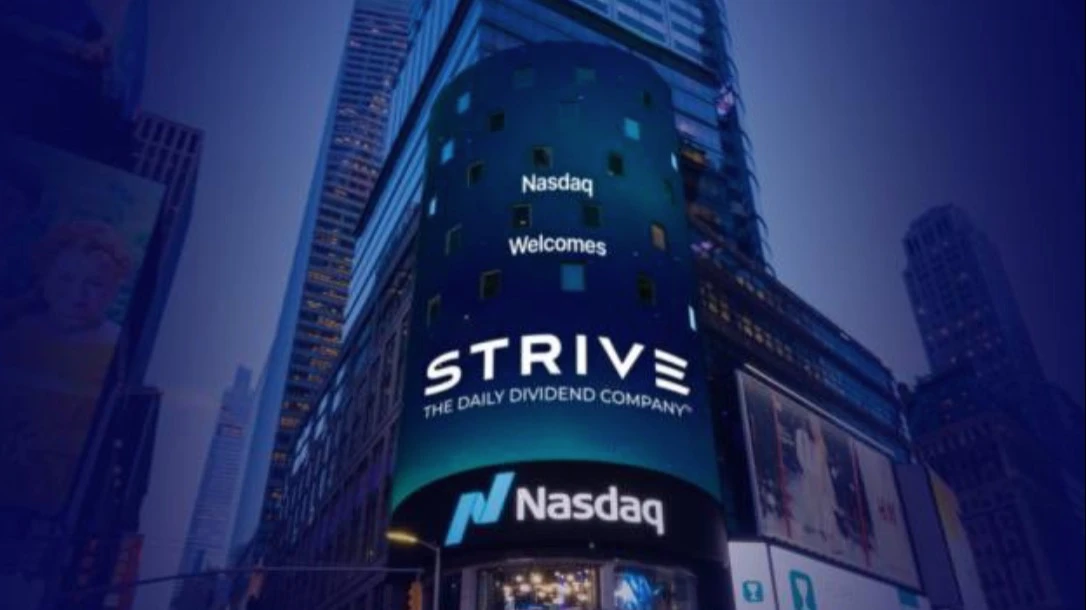
Strive, a company whose main asset is Bitcoin, has announced daily dividend payments. Photo: Strive / X
The American company Strive is the first in the history of the U.S. stock market to begin paying dividends on its shares every business day. It has been doing so for a month now. The effective dividend yield is just under 14% per year. The model is “workable but cleverly devised”: experts surveyed by Oninvest see both advantages and risks in it.
Dividends Every Day
On May 14, 2026, Strive CEO Matthew Cole announced the company’s decision to begin paying dividends daily starting June 16—along with its first-quarter financial results.
The company pays dividends only on its Variable Rate Series A Perpetual Preferred Stock (SATA). Strive also has Class A and Class B common stock, which do not pay dividends.
Cole stated that SATA “will become the first listed security in the history of the U.S. capital market to pay cash dividends every business day.” The company makes payments to shareholders listed in the registry as of the end of the previous day.
It used to pay dividends monthly. Now, they will still be approved in advance for the entire next monthly dividend period.
Strive's current annual dividend yield is 13%. Daily compounding increases the effective annual return to approximately 13.88%—due to more frequent reinvestment.
The point of switching to daily payouts is to position SATA not simply as an asset, but almost as cash. The idea of turning a “boring preferred stock” into a quasi-cash product is “a strong, well-thought-out move that really sets the company apart in the market,” says independent DeFi expert Roman Kaufman. According to him, SATA operates on the principle of DeFi staking, where a cryptocurrency holder “locks up” their coins in a smart contract and receives regular rewards in return. But while DeFi staking is a blockchain protocol without a centralized financial intermediary—such as a bank—SATA is a traditional security with an issuer and the corresponding infrastructure.
However, Strive classifies daily SATA payments not as dividends but as “returns of capital,” so the tax can be paid later—upon the sale of the shares. Mark Palmer, Managing Director and Senior Analyst for Fintech and Digital Assets at Benchmark-StoneX Group, notes that the plenty of preferred instruments across industries are funded out of capital or financing rather than reported profit. From that standpoint of what matters is the reserve, the seniority, and the issuer’s ability and willingness to fund the coupon.
Daily accrual reframes the preferred as a cash-like, yield-bearing instrument and reinforces the behavior of trading near par, which is a substantive design choice. It is also a genuinely effective communication and differentiation tool that builds an income-oriented following.

Bitcoin — at the heart of it all
Strive is an asset management company launched in 2022 by billionaire Vivek Ramaswamy (who nearly became the head of DOGE, the Department of Government Efficiency, alongside Elon Musk) and his friend Anson Freericks. Following its merger with Semler Scientific, which was finalized in early 2026, Strive essentially followed in the footsteps of Strategy and focused on cryptocurrency management.
Currently, its main asset is 19,000 bitcoins (as of early June), which are now worth approximately $1.23 billion. The company fully repaid all its debt obligations in the first quarter of 2026, according to a press release accompanying its financial statements.
Following the announcement of daily dividend payments, the company’s common stock rose 5.8%; year-to-date, it is down more than 14%. The company’s preferred stock has gained nearly 3.9% year-to-date.
Strive not only profits from rising cryptocurrency prices but also earns fees from managing Bitcoin assets, says Igor Plotnikov, COO of Millpay. Its main source of funding is the issuance of preferred SATA shares: investors buy them, the company purchases Bitcoin, and pays dividends to preferred shareholders daily.
Stress Test and Risks
Almost immediately after Strive began paying dividends daily, the market subjected the company to its first serious stress test: during the trading sessions of June 18–25, the price of SATA preferred shares plummeted from $100 to $83.53. The company attributed this to forced liquidation of positions rather than fundamental problems.
Mark Palmer agrees: “It was a forced unwind of leveraged positions collateralized by the preferreds in a still-thin market, not any deterioration in the underlying. So, on the question of resilience, the model held.”
Strive's business model has a vulnerability though, he adds. It depends on continuous access to capital markets, which is precisely what tightens under stress.
In essence, buying its shares is a bet on Bitcoin, Plotnikov adds. The company is not engaged in any manufacturing activities; it reported an operating loss of $319.7 million for the first quarter of this year, of which $295.8 million was due to a downward revaluation of Bitcoin.
All of its returns depend on future growth in the price of Bitcoin and its ability to continue attracting new investment.

Roman Kaufman believes that the “safe” Bitcoin price for the company—at which it would have sufficient assets to comfortably cover dividends on SATA—is $74,750. The company itself claims that its current balance sheet structure, given the cryptocurrency price mentioned above and a dividend yield of 13%, allows it to fund payments for approximately 19.6 years.
But Bitcoin is already trading lower—at $64,600. Since its October peak of $126,000, the cryptocurrency has lost about 50% of its value. Strategy, the largest corporate holder of Bitcoin, has sold 3,588 BTC for $216 million since the end of June. As Bloomberg reported, this was the largest sale of the cryptocurrency since 2020 and only the third in the company’s history.
In a stress scenario involving a further drop in the price of Bitcoin, Strive’s stability could be shaken, investors would rush to sell SATA shares, and their price would immediately plummet. If the price drops to $88, it could trigger an avalanche-like sell-off, Plotnikov believes.
So far, all five research firms covering Strive have assigned a “Buy” rating to the company’s common stock. The consensus price target is $29.6, which implies an increase of approximately 135% from current levels.