"The Maestro of Economics": Former Fed Chair Alan Greenspan Has Died. He Was 100 Years Old

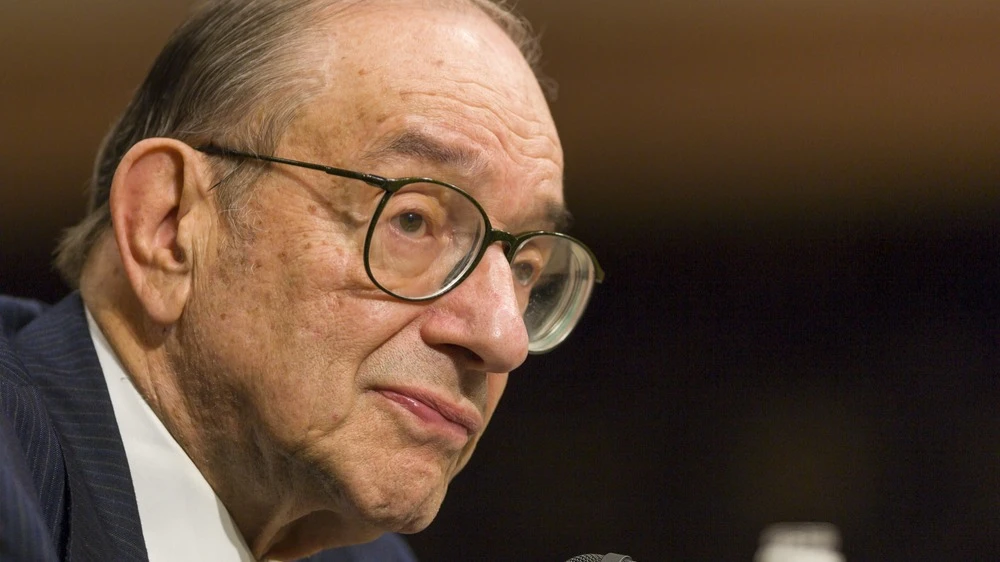
Alan Greenspan, who served as chairman of the U.S. Federal Reserve for many years, has died / Photo: Rob Crandall / Shutterstock
On Monday, June 22, Alan Greenspan, who led the U.S. Federal Reserve (Fed) for 19 years under four presidents, passed away. He was 100 years old, according to CNBC.
The influential economist passed away due to complications from Parkinson's disease, according to his wife, Andrea Mitchell, with whom he was married for 29 years and who serves as NBC News’ Washington correspondent and chief international correspondent.
What is Greenspan known for?
Alan Greenspan was appointed chairman of the Federal Reserve in 1987 by President Ronald Reagan. He held this position through periods of market crises and booms—until his resignation in 2006. This tenure was the second-longest in the agency’s history—falling just four months short of the record held by William McChesney Martin, who led the U.S. regulator from 1951 to 1970, according to CNBC.
Under Greenspan’s leadership at the Fed, the U.S. economy initially experienced a continuous decade of growth—from March 1991 to March 2001, according to Reuters. His decision to let the economy develop freely—despite calls to raise interest rates due to the threat of inflation, which ultimately never materialized because of a sharp rise in labor productivity in the mid-1990s— — helped secure years of prosperity for the United States and earned Greenspan the title of “economic maestro.”
His intuition at that moment still serves as a guide for current officials, Reuters notes. For example, former Fed Chair Jerome Powell cited it as an example of how personal judgment can sometimes surpass technical economic models.
Nevertheless, Greenspan’s insight into monetary policy was later called into question: in the 2000s and 2010s, critics lambasted his strategy for inflating a series of asset bubbles and setting the stage for the 2007–2009 financial crisis, Reuters notes. Greenspan remained at the helm of the Fed during the recessions of 1990–1991, the Asian and Russian financial crises of 1997–1998, the dot-com bubble burst in 2000, and the turbulent economic aftermath of the September 11, 2001, terrorist attacks.
In an effort not to unsettle the markets or reveal the regulator’s hand prematurely, Greenspan often phrased his statements in a way that left market participants scratching their heads, according to CNBC. “His long, convoluted sentences ultimately seem to undo what they set out to do at the beginning, descending into new levels of obscurity,” wrote Bob Woodward of The Washington Post in his 2000 biography, *Maestro: Greenspan’s Fed and the American Boom.”
After leaving the Fed, Greenspan admitted why he had used such convoluted language and offered a clear explanation: “It’s a language designed to deliberately obscure the essence of the matter in order to avoid certain questions that you know you can’t answer, because the words ‘I won’t answer’ or, essentially, ‘no comment’—that’s already an answer,” he said in a 2007 interview with CNBC. “So it all comes down to this: when, say, a congressman asks you a question and you don’t want to say ‘no comment,’ ‘I won’t answer,’ or something along those lines, I come up with four or five sentences that get increasingly obscure. The congressman thinks I’ve answered the question and moves on to the next one.”
Alan Greenspan was born on March 6, 1926, in the Washington Heights neighborhood of New York City. His father was a stockbroker and financial analyst. The future Fed chairman, whose childhood in the 1930s coincided with the Great Depression, was given $0.25 a week for pocket money. “Twenty-five cents, I’ll tell you, was worth a lot more back then than it is now,” Greenspan said in 2003.
Among his teachers and mentors were Arthur Burns, who would later become chairman of the Federal Reserve, and free-market advocate Ayn Rand, whom Greenspan was introduced to by his first wife, the artist Joan Mitchell.
This article was AI-translated and verified by a human editor