How Needham's Small Cap Growth Fund is benefitting from the AI boom
In 1H26, the fund quadrupled the return of the Russell 2000 Growth index

The fund is betting on AI infrastructure / Photo: Igor Omilaev / Unsplash
The AI boom helped deliver an around 87% six-month return for the Needham Small Cap Growth Fund. But that same boom also created problems for some of its holdings. Which three fund holdings delivered the highest returns this year, and which investment has underperformed the most?
About the fund
The Needham Small Cap Growth Fund offers a clear example of how investors in small-cap stocks can profit from the enormous spending on AI infrastructure. That spending benefits not only multibillion-dollar chip and accelerator manufacturers, but also developers of interconnect technology, suppliers of analytics software, and makers of passive components. This is where a significant share of U.S. small caps are concentrated.
The fund has been managed by Chris Retzler since January 2008. Retzler describes his approach as targeting “deep value opportunities at a reasonable price.” The fund has two share classes: the retail NESGX, which charges higher fees, returned 86.58% in the first half of the year, while the institutional NESIX returned 87.13%. By comparison, the Russell 2000 Growth index gained 22.18% over the same period. A year earlier, the picture was very different: for 2025, the fund underperformed the index, returning 11.16% versus 12.90%, respectively.
As of June 30, the fund had net assets of $419 million across 70 positions. Its portfolio differs radically from the composition of the Russell 2000 Growth. More than half of the fund – 58% – was invested in IT. That concentration comes at a cost. During another market selloff in July, the fund lost 16.63%, reducing its year-to-date return to 58.1% as of Monday, August 10.
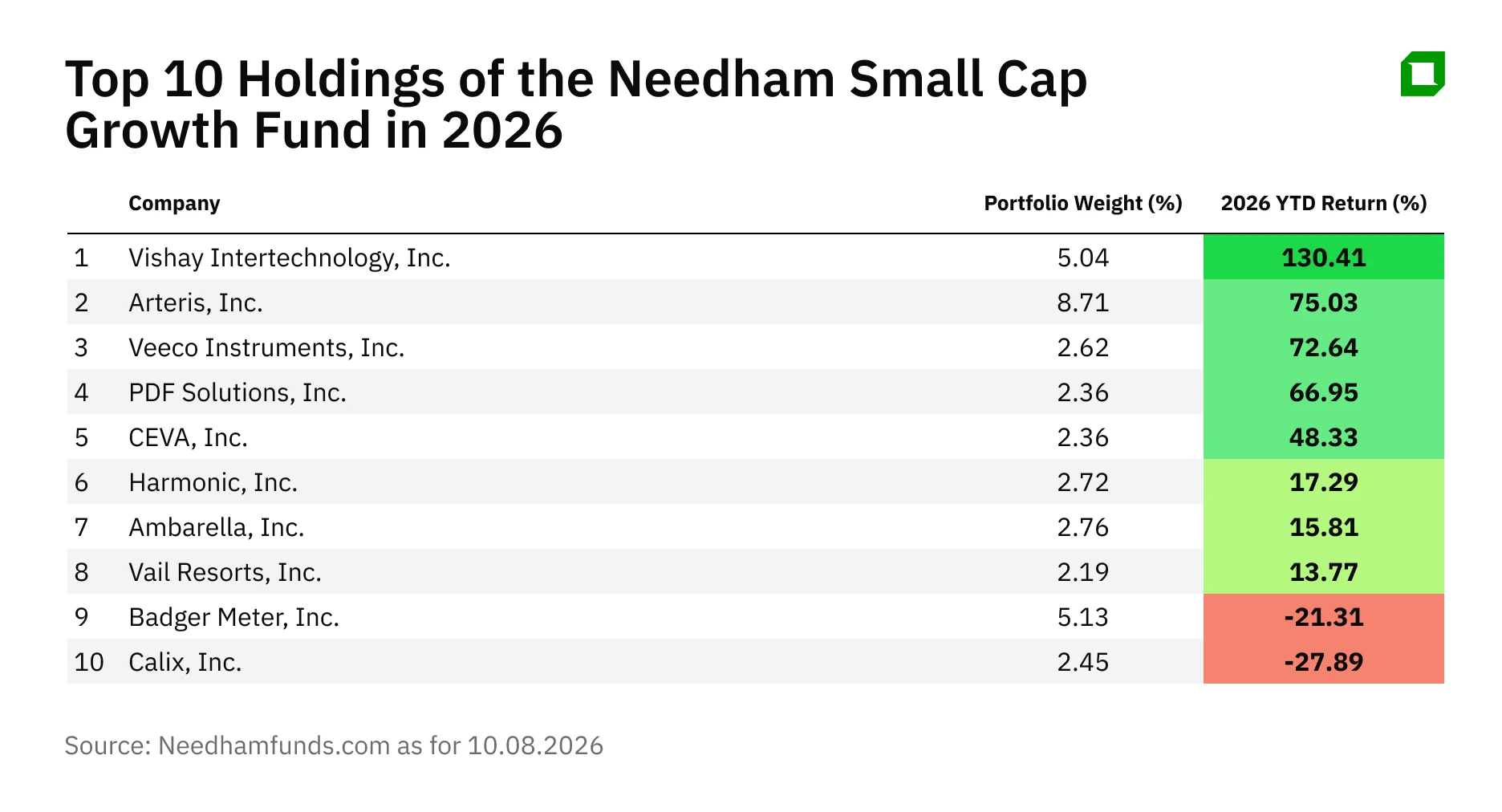
The fund’s 10 largest positions accounted for 36.34% of assets. Together, they contributed around 17 percentage points to its return. Its three-year beta is 1.35, indicating that the fund is more volatile than the market.
Best and worst performers YTD
Below we dive into the best- and worst-performing stocks in the Needham Small Cap Growth Fund portfolio so far this year.
Vishay Intertechnology (Malvern, Pennsylvania)
The best-performing stock among the fund’s 10 largest holdings, Vishay manufactures discrete semiconductors and passive components, including resistors, capacitors, diodes, and MOSFETs.
Vishay reported its second-quarter results on August 5. Adjusted revenue reached $918.6 million, up 20.5% year over year. Earnings per share came in at $0.19. The adjusted gross margin rose to 22.6%, exceeding the company’s guidance. The order book grew 18% quarter over quarter to $1.9 billion, while the book-to-bill ratio reached 1.32.
The industrial division represents a potential growth driver. Its second-quarter revenue jumped 30% year over year on demand for smart grids, power electronics used in AI, and high-voltage direct-current lines. JPMorgan estimates that Vishay’s AI-related revenue will total $150-200 million in 2026, equivalent to 4-5% of sales.
One risk for Vishay is its lower margins versus competitors in data-center power solutions. In addition, its convertible debt has increased the share count from 137 million to 162 million, diluting existing shareholders. The average target price on Vishay is $39 per share, implying 17% upside.
Arteris (Campbell, California)
The company develops technologies for moving data between processor cores, memory, and AI accelerators. On August 6, Arteris reported second-quarter revenue of $24.1 million, up 46% year over year. Remaining performance obligations totaled $135 million, up 36%. Annual contract value plus royalties reached $99.5 million, an increase of 44%. The company described all three figures as records. Meanwhile, the management raised its 2026 revenue guidance to $95-98 million from $91-95 million.
The company’s growth is being driven by customers’ transition to chiplets and custom AI accelerators: its largest deals of the last quarter came from data centers, while in the automotive segment, the company earned royalties from Li Auto autonomous-driving chips in mass production.
On the day the results were released, TD Cowen reiterated its “buy” rating on the stock at target price of $40 per share. On July 16, Oppenheimer initiated coverage of the stock with an “outperform” rating and TP of $40 per share. In August, Jefferies upgraded Arteris to “buy” from “hold” and raised its TP to $50 from $35 per share. The stock’s average target price on Wall Street is currently $41 per share. It closed Thursday at $27.59 per share.
However, despite its record metrics, the company remains unprofitable: its operating loss for the quarter was wider than analysts expected, while royalty growth slowed sequentially. CFO Nick Hawkins attributed this to logistical and supply-chain issues at one customer.
Veeco Instruments (Plainview, New York)
The company manufactures equipment used for laser annealing, ion-beam etching, and lithography. On August 5, the company reported revenue of $193.5 million, up 16.5% year over year and above its own guidance. Adjusted earnings per share came in at $0.33 versus the $0.28 consensus.
Needham notes that all of the company’s business lines contributed to the growth. The main driver was a $200 million order for advanced-packaging equipment – used to combine multiple chips or dies in a single package – received from several customers in the second quarter, with shipments set to begin in the first half of 2027.
The management raised its 2026 revenue guidance to $780-810 million from $740-800 million, but at the same time lowered its adjusted earnings-per-share guidance to $1.36-1.61 from $1.50-1.85. The reason is that Veeco is adding staff and expanding capacity ahead of expected growth in 2027.
The rise in Veeco’s stock is not solely attributable to its operating performance. In February, shareholders approved the company’s merger with Axcelis Technologies. The deal is expected to close by the end of the year. However, it hinges on obtaining approval from China’s antitrust regulator (SAMR).
Veeco’s stock currently reflects the likelihood and timing of the deal’s completion more than the company’s operating results. For this reason, Needham on August 6 maintained its “hold” rating on the stock without issuing a target price. Citigroup on Monday raised its TP to $63 from $60 per share, while maintaining its “buy” rating. The consensus target price is $61.33 per share. The stock closed Thursday at $53.58 per share.
Calix (San Jose, California)
This was the worst performer among the Needham fund’s 10 largest holdings. The company sells broadband operators a bundle of equipment, a cloud platform, and managed services.
Its second-quarter revenue totaled $293.3 million, up 21% year over year and above the high end of its own guidance. Adjusted earnings per share reached $0.47, also exceeding the company’s own guidance.
On paper, it was a strong report, but the stock fell more than 12% in extended trading on the day of the release, followed by a further decline of more than 6% over the next three days. Markets were reacting to the company’s gross margin coming in below the market consensus, at 54.8% versus 55.6%, respectively.
The reason was rising memory prices caused by strong demand from data centers. Calix buys memory chips for Wi-Fi equipment, meaning that higher prices directly reduce the company’s margin.
The management expects its gross margin to decline further in the third quarter to 50.5-53.5% versus the market consensus of 55.7%, because part of its order book is locked in at older prices. The company is passing higher memory costs on to new orders and now revises the surcharge monthly rather than quarterly. However, these surcharges only offset the additional costs. The management is not yet forecasting when the gross margin will return to around 55%, because it cannot accurately predict further changes in memory prices.
On July 21, JPMorgan lowered its target price for Calix to $58 per share from $65 per share, while maintaining its “overweight” rating. The average target price for the stock is $62.33 per share, implying 50% upside. Six of the seven analysts covering the stock have a "buy" call on it.
Four takeaways for investors
The Needham Small Cap Growth Fund is betting not directly on AI but on the infrastructure around it: on-chip interconnects, packaging equipment, manufacturing-data analytics, licensable intellectual property, and broadband networks.
The wide dispersion of returns among the fund’s largest holdings shows that its performance is driven by individual growth stories. At least one company was supported not by its operating performance but by an M&A deal.
The portfolio’s growth depends on high levels of hyperscaler capex, affordable memory prices, and the market’s willingness to pay high valuations for unprofitable growth companies. At the same time, some holdings are suffering from the same factor supporting other companies in the portfolio: for example, rising electronic-component prices are putting pressure on Calix’s margin.
A portfolio with such a high concentration in IT and AI is better suited to investors with a long-term investment horizon and a high tolerance for volatility than to those expecting stable returns.