War in the Middle East: what should investors do at Monday's market open?

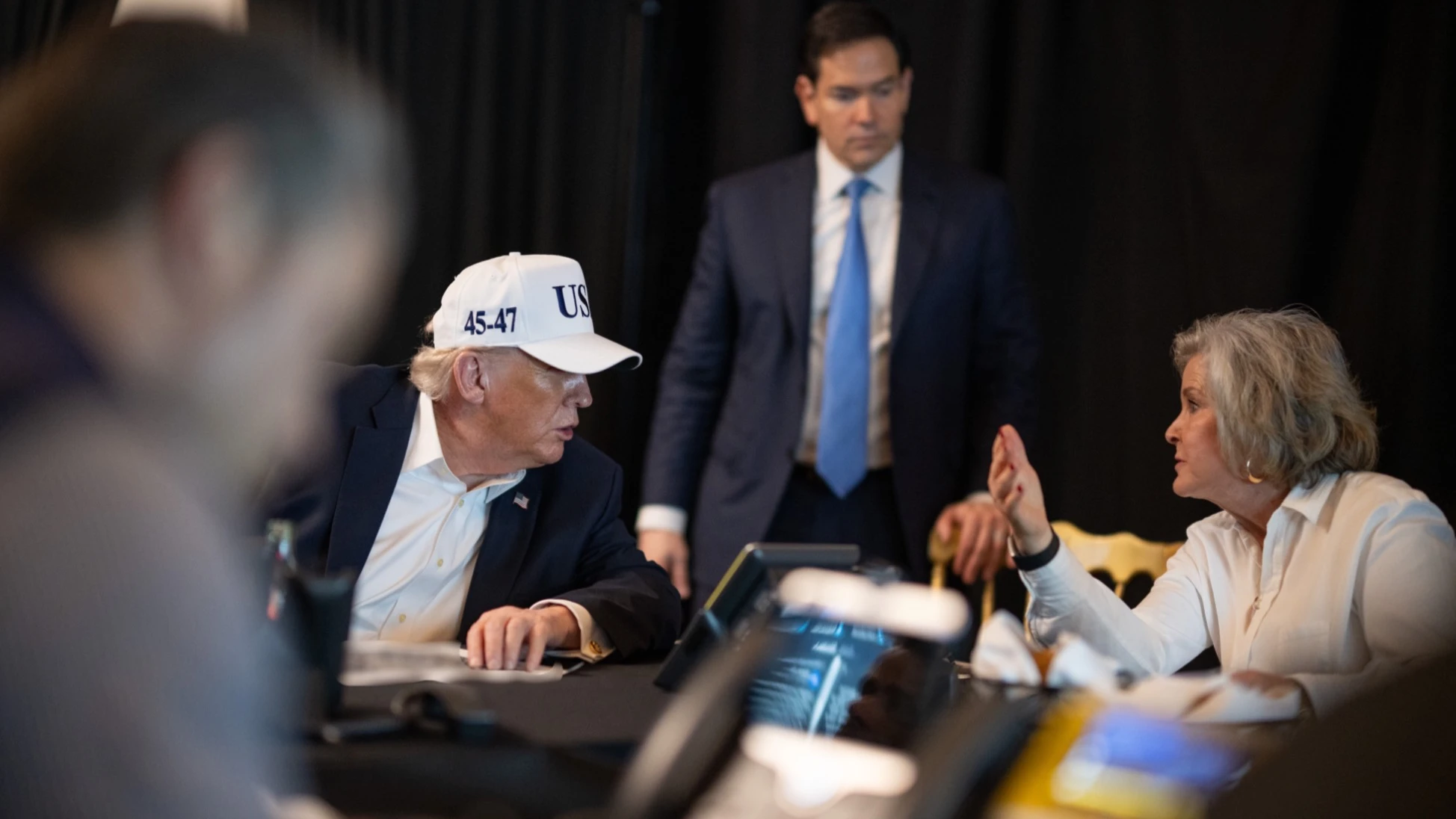
On February 28, the U.S. and Israeli military operation against Iran began. The White House published a photo of US President Donald Trump watching its progress. Photo: x / The White House
On Monday, the markets will face one of the most serious geopolitical tests in recent times: they will open amid a de facto blockade of the Strait of Hormuz and military strikes against oil-producing countries in the Middle East. Oninvest has collected the opinions of managers and investors on what market players should prepare for.
US and Israeli military operation against Iran: what has already happened
The U.S. and Israel launched a military operation against Iran on Saturday, February 28.
To the current moment:
- The Islamic Republic's supreme leader, Ayatollah Ali Khamenei, and four dozen of its top officials have been killed, including Islamic Revolutionary Guard Corps (IRGC) Commander-in-Chief Mohammad Pakpour and Chief of General Staff Abdulrahim Mousavi.
- Israel and Iran continue mutual shelling, in addition, the Islamic Republic strikes its Middle Eastern neighbors - UAE, Bahrain, Qatar, Kuwait. Secretary of Iran's National Security Council Ali Larijani claims that the targets of these strikes are U.S. military bases.
- Iranian Foreign Minister Abbas Araqchi said in an interview with Al Jazeera that the country's authorities have no plans to close the Strait of Hormuz. One-fifth of all oil shipments pass through the strait, and it is already de facto closed: Reuters reported on March 1 that at least 150 tankers are in the open waters of the Persian Gulf outside the strait, with dozens of others on the other side.
- OPEC+ is already making attempts to prevent a deficit in the oil market. On March 1, the eight countries that make up the grouping decided to increase production by 206,000 bpd in April, with Saudi Arabia and Russia accounting for the largest increases. But unless oil can physically leave the Persian Gulf, these increases "will have limited immediate market impact," Jorge Leon, head of geopolitical analysis at Rystad Energy, told the WSJ.
Since the conflict started over the weekend, only the cryptocurrency market reacted to it - on Saturday it was losing $128 billion in market value at the moment. The price of bitcoin fell to $63.1 thousand. But on March 1, the cryptocurrency market recovered some of its losses.
What an investor should do: basic scenarios
In the stock market, the main reaction can be expected as early as Monday morning. How should investors prepare for the opening of the markets?
"There could be many options by morning: from "everything is gone, let's run into gold and Japanese yen" to "urgently short oil, as everything(military conflict - ed.) is already over," Alexander Orlov, managing director of Arbat Capital, told Oninvest. - My opinion is that the first market movements will be wrong, and it will be necessary to stand against them or at least not to run after them".
Alexei Tretyakov , manager and author of the War, Wealth & Wisdom Telegram channel, says that because of the high degree of uncertainty, it is difficult to make any forecasts - "it would be a finger in the sky". "Therefore, when the markets open, the best solution will be to remove excessive risks (for example, close leveraged positions in shares of Dubai developers) and follow the development of events," he told Oninvest.
"The market first overvalues the disaster and then overvalues the recovery," investor Yevgeny Marchenko writes in his Telegram channel Kubyshka.
He believes it is necessary to keep part of the portfolio in liquid instruments (savings accounts and money market funds) and consider "moderate exposure" to energy and banks - this, in his opinion, will be a hedge against an inflation shock. He also believes that market players need to be cautious when investing in companies with high dependence on fuel and logistics costs, in growth stocks with a simultaneous jump in bond yields and in leverage.
In the case of the blockade of the Strait of Hormuz, Marchenko expects a short-term jump in oil prices above $120-150 per barrel, a sharp increase in volatility in commodity markets, a surge in inflation expectations around the world and the transition of global markets into risk-off mode.
"For the US, this means a double blow <...> Indices are capable of going into a correction of 10-20% depending on the duration of the blockade. Personally, I see a subdued correction of 2-4% on Monday so far. But if the correction does intensify to 10% and above I will increase exposure to the broad market," he wrote.
Investment banker Evgeny Kogan in Telegram-channel bitkogan on February 28 presented two scenarios of developments related to Iran's war with the U.S. and Israel and their impact on the reaction of markets.
In his opinion, if the conflict is over within two or three days and the Strait of Hormuz is opened, we can expect a short-term increase in the price of gold followed by a pullback - up to the point that the price of gold will be below the level recorded before the military operation. Then the factor of global geopolitics will no longer be a determining factor in the stock and debt markets, he believes.
The second scenario, which he refers to as "smoldering chaos," assumes a prolongation of the conflict. Then gold will become "the basic asset in portfolios for years to come", and the constant risk of terrorist attacks on tanker routes and destabilization of Iraq and Saudi Arabia will create an eternal "geopolitical premium" to the price of oil. The S&P 500 will go sideways, and if the situation develops unfavorably, it will go into negative territory; it is also possible that inflation will accelerate, which will affect the debt market. But all this, according to Evgeny Kogan, will be balanced by the topic of AI development and risk-off strategies.
Atlas Capital 's analyst team warns that events around Iran "are not the first episode, and clearly won't be the last."
"Short-term such events create noise, give a reason for emotional selling and volatility surge - but not more than that. They do not change the fundamental picture of the market. In a week nobody remembers about them, markets return to where they should have come, and those who sat in the cache "until the situation becomes clearer", silently look at the missed growth", - they wrote.
This article was AI-translated and verified by a human editor