Western, Barbie, and Alpine Skiing: What Will Help Wrangler's Stock Rise 50%?

Over the past 12 months, Kontoor Brands’ stock has lost 20% of its value / Photo: Kontoorbrands.com
Kontoor Brands—the owner of the Wrangler brand—has always sought to sell not just jeans, but a lifestyle—one rooted in American casual style. Over the past year, the company’s stock price has fallen by 20%, and it is now restructuring its jeans business: it is promoting the cowboy-inspired Wrangler line for women with the help of Barbie, has acquired the activewear manufacturer Helly Hansen, and has decided to sell Lee, which has been losing revenue. Will this strategy help accelerate growth? What threats does the Super El Niño pose to the company? And why are analysts forecasting a 50% rise in the stock price of Wrangler’s parent company? Find out in this Oninvest article.
Marlon Brando and the Cowboys
Kontoor Brands is a relatively young company, but one with long-established brands. In 2019, it was spun off from VF Corporation—a large American conglomerate of fashion brands, including Vans and The North Face. The new company inherited denim brands with a long and distinguished history: Lee and Wrangler.
Lee traces its roots back to 1889—its founder, Henry David Lee, was a wholesale grocer who launched his own line of overalls. Lee jeans didn’t become a staple of fashion and a symbol of youth culture until the 1950s, thanks to movie stars Marlon Brando and James Dean. Wrangler dates back to the 1940s, when the brand’s jeans were created“by cowboys for cowboys”and tested by rodeo champions.
Denim had long been the backbone of VF Corporation—as far back as 2003, it accounted for more than half of the company’s revenue. But by the late 2010s, the denim business had lost its appeal compared to other brands such as Vans and The North Face, which specialize in outdoor gear. In 2018, revenue for VF Jeanswear declined by approximately 2% to $2.76 billion, while other business segments grew at high single-digit rates.
A New Era
VF Corporation spun off its denim division in 2019: the spun-off business was named Kontoor Brands and retained the Wrangler, Lee, and Rock & Republic brands. VF distributed 100% of Kontoor Brands’ shares to its existing shareholders and retained no stake in Kontoor following the transaction. For every seven shares of VF, shareholders received one share of the new company.
In connection with the transaction, Kontoor raised approximately $1 billion in debt through a new credit line and transferred most of these funds to VF. In its subsequent financial statements, Kontoor reported that the resulting debt could limit the company’s future growth and negatively impact its results, financial position, and cash flows.
Despite this, on the day trading began, Kontoor CEO Scott Baxter called the spin-off a “new era” for Wrangler and Lee. The company planned to develop these denim brands on its own and become a global company specializing in lifestyle brands, rather than simply producing successful men’s jeans and selling them wholesale — as Paul Kirney, vice president of equity research at Barclays, described VF’s denim business.
Western-Style Barbie
However, the transformation was not without its challenges—the company’s key brands began moving in different directions. By 2023, Wrangler accounted for nearly 70% of revenue, and its share of the brand’s total revenue had been steadily increasing, while Lee’s share had been declining for three years, according to data from Kontoor.
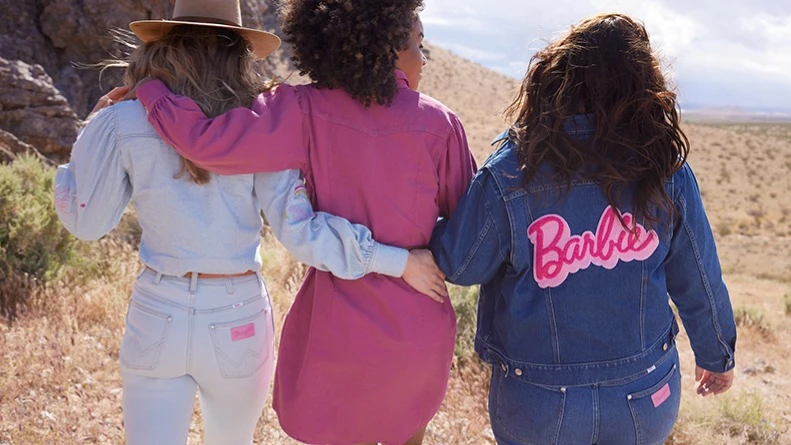
A key factor in Wrangler’s success was the traditionally male-oriented brand’s focus on a female audience. This was aided by the brand’s collaboration with country star Lani Wilson, known in part for her role in the TV series “Yellowstone,” which is set in the modern American West. And the Wrangler x Barbie collaboration in the fall of 2023 became, according to the company, Wrangler’s fastest-selling collaboration in history.
The development of a clothing line inspired by the American West became one of the key factors behind Wrangler’s rise: In 2024, Kontoor called the year “Wrangler’s most successful in decades”—revenue in the American Western category grew by 5%.
In addition, Wrangler began developing a line of activewear. In 2024, this category generated more than $200 million in revenue, growing by 15% over the course of the year and doubling over five years, the company reported in its annual report.
Lee also tried to move away from its image as a classic denim brand and rebrand itself, in part by appealing to a younger audience. However, collaborations with the Japanese anime franchise Dragon Ball Z and the Chinese streetwear brand Roaringwild did not help reverse the downward trend. Lee’s revenue for 2023 fell by 4% to $843 million. In 2024, the decline accelerated to 6% ($791 million).
Helly Hansen Takes the Lead
In search of new growth opportunities, Kontoor announced in early 2025 that it had acquired Helly Hansen—a Norwegian brand of sailing and skiing apparel—for approximately $900 million.
Helly Hansen, founded in 1877, is known for a series of technological breakthroughs: from the introduction of fleece in sportswear in the 1960s to the development of moisture-wicking base layers in the 1970s and the patented H2 Flow ventilation system in 2012. Helly Hansen gear is popular among national teams and Olympic athletes.
Kontoor acquired the brand from the Canadian retailer Canadian Tire, hoping to gain access to a more affluent, young, and active audience, as well as to diversify geographically.
In the second half of 2025, Helly Hansen generated $475 million in revenue, with two-thirds coming from international markets, and Kontoor took the next decisive step.
Lee's Fall
In May 2026, Kontoor announced the sale of the Lee brand to Authentic Brands Group—whose portfolio includes Reebok and Guess—for up to $1 billion. The apparel manufacturer planned to focus on its brands with higher growth rates—Wrangler and Helly Hansen.
Kontoor believed that Lee's first major advertising campaign in many years—aimed at repositioning the brand— helped improve brand perception; however, sales still fell by 5% by the end of 2025. As a result, Lee’s business turnaround will continue without her involvement.
The agreement provided for an initial payment of $750 million and a potential additional payment of up to $250 million, the amount of which would depend on Lee's future performance under the management of Authentic Brands Group.
The transaction is expected to close in the fourth quarter of 2026. Once it is completed, Kontoor plans to use $400 million for an accelerated share repurchase program and the remaining proceeds to repay debt.
What's happening now
In the second quarter of 2026, Kontoor’s revenue from continuing operations rose 19% to $584 million: Helly Hansen contributed $114 million, and Wrangler’s sales increased by 2%. Adjusted operating income rose 19% to $94 million. The company raised its 2026 adjusted earnings per share guidance to $5.25–5.35. However, debt remains significant: as of the end of the quarter, it stood at $1.1 billion.
In early September, at Helly Hansen’s investor day, Kontoor outlined the brand’s long-term strategy and financial goals through 2030. The company expects to increase Helly Hansen’s revenue to more than $1.1 billion (up from $675 million in 2025), bring the operating margin to approximately 15%, and generate more than $500 million in total cash flow.
“We are expanding our presence in the U.S., strengthening our position in the Alps, and developing our activewear and workwear lines, where our growth potential is greatest,” said Helly Hansen Global CEO Berre Hegbom, outlining the European brand’s plans for global expansion.
What Analysts Are Saying
Analysts’ opinions on Kontoor’s prospects are mixed. Matthew R. Boss, an analyst at JP Morgan North America Equity Research, is optimistic (a report dated September 3 is on file with the editorial staff): “The portfolio transformation over the past five years, including the recent sale of Lee, lays the foundation for annual revenue growth in the mid-single-digit range and higher, as well as total shareholder return in the mid-double-digit range.” His price target remained at $105 with an “Overweight” rating—63% above the stock’s closing price on September 24. Barclays analyst Adrienne Y and her colleagues also maintained an “Overweight” rating with a price target of $99 (the September 8 report is on file).
Laurent Vasileanu, an analyst at BNP Paribas Securities, highlights the weather risk facing Helly Hansen, a significant portion of whose business is tied to winter sports. According to him, during the previous Super El Niño (a climatic phenomenon in which the surface waters of the equatorial Pacific Ocean abnormally warm every few years), the brand’s revenue fell by 5% in 2015 and by another 7% in 2016 (the report is on file with the editorial office). The risk is high again now: NOAA estimates the probability of a very strong El Niño in the fall and winter of 2026–2027 at more than 90%. BNP Paribas has reaffirmed its “underperform” rating with a price target of $50. This is the lowest target price for the company’s stock to date, implying that the stock could fall by 24%.
Overall, Wall Street maintains a positive outlook on Kontoor. On MarketWatch, out of 11 analysts covering the company, eight have a “buy” recommendation. Two other analysts recommend holding the company’s stock, and one recommends selling. The average price target for Kontoor shares is $97.50, which is 51.3% higher than the closing price on September 24.