What makes Physical Intelligence—the company Bezos has invested in—so interesting?

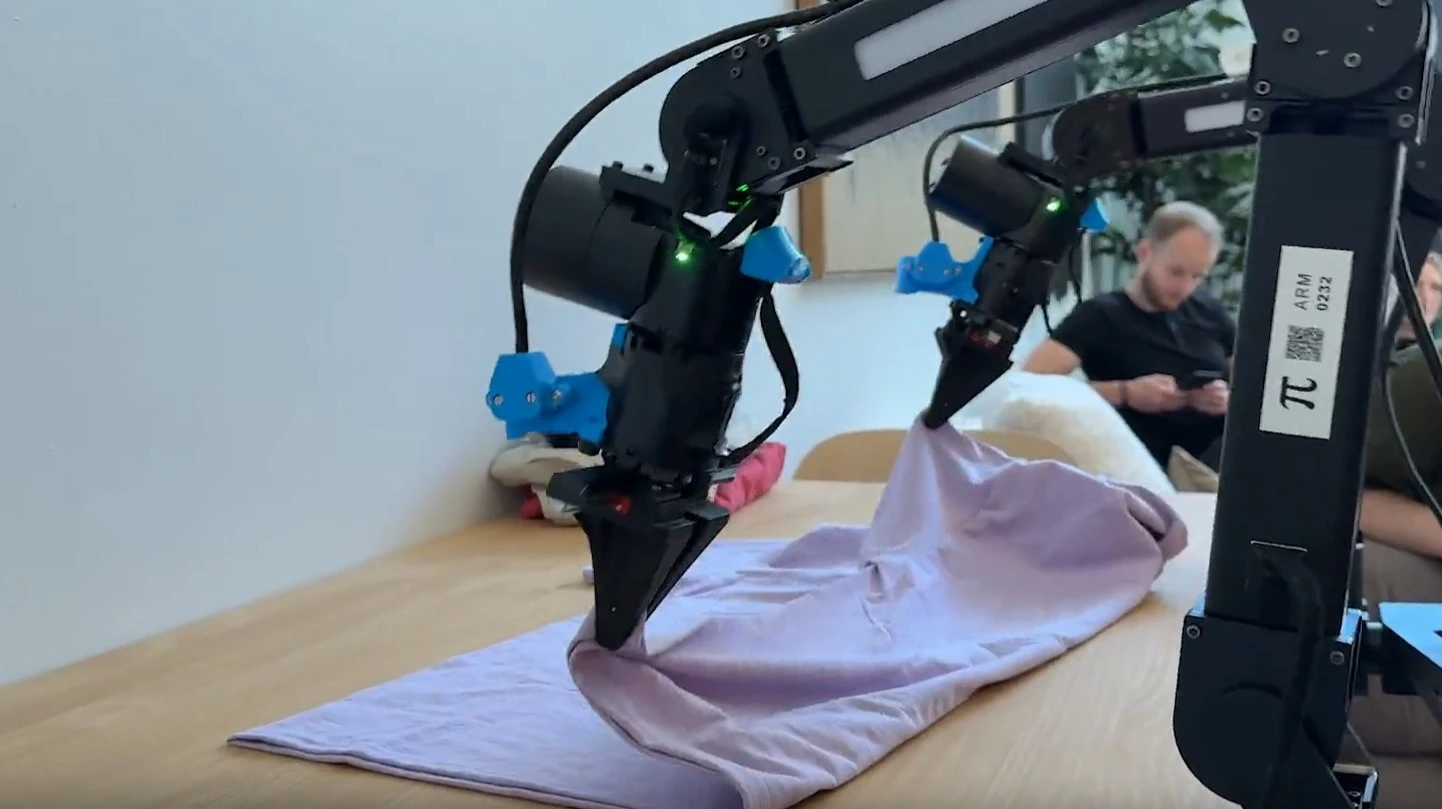
The company's investors include OpenAI, Jeff Bezos, Alphabet's CapitalG fund, and Thrive Capital. /Photo: Physical Intelligence
Physical Intelligence, co-founded by a Russian-born professor of robotics, has raised more than $2.1 billion over the past two years. Its investors include billionaire Jeff Bezos and even OpenAI, which is, to some extent, a competitor. What makes this company so interesting?
Expansion of floor space
What connects the rental housing provider Airbnb and the company Physical Intelligence? The answer may seem surprising: a former industrial building on Brannan Street in San Francisco. In the early 2010s, this building housed Airbnb’s headquarters, and just recently, PI subleased part of that office space. The space in question is 80,964 square feet, although earlier this year, discussions centered on approximately 60,000 square feet.
At the same time, Physical Intelligence expanded south of San Francisco and leased 233,500 square feet in a business complex next to Google’s headquarters. According to the Silicon Valley Business Journal, the space is intended for offices and R&D activities.
Why would a company need so much space right away if it isn’t actually involved in physical manufacturing, despite its name, Physical Intelligence? The explanation likely lies in the nature of its technology: Physical Intelligence is attempting to create a kind of universal “brain” for real robots—AI firmware for machines. That’s why the company may need computing infrastructure and a large amount of space where it can train real robots and test and refine its “brain” models.
What Physical Intelligence Does
The company develops artificial intelligence models for robotics—vision-language-action (VLA) models—that are capable of perceiving their surroundings, understanding instructions, and controlling the machine's actions.
The latest model of this type is the π0.7, which was unveiled in April of this year. The company notes that this model is capable of dividing operations between robots and tasks: for example, it can work with a second machine and fold clothes without specific data for that task, as well as learn to operate a household appliance through language training.
In its materials, the company also describes real-world—not just laboratory—experiments: robots equipped with its models are operating at active companies' facilities, performing tasks such as packing orders.
According to Revenue Memo, Physical Intelligence had approximately 80 employees in January 2026.
"I'm not very good at business…"
“…And I don’t really know much about investing, so I can’t claim to know how to do it,” said Sergey Levin, a professor of robotics at the University of California, Berkeley, and one of the founders of Physical Intelligence, in a recent episode of The Peterman Post podcast. He has experience at Google and is a recipient of the Presidential Early Career Award for Scientists and Engineers (PECASE).
Keid Metz's book *Genius Makers* states that the professor grew up in Moscow; his parents were engineers who worked on the Soviet “Buran” project.
Physical Intelligence was co-founded by Levin, Google DeepMind researcher and Stanford lecturer Karol Hausman, Stanford University professor Chelsea Fink, former Google Brain and Google DeepMind researcher Brian Ichter, Adnan Esmail, who previously led engineering at Anduril after working at Tesla, and Lachi Grum, a former Stripe employee and well-known business angel who has invested in companies such as Figma, Notion, and Ramp.
The company does not disclose its financial statements. Despite this, Physical Intelligence has already raised approximately $2.1 billion from investors. According to Revenue Memo, these investors include OpenAI, Jeff Bezos, Alphabet’s CapitalG, and Thrive Capital. OpenAI participated in funding rounds both directly (in November 2024 and November 2025) and through the OpenAI Startup Fund (in March 2024). The company does not disclose the exact investment amounts or a breakdown of the funds.
Bezos participated in two funding rounds and was one of the lead investors in a $400 million Series A round in November 2024; he then participated in a $600 million Series B round in November 2025, but the amount of his investment was not disclosed.
In July, the Forge platform listed Physical Intelligence among the ten most sought-after private companies of the second quarter of 2026 and cited a valuation of $11.19 billion. According to AXEVIL’s estimates, the company’s share price could currently be $633.50. Nasdaq Private Market, on the other hand, valued the stock at $500.59 as of September 16.
Strengths and Weaknesses of Physical Intelligence
According to the Startup Diligence report, the company’s key risk is that it must transform its pilot projects and research into full-fledged paid contracts within a relatively short timeframe. The report notes that a lack of commercial revenue by the end of 2026, coupled with the absence of a compelling client portfolio, could become a “turning point” for the company’s investment appeal.
The Startup Diligence report also mentions competition from Skild AI and Google DeepMind, as well as Physical Intelligence’s reliance on Google’s technologies—the company’s first VLA model uses the PaliGemma base model developed by Google DeepMind.
The Startup Diligence report also notes the risks associated with reliance on certain key personnel—the departure of Sergey Levin or Chelsea Fink before the company reaches commercial operations could undermine its investment appeal.
But it is the team itself that is highlighted as one of Physical Intelligence’s strengths. These researchers come from various fields, so the company has the expertise to train models on different types of robots, which can create a “data flywheel” effect: the more real-world robots use the model, the more data the company receives for further robot training.
Sergey Levin previously stated that robotics is still in the stage of searching for technology that can be reliably scaled. Unlike large language models used in AI—where increases in computational resources, data volume, and model size already yield fairly predictable improvements in performance—such a correlation has not yet been established for robotics.
Company representatives, as well as Levin himself, did not respond to Oninvest’s questions about plans to raise investment or go public.
This article was AI-translated and verified by a human editor