Where to invest $10,000 when the world is on the brink of a global recession: three stocks for April

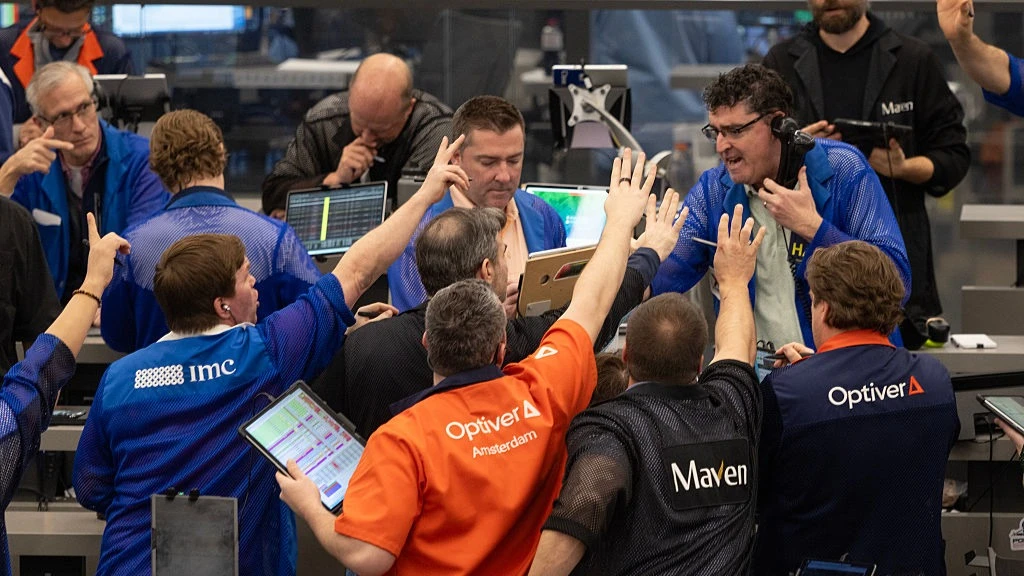
President Trump has promised the imminent end of the war for the 13th time: the cost of a barrel of Brent fell below $100/bbl on April 1. Photo: Scott Olson/Getty Images
In March, the cost of Brent crude oil rose by 63%, several investment banks raised their forecasts on the probability of global recession due to the war in the Middle East. Rising oil prices and the threat of a global crisis put the investor in front of an uncomfortable choice: look for protection (where?) or continue betting on growth. Private Wealth Manager Renat Faizulin has selected three stocks for Oninvest that combine both scenarios.
Alphabet: how to protect yourself from the AI bubble while in the bubble
The first stock is Alphabet. This is a bet not so much on AI, but on the sustainability of the business if expectations around it turn out to be inflated. The company controls key positions: it has a search engine, Google Cloud, YouTube, and a very strong R&D arm:
It's a company that spends a huge amount of money on R&D and invests heavily in startups and in artificial intelligence. If you overlay AI on the Google ecosystem, it looks as sustainable as possible

In 2025, Alphabet spent $61.1 billion on research and development, which is more than the budget of many countries. For example, Bulgaria's budget for 2025 was $54.98 bln.
If the AI story turns out to be partially a bubble, Google won't suffer critically because their core services are already generating steady demand and revenue

Alphabet has a net profit margin of 32.81% (TTM) compared to the industry average of 15.28%. Fayzulin points out that the company's stock moves roughly in line with the market: at the close of trading on March 31, its sensitivity to market movements(beta) was 1.11, while NVIDIA Corporation or Tesla Inc., for example, have higher volatility: 2.38 and 1.93, respectively.
Alphabet stock was worth $286.90 at the close of trading on March 31.
Berkshire: in cash we trust
Berkshire Hathaway is a bet on liquidity and the ability to make money in a crisis, not on a particular sector or macro scenario.
The company has a huge amount of cash, and the stock gives access to a diversified portfolio of assets - from insurance business to stakes in major U.S. companies. A separate argument in favor of Berkshire is liquidity. The company has $373.3 billion in cash on its balance sheet, which gives it the ability to aggressively buy assets during market drawdowns.
It's a built-in crisis investment mechanism

Even after Warren Buffett's departure from active management, the company retains continuity: his strategy is continued by Greg Abel.
At the same time, the securities remain less volatile than the market as a whole: beta 0.69 at the close of trading on March 31 makes them a tool to reduce the overall risk of the portfolio. Since the beginning of the year the securities have fallen by 4.67%, but Renat Faizulin believes that in the long term the growth potential is high - but this is not a story of one year. Over the past five years, year-to-date, Berkshire Hathaway shares are up 87.54%: "And this is qualitative growth, without big drawdowns, sharp jumps and with steady dynamics," notes Faizulin.
Based on a total budget of $10,000, he suggests looking at Class B shares. There's nothing wrong with Class A shares except the price: at the close of trading on March 31, one security was worth $718,000 Class B is more affordable at $479.2 per share.
ExxonMobil is a "cash machine."
American ExxonMobil is a bet on the current reality, where energy is still the foundation of the economy. Low production costs allow the company to generate significant cash flow already at oil prices from $65 per barrel:
"Over the next five years, the company expects to generate approximately $145 billion of cumulative excess cash flow at a Brent oil price of $65," the company's 2030 development plan outlines.
It's not just an oil company, it's a cachet-making machine

Renat Faizulin notes good diversification: Exxon operates along the entire value chain - from raw material extraction to petrochemicals - and the company is geographically spread across key regions. The portfolio includes fuels, lubricants, plastics and chemicals, which makes the company less dependent on certain market segments. In addition, ExxonMobil is betting on a gradual and pragmatic adaptation to the energy transition, trying not to create risks to the profitability of the key oil and gas business. By 2030, the company plans to invest about $20 billion in low-carbon areas. At the same time, about 60% of these funds will go not into solar and wind power, but into solutions to reduce emissions.
The stock is supported by strong dividends, expected dividend yield for the next 12 months is now 2.40%, and strong capitalization (over $660 billion). In the long term, the market assumes a scenario in which ExxonMobil could approach the $1 trillion mark.
At the close of trading on March 31, ExxonMobil's stock was worth $169.7.
Briefcase design
If the proposed ideas are assembled into a single strategy, the distribution could look as follows, the private equity manager suggests: 45% to Berkshire Hathaway, 35% to Alphabet, 20% to ExxonMobil. Given the current asset volatility, the final beta of the portfolio is about 0.77. The portfolio is 23% less sensitive to the market (S&P 500) and should generally show smoother dynamics.
In the event of a correction or "AI bubble bursting", the roles are fairly clear. Berkshire gets an opportunity to use liquidity and buy assets on drawdown. Exxon benefits from rising energy prices, which often accompany geopolitical crises. Alphabet, for its part, remains resilient through its core businesses of search, advertising and cloud.
If an energy crisis scenario materializes, for example, if the Strait of Hormuz remains closed until the summer, ExxonMobil becomes the main beneficiary. Rising energy prices partially pressurize the margins of technology companies, including Alphabet, but this effect is offset by the profits of the oil and gas segment. Berkshire Hathaway in this configuration again serves as a stabilizer. In the event of a recession, Berkshire will be the key pillar. The result is a structure with a clear logic: moderate volatility, sector diversification and preservation of growth potential.
Let's not forget about the psychological factor. Deep drawdowns are one of the key reasons why a private investor leaves the market with the feeling that "this is a casino". In this configuration, the probability of such a scenario is noticeably lower: the portfolio does not promise sharp jumps, but it provides what is most valued in turbulence - controllability and predictability.

Disclamer: the ideas presented are for informational purposes only and do not constitute personalized investment advice. Past returns do not guarantee future results. It is important to conduct your own analysis or consult with a specialist before making investment decisions.
This article was AI-translated and verified by a human editor