Without Binance and USDT: How Will the European Crypto Market Change Starting July 1, 2026?


As a result of the cryptocurrency reform, EU residents will lose access to Binance, the largest cryptocurrency exchange, starting July 1. Photo: Art Rachen/Unsplash
Starting July 1, 2026, all cryptocurrency platforms that wish to serve customers in Europe must hold a special license under the MiCA regulation—the world’s first set of rules for the cryptocurrency market, adopted by the EU. To date, fewer than 8% of the 3,167 companies have been able to obtain a license. The rest will have to leave the European market. This is not the only consequence of the EU’s sweeping crypto market reform.
What's changing on July 1?
The licensing of cryptocurrency platforms under the MiCA (Markets in Crypto Assets) regulation is part of a global financial market reform that began in the EU back in 2020. Its overall goal is to make the European financial sector more transparent and stable and to protect investors’ rights.
Starting July 1 of this year, all crypto-asset service providers operating in the European Economic Area—crypto exchanges, brokers, custodial wallets, etc.— — must hold a new pan-European license in order to continue operating legally with clients.
The licensing requirement is essentially extraterritorial: all crypto platforms must comply with it, regardless of their place of registration or whether they have a European legal entity, the EU’s crypto platform regulator—the European Securities and Markets Authority (ESMA).
Crypto providers without a MiCA license will have to close the accounts of their European clients and require them to withdraw their funds, or allow them only to sell their assets and withdraw money.
All of the lawyers surveyed by Oninvest consider this scenario the most likely, especially since the “passport-based” blocking mechanism has already been tested on users from sanctioned countries such as Iran and Russia, notes Yuri Brisov, a partner at Digital & Analogue Partners. Many platforms restrict access to U.S. citizens to avoid issues with the U.S. Securities and Exchange Commission.
Using the reverse solicitation mechanism to retain the client base in the EU will not be possible. ESMA explained to Oninvest that it only permits the servicing of individual clients who have themselves approached an unlicensed provider, rather than mass engagement with users.
What are the requirements for crypto companies?
First, MiCA sets minimum capital requirements for trading venues. These range from €50,000 for those providing basic services—such as advisory services and order routing to other platforms—to €150,000 for exchange activities.
Second, companies must maintain reserves equal to 25% of their annual operating expenses for the previous year, while new entrants must maintain reserves equal to 25% of their projected operating expenses.
Third, client funds and company funds must be held in separate accounts. In the event of bankruptcy, this will exclude user funds from the bankruptcy estate, which creditors can claim.
Finally, all platforms must be prepared to comply with a set of related regulations. For example, the Travel Rule, under which they exchange data on the sender and recipient without a minimum transaction amount threshold, and enhanced due diligence applies to transactions involving non-custodial wallets of €1,000 or more, says Olga Goncharova, CEO of the consulting firm RizzGo. Additionally, crypto service providers will not be able to serve anonymous accounts and will be required to collect data on users’ tax residency. They will submit this data to European tax authorities for the first time in 2027.
Self-custody of cryptocurrencies, DeFi, and peer-to-peer transactions remain outside the direct scope of European legislation, but this loophole closes the moment funds are deposited or withdrawn, says Yegor Vinogradov, CEO of the crypto brokerage Sun Crypto Management.
The crypto market grew out of the idea of freedom, self-control over assets, and minimal involvement of intermediaries. The MiCA regulation proposes a fundamentally different approach: if you want to work with European clients, you need a license, reporting requirements, reserves, sanctions risk management, and ongoing interaction with regulatory authorities. This is the normal price of maturing.

The regulations themselves do not provide for fines for companies that violate them; Oninvest did not disclose any details to ESMA, noting that it would coordinate its actions with regulators in EU member states and law enforcement agencies.
It is possible that ESMA will follow the example of the United Kingdom, whose regulator publishes a “blacklist” of unauthorized platforms, or that of Kazakhstan, which blocks the websites of unregulated crypto providers, suggests independent crypto expert Viktor Pershikov.
In any case, reputational risks will be the main challenge for the crypto industry, according to Andrei Suvorov, a senior attorney at GSL Law & Consulting. If a company or its top management is held liable, this could become an obstacle to obtaining a license outside the EU, if required by local legislation.
There are also no fines for EU residents who use unlicensed services. In such cases, they will most likely not be entitled to compensation for losses, to file a complaint with the European regulator, or to seek protection from the European Court of Justice.
Market Turmoil: What the New Regulations Have Led To
After July 1, the licensing process will continue for new companies and for those that did not meet the deadline during the transition period. The latter will be required to transfer users’ crypto assets to licensed operators and temporarily suspend operations in the EU.
In other words, this effectively means that companies will have to cede their share of the European market to their competitors.
This is the scenario facing Binance, for example—the world’s largest cryptocurrency exchange. It was unable to obtain a license from the Greek regulator HCMC and will attempt to do so in another European jurisdiction. The company has already informed its customers that, starting this week, it will suspend cryptocurrency-related services in several EU countries. The company did not respond to Oninvest’s inquiry.
Binance has 300 million users worldwide. The company does not disclose how many of them are in Europe. According to estimates by the well-known crypto enthusiast Spigg, Binance’s user base in the EU could range from 40 to 47 million people.
Binance isn't the only one that has faced licensing issues. According to estimates by the consulting firm Coincub, 3,167 crypto service providers were operating in the EU prior to the reform. As of June 30, 244 entities had received licenses and were listed in the ESMA registry.
As a result of the reform, only 14 licensed participants can operate a full-fledged exchange—with an order book and order management—says Brisov.
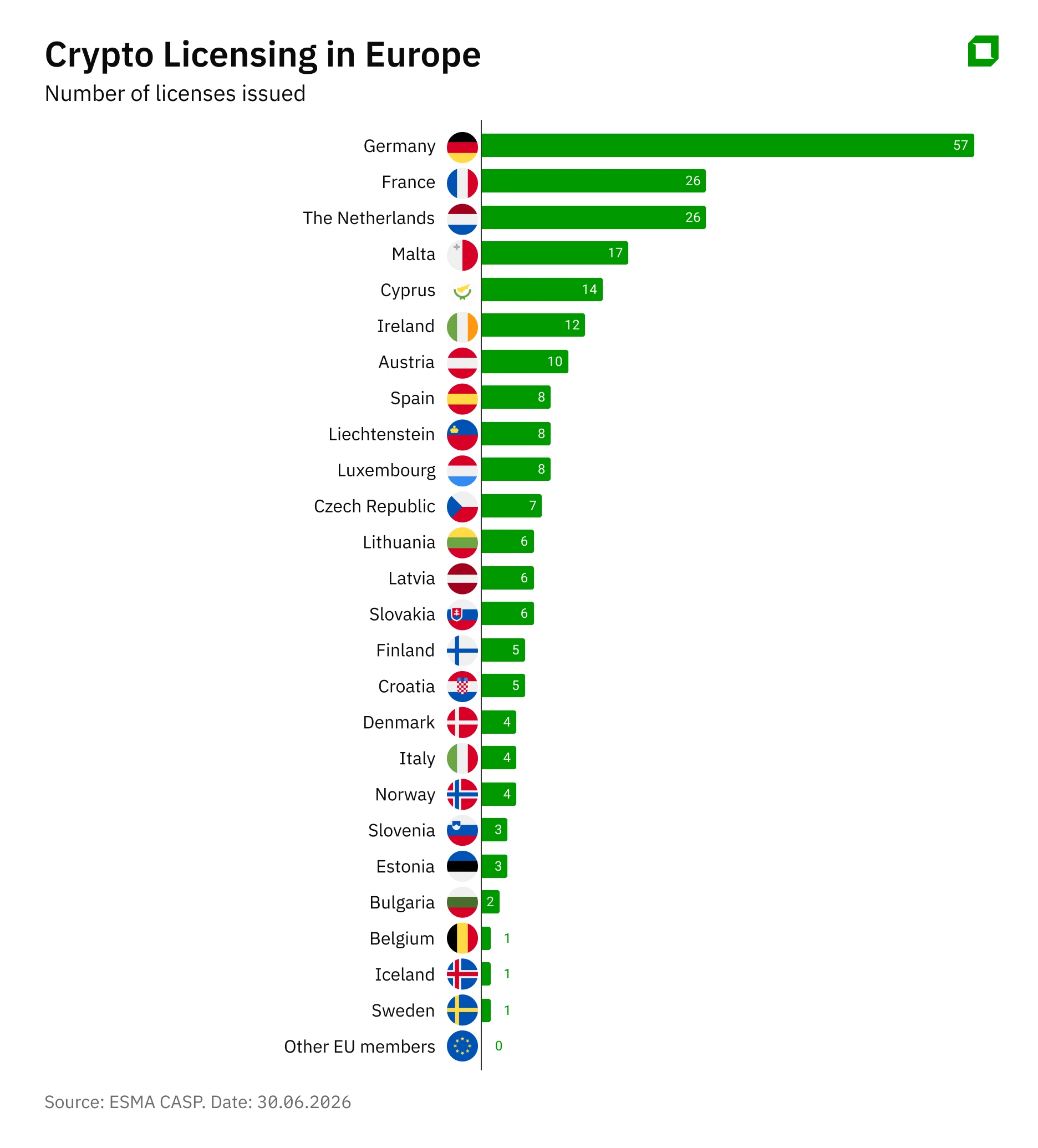
Germany issued about a quarter of all licenses. The Netherlands, France, Malta, and Ireland were also among the leaders. Poland, where many crypto companies were also operating, has not yet been able to pass the necessary legislation and cannot issue licenses, Gocharova explains. The Czech Republic, on the other hand—where not a single crypto company had been registered—has granted several authorizations following the MiCA reform.
Major non-European crypto exchanges have been able to take advantage of regulatory arbitrage in favorable European jurisdictions, Coincub reported. Among them are ByBit, a company registered in the UAE that obtained a license in Austria, as well as OKX and Crypto.com, which obtained licenses in Malta. U.S.-based Coinbase, Gemini, BitGo, and Robinhood, as well as the U.K.’s Revolut, also obtained licenses without any issues. At the same time, small European crypto startups have been left out of MiCA, and this could lead to a brain drain, Coincub laments.
Graduates of European universities with degrees in blockchain-related fields are leaving the EU. Coincub analyzed how the number of job openings related to blockchain, cryptocurrency, or Bitcoin has changed in the local market. In 2022, there were more than 100,000 such positions across the EU; in 2023, when the reform began, there were about 61,000; and by early 2025, there were only 10,000.
What does this mean for European customers of cryptocurrency exchanges?
Mandatory licensing is unlikely to result in all foreign crypto platforms becoming inaccessible to EU residents after July 1, 2026, argues Tatyana Malykh, a lawyer at ANP “Zenit”: Platforms from jurisdictions with formal regulation and high risks will remain, and blatantly “gray” platforms—which have never been interested in licenses—will continue to operate.
It is important to note that the previous phase of financial sector reform—in the summer of 2024—led Tether, the issuer of USDT (the largest stablecoin by average daily market capitalization), to stop doing business with the European market.
In the spring of 2025, its CEO, Paolo Ardoino, stated that the company would not apply for a European license, and in the spring of 2026, he said that MiCA’s requirements were incompatible with the company’s business model. As a result, European companies stopped offering access to USDT.
Tether was not satisfied with the requirements imposed on issuers of such tokens. For popular stablecoins, regulation essentially amounts to an increased regulatory burden on banks, says Brisov.
If all three of the following criteria are met simultaneously: more than 10 million users, a market capitalization of more than €5 billion, and at least 2.5 million transactions totaling more than €500 million, issuers must maintain equity capital at 3% of their reserves, and 60% of their reserves must be held in bank deposits within the EU. They are also prohibited not only from earning income on their reserves but also from rewarding users with that income. In other cases, the requirements are less stringent: stablecoins must be 100% backed by liquid and low-risk assets, of which 30% of the collateral must be held in bank deposits within the EU. The issuer may invest the remaining assets only in highly liquid and low-risk instruments. The issuer’s equity must be at least €350,000 or 2% of the average value of reserve assets.
Circle emerged as the winner following Tether’s voluntary withdrawal; it is the only one of the top 10 stablecoin issuers by market capitalization to have obtained a MiCA license in France. It issues USDC, which is pegged to the U.S. dollar, and EURC, which is pegged to the euro. Issuers whose stablecoins are pegged to a basket of assets have not obtained a single license.
In addition, through MiCA, the EU is restricting the spread of dollar-pegged stablecoins in the European payments market. This is due to a requirement that issuers of stablecoins pegged to currencies outside the EU cease issuing them if the volume of payments exceeds €200 million per day or an average of 1 million transactions per quarter. There are no such restrictions for stablecoins pegged to the euro.
The EU isn't completely pushing the dollar out, but it is laying the groundwork for the growth of euro-denominated instruments within its own market.

As a result, White Stone attorney Alexandra Fedotova believes that the real competitor to USDC in Europe will be not so much a private euro-pegged stablecoin as the digital euro.
This article was AI-translated and verified by a human editor