The market is unfazed by the stock decline: Wall Street's fear index is at its lowest level since December


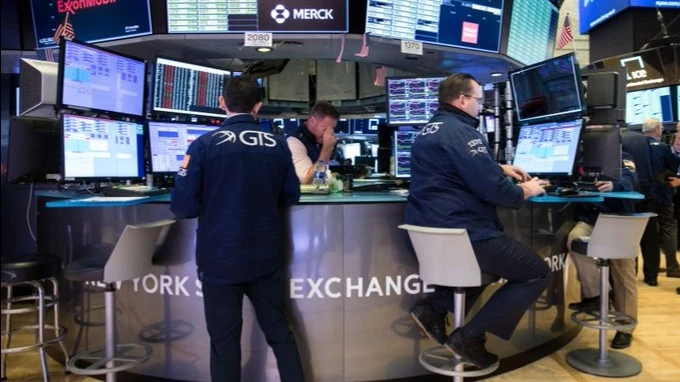
Despite the tense situation in the Strait of Hormuz, the VIX volatility index fell 3.6% over the past week / Photo: X / NYSE
All three major U.S. stock market indices closed lower on August 14, but investors do not seem too concerned about this, according to MarketWatch. The so-called Wall Street “fear index,” or the Cboe VIX volatility index—which often rises as market volatility increases and stock prices fall—dropped 2.6% to 14.3 points, its lowest level since December 30. Over the week, the VIX lost 3.6%, and since the beginning of August, it has fallen 10.2%.
In Friday's trading, the S&P 500 broad-market index fell by less than 0.2% and closed at 7,785.8 points. Earlier this week, it rose above 7,800 points for the first time. Over the past five days, the S&P 500 rose 0.4%.
The Dow Jones Industrial Average, a "blue-chip" index, fell 0.2% on August 14 and closed at 53,732.4 points. For the week, the DJIA declined 0.6%.
The Nasdaq Composite Index fell 0.28% during the day, to 26,729.2 points. However, the index managed to close slightly higher for the third consecutive week, gaining 0.1%.
Stocks reacted with a slight decline on Friday to a new escalation in the Middle East: Iran struck two vessels belonging to the Emirati company Adnoc Logistics & Services as they were passing through the Strait of Hormuz. The U.S. will soon announce unprecedented economic measures against Iran, U.S. Treasury Secretary Scott Bessent said yesterday. Brent futures rose 2% on Friday to $88.8 per barrel, while WTI futures rose 1.4% to $82.4 per barrel.
“I think investors are already experiencing news fatigue,” Barron’s quotes Daniel O’Regan, managing director of equity trading at Mizuho Securities, as saying. “Just as the conflict between Russia and Ukraine has gradually become background noise for the markets, the market no longer fluctuates by 1–3% after every headline related to Iran. This is probably a healthy sign.”
At the same time, the dollar fell 0.3% against a basket of global currencies, hitting its lowest level since May. The ICE U.S. Dollar Index dropped to 99.65 points. The currency was affected by a decline in traders’ expectations regarding a Fed rate hike in September, as a series of economic data releases pointed to a slowdown in inflation. Specifically, retail sales fell 0.6% in July after rising 0.2% in June, according to data from the U.S. Census Bureau. The decline was the first since October 2025 and the largest in 14 months, Reuters noted. In addition, weaker-than-expected data on consumer and industrial inflation were released this week. Concerns about the labor market also intensified after the July jobs report showed that employers unexpectedly cut jobs.
By the end of this week, more than 90% of S&P 500 companies will have reported their second-quarter results, and their year-over-year earnings growth currently stands at about 50%, according to FactSet data. If earnings growth remains roughly at current levels by the end of earnings season, oil will continue to trade above $80 per barrel due to the closure of the Strait of Hormuz, and the Federal Reserve will keep interest rates unchanged, according to Jay Hatfield, founder, CEO, and portfolio manager at Infrastructure Capital Advisors. “Today, we seem to be seeing the start of a sideways phase following the end of earnings season,” he told CNBC. Hatfield expects the S&P 500 to reach 8,100 points by the end of the year.
This article was AI-translated and verified by a human editor