AMD will acquire the startup founded by the "godmother of AI" for $8 billion. This will help it compete with Nvidia
World Labs specializes in spatial intelligence and develops “world models”—AI systems capable of operating in the physical world

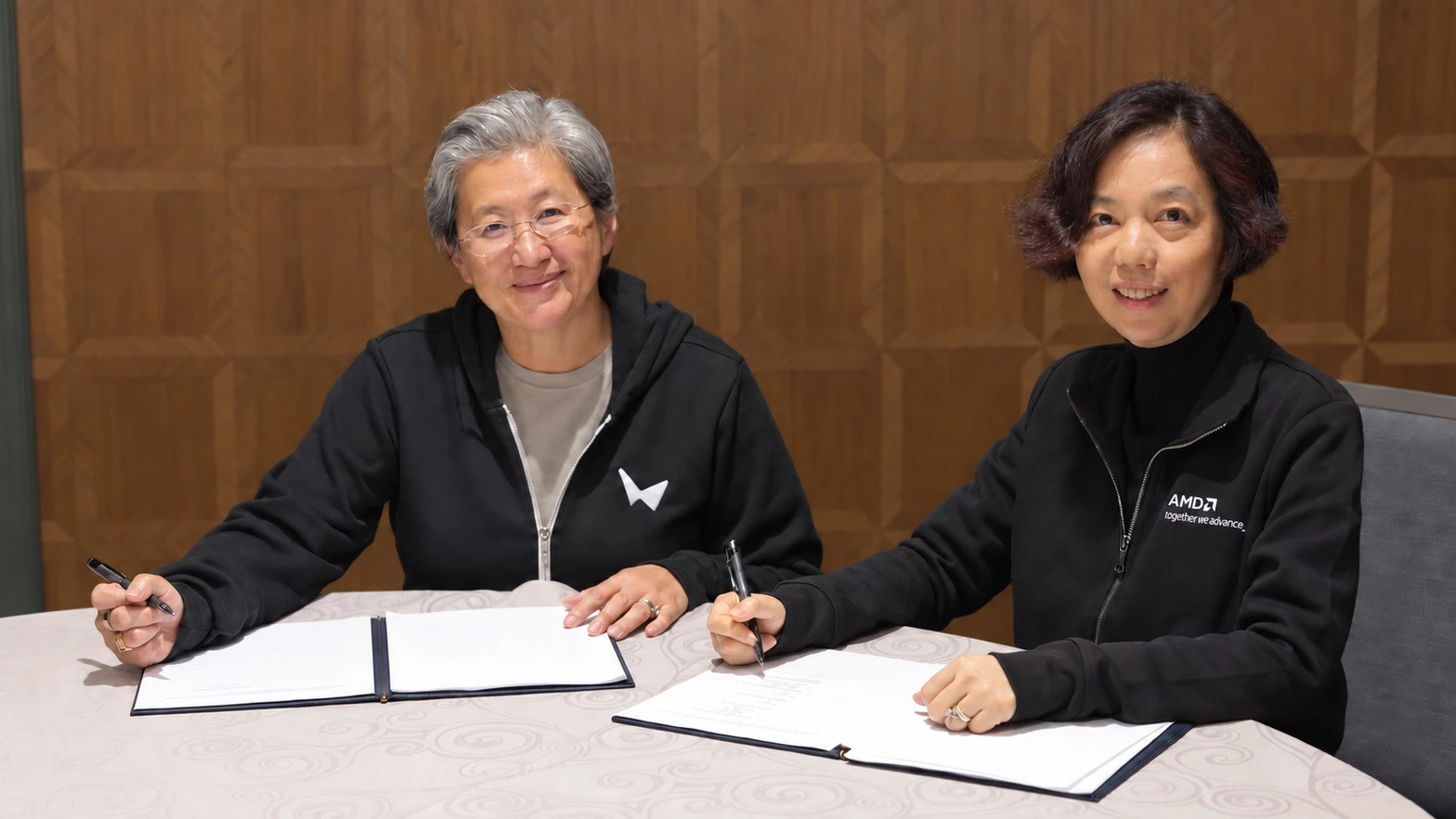
"The Godmother of AI," Fei-Fei Li (right), will join the AMD team led by Lisa Su (left) / Photo: X / Fei-Fei Li
Chipmaker Advanced Micro Devices announced that it plans to acquire the startup World Labs for $8.2 billion, which was founded by one of the most influential researchers in the field of artificial intelligence, Fei-Fei Li, according to Bloomberg. She is known as the “godmother of AI.” The deal will allow AMD not only to bring her onto its team but also to position itself for the next era of AI.
Details
AMD, which previously invested in World Labs, will pay for the startup with its own shares. The deal will be finalized by the end of the year, pending regulatory approval, according to a company statement.
Following the acquisition, a team of leading researchers and the AI models they developed will join AMD. Fei-Fei Li, who previously served as CEO of World Labs, will join AMD as executive vice president and chief scientist and will report directly to CEO Lisa Su.
In a press release, Su stated that the acquisition would allow her company to gain a deeper understanding of how cutting-edge AI models are developed and to design the chips needed for them. AMD is one of Nvidia's biggest competitors in this market.
“The better you understand the entire process from start to finish, the more sophisticated a system you can build,” she said in an interview with Bloomberg Television. “That’s exactly why we’re acquiring World Labs: to gain access to the world-class team of experts that Fei-Fei has assembled and to combine it with AMD’s capabilities in hardware, software, and computing systems.”
What is Li Fei-Fei known for?
Li is often referred to as the “godmother of AI,” according to Business Insider. She is best known as the creator of ImageNet—a dataset of images that helps improve computer vision. She later served as chief scientist for artificial intelligence and machine learning at Google Cloud and became one of the co-founders and co-directors of the Stanford Institute for Human-Centered AI.
World Labs, a startup Li founded in 2024, focuses on spatial intelligence and develops “world models.” These models generate and simulate three-dimensional environments—that is, the physical world—based on text, images, and video. This sets them apart from the products of OpenAI and Anthropic: their services are not trained on data about the physical world, explains MarketWatch.
According to World Labs, the technology can be used to advance robotics, scientific research, and industrial equipment.
Earlier in September, the company unveiled Atlas—a new model capable of predicting what a scene will look like from a different camera angle based on a small set of two-dimensional images. The startup compared this approach to how large language models predict the next word in a sentence.
In July, World Labs acquired SceniX, a company specializing in robotics and simulation. The terms of the deal were not disclosed. SceniX’s technology enables the transfer of real-world robotic tasks into simulations, the mass creation of environmental scenarios, the training of robots within those simulations, and the subsequent transfer of the acquired skills back to physical equipment.
“As our company grows, so do our ambitions,” Lee told Bloomberg. She said that, along with this, the startup’s need for computing power has also increased. “At this stage, joining forces with AMD truly gives us, AMD, and the entire ecosystem the opportunity to accelerate the cycle of mutual development,” she emphasized.
Context
This isn’t AMD’s first acquisition of an AI startup: in 2024, the chipmaker bought Silo AI, a Finnish developer of AI models, for more than $650 million. And in August, it announced the acquisition of the Canadian company Taalas—a developer of specialized solutions for inference, that is, deriving data based on user requests.
AMD’s larger competitor, Nvidia, was one of the first to begin integrating hardware and services with AI chips so that customers could get their systems up and running faster, according to Bloomberg. The company is now using this strategy to tap into new customer segments, expanding beyond the cloud giants that continue to drive a significant portion of its growth. In early September, Nvidia announced the acquisition of Hugging Face—often referred to as the “GitHub of AI”—for approximately $13 billion. Hugging Face has become the primary repository of AI databases and models for researchers around the world.
This article was AI-translated and verified by a human editor