"Designed to Lose Money": Why an Investor from *The Short Game* Shorted CoreWeave
Just a couple of weeks before the crash, the famous investor wrote in his blog that he had closed his short position in the cloud provider’s stock and wanted to replace it with put options. It is unknown whether he actually did so.

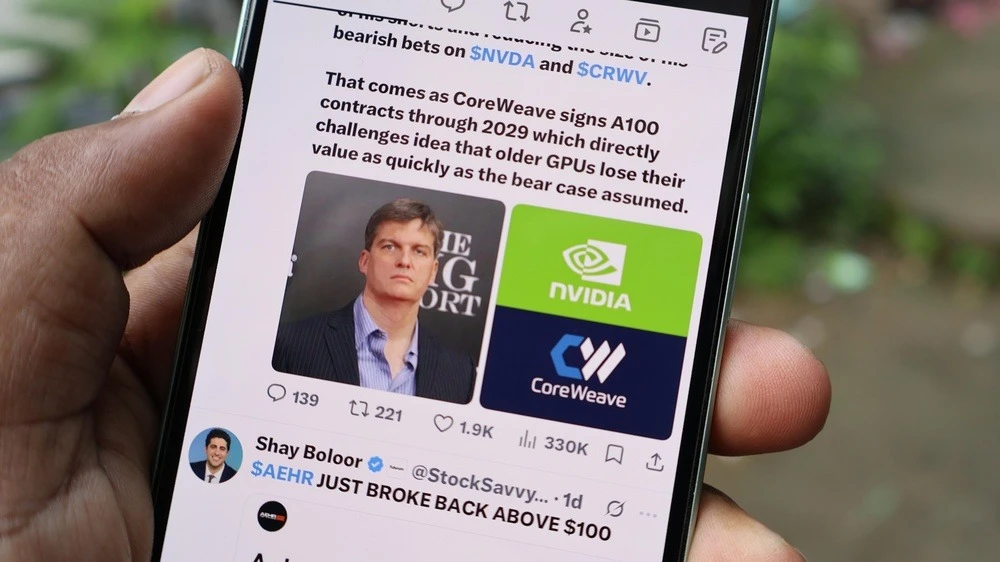
For nearly a year, Burry has been pointing out the risks associated with CoreWeave—from questionable depreciation to record-high default insurance costs / Photo: FotoField / Shutterstock.com
Shares of data center operator CoreWeave fell 20% in just three days this week. Michael Burry, known as the inspiration for one of the characters in “The Big Short,” has long warned about the risks associated with CoreWeave and opened a short position in the company’s stock earlier this year. In his Substack blog, he wrote that CoreWeave is “designed to lose money” and that its massive investments in AI infrastructure may not pay off. What did the famous short seller, who predicted the 2008 crisis, have to say about the company that has become a symbol of the current sell-off?
What did Burry criticize CoreWeave for?
Burry still had the ability to speak in November 2025, while discussing the challenges facing the entire AI industry, pointed out the risks faced by CoreWeave and similar companies—namely, the gap between the actual lifespan of the hardware and the payback schedule. The investor noted that companies expect to lease out servers for years to recoup their investments and pay off their debts. However, the equipment could become obsolete much sooner and stop generating the expected revenue, Burry warned. As of the end of September 2025, CoreWeave reported $6.9 billion in investments in data centers not yet in operation: according to the short seller’s logic, these facilities could lose their commercial value even before launch, leaving the company with an aging fleet and obligations to creditors.
In January 2026, Burry named CoreWeave as one of the most vulnerable players in the AI boom, alongside Nvidia. When asked why he was betting on a decline in Nvidia’s stock rather than that of its largest customers, Burry wrote that hyperscalers like Microsoft, Meta, and Alphabet would be able to weather a downturn in the AI sector thanks to revenue from other business lines. Nvidia and its “protégé” CoreWeave, on the other hand, are much more dependent on Big Tech’s spending on AI infrastructure and could suffer significantly if those companies begin to cut back on investments. Burry wrote at the time that Nvidia and CoreWeave were the most likely candidates for short positions in the AI industry.

In May, an investor warned that the credit default swap (CDS) market—contracts that investors buy to insure against a company’s inability to pay its debts—points to an “existential” credit risk for CoreWeave. Burry noted that the debt market assesses risks more soberly than equity traders, and that insurance against CoreWeave’s bankruptcy is the most expensive among comparable companies.
In July, Burry entered into a public dispute with CoreWeave’s CEO. Mike Intrator claimed that graphics processors retain their value for much longer than is commonly believed: customers would be willing to lease them for five to six years, and CoreWeave was able to resell previous-generation chips for 95% of their original price. Burry stated that Intratore is mistaken: businesses rent old processors not because of their value, but because of a shortage of computing power. As soon as this infrastructure bottleneck is resolved and modern systems come online, the artificially sustained demand for obsolete equipment will dry up, and CoreWeave may have to write off the depreciated servers and record losses amid a massive accumulated debt, the investor wrote.
In August, Burry moved from criticism to action and opened a short position in CoreWeave stock. He did not disclose the exact size of the position. As early as September 28, the investor announced on his blog that he had decided to rebalance his portfolio and replace his short positions in AI companies with put options. These instruments grant the right to sell an asset at a predetermined price and are typically used to profit from or hedge against a price decline. Burry wrote at the time that he had closed his short position in CoreWeave but was unable to find suitable replacement contracts at an attractive price. At the time of publication, the investor had not disclosed whether he had purchased put options before the price collapse, as he had intended.
At the same time, Burry continued to criticize CoreWeave. On October 1, he disputed the company’s CEO’s prediction that the computing power shortage would persist for the foreseeable future. Burry believes that the component shortage could end as early as 2027, after which the cost of leasing older chips will drop sharply. The investor points out that in the 1960s, leasing companies went bankrupt because rental rates for older IBM computer models plummeted after the release of the next generation of machines. According to Burry, AI infrastructure operators, including CoreWeave, risk suffering the same fate.
Context
Shares of CoreWeave, a major Nvidia partner in the cloud AI infrastructure sector, plummeted by more than 15% in just one day, on October 14. The sell-off followed a sharp rise in the company’s bond yields, which had climbed above 15% in recent days. The cost of the company’s credit default swaps (CDS) jumped to a record high. A forecast by analysts at Gartner put additional pressure on the stock: on October 14, they warned that most non-cloud providers would not be able to survive as independent companies after 2030 due to price pressure and massive capital expenditures.
CoreWeave sought to reassure investors: In a memo to employees, CEO Mike Intrator called the market’s reaction “irrational.” According to him, the company’s contract portfolio is large enough to comfortably meet its obligations.
This article was AI-translated and verified by a human editor