The Most Profitable Small-Cap Stocks in the Russell 2000 Are Trading at a Discount of Nearly 40%: How Can You Find Them?
Oninvest developed six financial filters based on the Royce Fund's approach and selected three high-quality small-cap stocks

According to Oninvest's calculations, among the current constituents of the Russell 2000, companies with the highest ROIC are trading at a discount of nearly 40% / Photo: Shutterstock.com
Stocks of companies with high return on equity aren’t necessarily expensive, concluded Royce Investment Partners, an investment management firm that specializes in small-cap investments. Oninvest tested this theory using the current Russell 2000 index: according to its calculations, the most profitable small-cap stocks are currently trading at a discount of nearly 40% compared to other profitable companies. Oninvest analyst Aldiyar Anuarbekov identified 34 high-quality stocks using Royce’s approach and selected three from among them that are likely to maintain high profitability for years to come.
High profitability at a low price
The Royce Premier Fund selects small-cap companies that consistently generate returns on invested capital, generate cash flow, and are not heavily indebted. In their research, Royce’s portfolio managers note that high-quality companies do not necessarily come at a high price.
Historical data supports this idea: from June 2001 through June 2026, the top 20% of companies in each Russell 2000 sector generated an average annual return of 11.6% over 10-year periods, while the index itself returned 9.1%.
As of June 30, 2026, the EV/EBIT multiple for these companies was 14.6, compared with 29.7 for the Russell 2000. In other words, the most profitable companies were cheaper than the index, not more expensive.
What the Oninvest calculation showed
Oninvest examined whether this price gap persists in the current composition of the Russell 2000. As a proxy for the index, we used the composition of the iShares Russell 2000 ETF. Financial companies were excluded from the sample: their debt and operating income are structured differently, so it is not appropriate to compare them with industrial or technology companies using the same metrics.
According to Oninvest’s calculations, the top fifth of companies with the highest return on invested capital (ROIC) in each sector are valued at a multiple of 13.9 times annual operating profit (EV/EBIT), while profitable companies from the remaining 80% are valued at a ratio of 22.6. This means that companies with the highest ROIC are priced approximately 38% lower.
How to Find High-Quality Stocks on Your Own
A low valuation alone does not make a stock attractive. So-called “compounders” generate high returns on invested capital and reinvest their profits year after year at the same rate of return. As a result, their profits grow through the power of compound interest. If a company fully reinvests its earnings and maintains a 20% annual return, its profits will theoretically increase approximately 6.2-fold over ten years. With a 5% return, they will increase only 1.6-fold, according to Oninvest’s calculations.
Oninvest has distilled the Royce Premier Fund’s stock-selection principles into six specific criteria, each of which investors can find in the company’s financial reports:
ROIC must exceed 15% for several consecutive years. This metric reflects how much operating profit the company generates on the capital invested in the business;
Free cash flow must remain positive for four years;
Net debt must not exceed annual EBITDA—earnings before interest, taxes, and depreciation;
revenue growth;
The number of shares should not have increased by more than 5% over the past few years;
The EV/EBIT ratio should not exceed the market median—which currently stands at about 19 for companies in the Russell 2000.
When making a selection, it is important to keep in mind that high profitability may be temporary—for example, due to a favorable economic cycle or a sharp rise in prices within the industry.
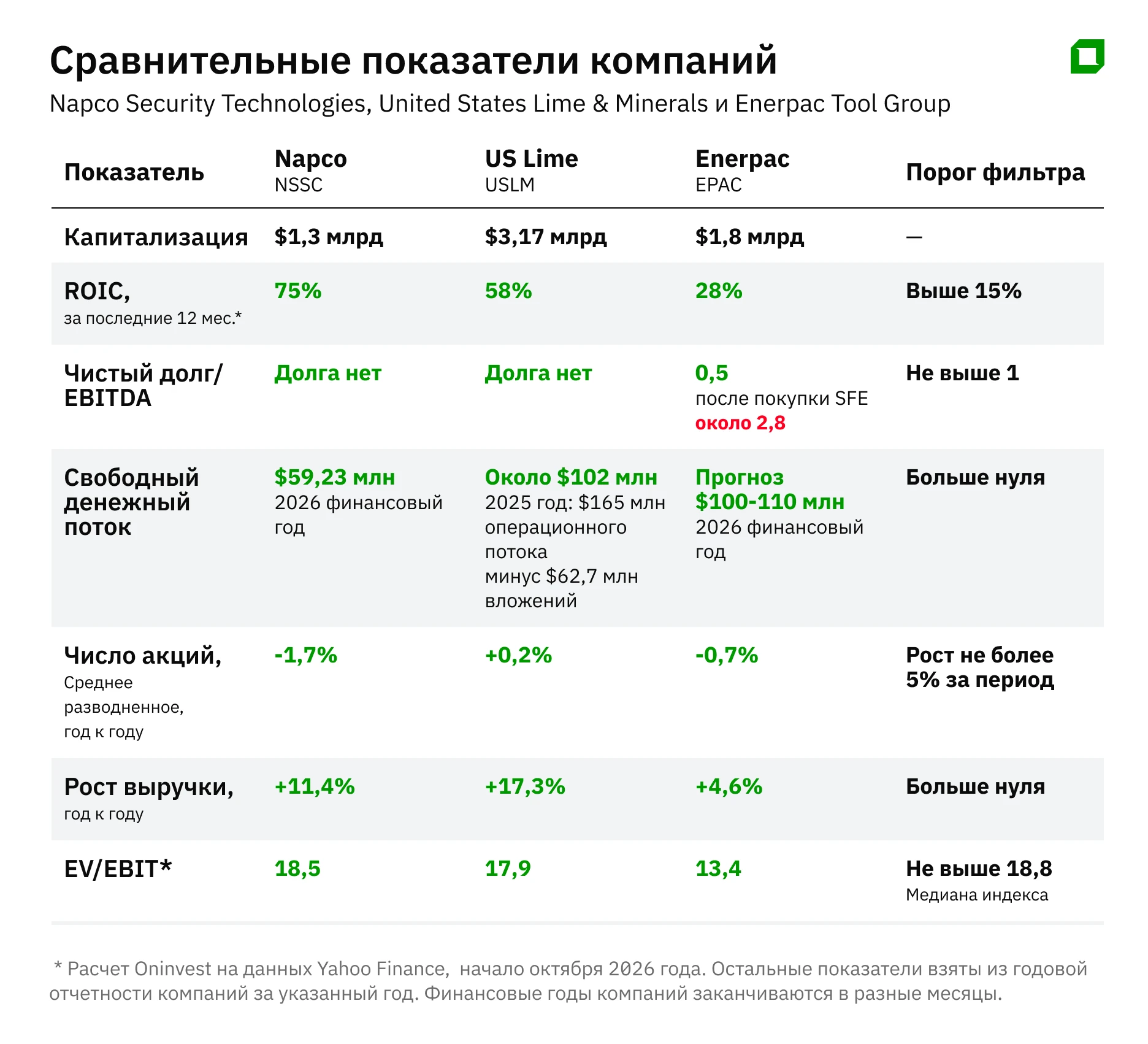
Of the 1,420 companies in the Russell 2000 Index, 34 met all six criteria. Oninvest selected three small-cap stocks whose advantages appear to be sustainable: Napco Security Technologies, United States Lime & Minerals, and Enerpac Tool Group.
Napco Security Technologies (ticker symbol NSSC)
Napco manufactures security and fire alarm systems, as well as StarLink radio modules that transmit alarm signals to a monitoring center. Once the radio module is installed and activated, the dealer pays Napco a monthly fee for communication services and access to its platform. “A radio module sold today becomes recurring revenue tomorrow,” said Napco CEO Kevin Beushel.
In fiscal year 2026 (ended June 30, 2026), Napco’s revenue grew by 11.4% to $202.3 million. Subscription revenue increased by 13% to $97.5 million, and its gross margin exceeded 90%. Free cash flow increased by 15.2% to $59.23 million. The company has no debt, and its cash on hand totaled $126.93 million as of June 30, 2026.
The consensus among six analysts surveyed by S&P Global is to “strongly buy” the company’s stock. The average price target of $50.67 implies upside potential of about 40% relative to the closing price on October 5. On August 24, 2026, TD Cowen analyst Lance Vitanza raised his price target to $55 from $53, maintaining his “buy” rating. The main risk is related to one-time factors. The duty refund added about 6 percentage points to fourth-quarter gross margin. In addition, Napco recognized $16 million in expenses related to the settlement of a lawsuit concerning prior financial disclosures; two other legal proceedings are still ongoing.
United States Lime & Minerals (USLM)
A Dallas-based company mines limestone and uses it to produce lime for road construction, metallurgy, water treatment, and agriculture. Lime is a cheap and heavy material, so it is typically shipped no further than 400 miles (640 km) from the plant. To enter such a local market, a competitor must find a deposit, obtain permits, and build a production facility near its customers. Therefore, US Lime considers the barriers to entry in the industry to be high.
In the second quarter of 2026, revenue rose 8.3% year-over-year to $99.13 million, and net income increased 11.9% to $34.51 million. However, for the first half of the year, revenue increased by only 2.3%, and net income by 0.2%.
Operating income in the second quarter totaled $40.66 million, or 41% of revenue. The company has no debt, and its cash balance at the end of 2025 was $371.1 million. “We expect data center projects to continue to drive strong demand from the construction industry, and the new kiln at our Texas facility is scheduled to begin operations this summer,” said Timothy Byrne, President and CEO of U.S. Lime & Minerals. The company has not yet announced the furnace’s launch; investors should look for confirmation in the third-quarter 2026 report.
In March, Freedom Broker raised its price target for the company’s shares to $138 from $125, while maintaining its “Buy” rating. The target implies a 24.5% increase from the closing price on October 5. The company faces risks related to the cyclical nature of construction and to fuel and transportation costs, which held back gross profit growth in the first half of the year.
Enerpac Tool Group (EPAC)
A Milwaukee-based company founded over a century ago manufactures high-pressure hydraulic tools and systems for the precise handling of heavy loads.
In the third fiscal quarter (March–May 2026), revenue rose 6% year-over-year to $167.6 million, and net income increased to $29.8 million from $22 million. Capital expenditures for the first nine months of fiscal year 2026 (ended May 31) totaled $9.24 million, with operating cash flow of $69.26 million. The net debt-to-EBITDA ratio was 0.5; during the nine-month period, the company repurchased $81.13 million worth of its own shares.
At the same time, Enerpac lowered its forecast for the full 2026 fiscal year: revenue expectations from $635–650 million to $635–645 million, and adjusted EBITDA from $158–163 million to $151–156 million.
In July 2026, Enerpac agreed to acquire SFE Group, a manufacturer of welding and machine tool equipment, for $472 million and plans to close the deal between September and November 2026. Following the acquisition, the company estimates that its net debt-to-EBITDA ratio will rise to approximately 2.8. Another risk relates to the service segment, where revenue declined by 8% excluding acquisitions.
According to MarketWatch, the company's stock has two "Buy" ratings from analysts and one "Hold" rating. The average price target is $48, which is 33% higher than the stock's closing price on October 5, 2026.
What Matters to an Investor
Filters weed out weak companies but do not guarantee returns. Quality can lag behind the market for years, as has been the case over the past year: Over the 12 months ending June 30, 2026, the Royce Premier Fund gained 31.17%, while the Russell 2000 posted a total return of 40.78%.
Even the company that Royce cites in the article as an exemplary compounding stock in his portfolio—Quaker Houghton, a manufacturer of industrial lubricants and process fluids for the metallurgy and machinery industries—has its flaws. Royce’s portfolio managers acknowledge that the acquisitions have added debt to Quaker Houghton’s balance sheet.
For the same reason, Enerpac technically qualifies based on its most recent report, but after the acquisition of SFE, its debt burden will exceed the threshold set by the editorial board.
This is not intended as individual investment advice.