I gave three AI chatbots €500 to invest. Here's what they did with my money

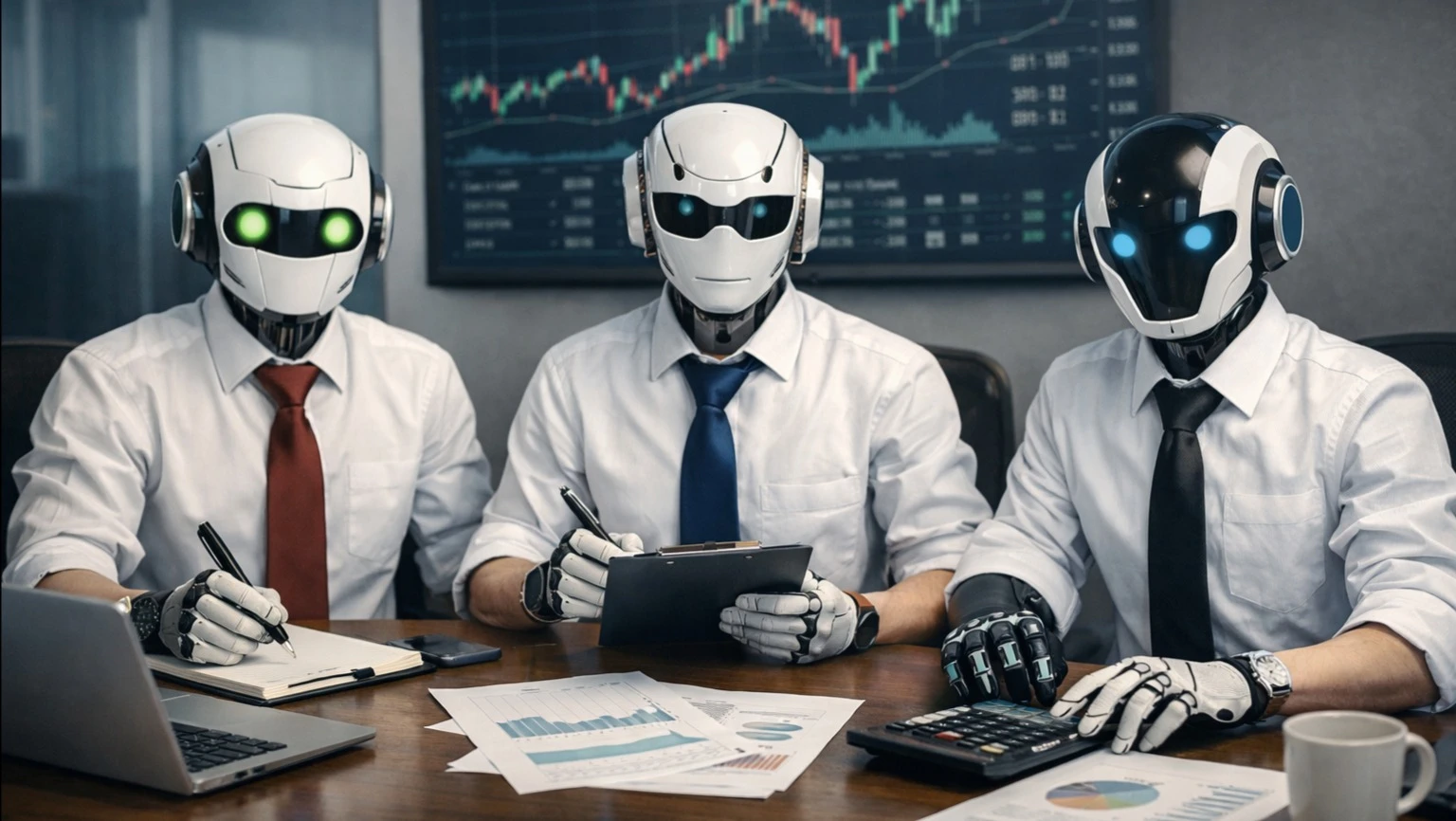
Morgan Stanley predicts AI will jeopardize 10% of jobs in the European banking sector.
71% of asset management firms plan to incorporate generative AI into their operations, according to data from a survey of 500 senior investment industry executives in key global markets conducted by Grant Thornton in partnership with ThoughtLab. Two-thirds say the payoff in AI is still modest, and 12% see no return or negative results. I don't have access to the same resources and infrastructure as BlackRock, for example, or another large money manager. But if the majority is going to implement generative AI, it is logical to ask whether it can already fulfill a basic investment objective at the retail investor level today.
Task for bots: investments without ESG and with maximal returns
I decided to give a task to three AI chatbots to invest €500 for a month with maximum profit for me. We do not take into account taxes and brokers' commissions in this task. The three AIs involved in the experiment are the American ChatGPT from OpenAI and Claude from Anthropic, and the Chinese DeepSeek. The prompt was the same:
- disregard ESG and other morals, the goal is to maximize profits;
- exclude ETFs and protective assets from investments;
- decide where to invest if I want to bet only on the US, Europe or emerging market (name countries);
- allocate the portfolio geographically, i.e. say in which markets what percentage of the portfolio to invest in;
- choose three sectors and three stocks for each market;
- if I were to pick sectors, which three should I invest in.
Spoiler: all three chatbots matched on shares of the same company, it is in Europe.
ChatGPT portfolio: Euroskeptical
"If the goal is to maximize profit in one month, this is no longer classic investing, but a bet on strong market movements. In such a short period of time, it is not the "most reliable company" that wins, but the one where sharp growth is possible due to news, reports or general market sentiment," ChatGPT prefaced its recommendation and advised to choose the US out of all three markets, as it is the largest and it is easier to get out of a position there quickly.
Altman's bot recommends investing 60% in the States and 25% in emerging markets: India and Brazil. These two countries, along with China, have been among the beneficiaries of the latest duty perturbation: after US President Donald Trump imposed new levies of 15% in response to the Supreme Court's decision to strike down global tariffs. The average effective tariff rate, as calculated by Bloomberg Economics, was around 12% - the lowest since "Emancipation Day" in April 2025. OpenAI doesn't believe in Europe in terms of quick returns and has given it 15% of my money.
In the US, the startup advises investing in its partner, Nvidia. "Shares of this company often rise and fall sharply on news about technology and artificial intelligence," ChatGPT prompted. Nvidia is one of OpenAI's big investors, although previous plans to invest $100 billion have been canceled, the semiconductor maker plans to invest $30 billion in the startup as part of a new funding round, sources told the Financial Times.
In addition, ChatGPT recommended investing in Palantir, calling the main provider of AI resources for the Pentagon "a company that responds quickly to major contracts and news."
In third place is Coinbase, the crypto exchange is highly dependent on the rise or fall of cryptocurrencies, so the movements can be very sharp.
In the emerging markets segment, ChatGPT chose two large Indian holdings and one Brazilian company. At the top of the list is Reliance Industries, a conglomerate from India with interests in just about everything from energy with oil and gas to entertainment. "Large company, sensitive to domestic economic growth," the chatbot characterized it.
Next comes the Brazilian oil company Petrobras, whose quotations have jumped by 33% since the beginning of the year. And closing the list is Adani Enterprises, another large Indian holding company with extensive business: from food production to defense and oil exploration. The company also has a copper business, and copper is one of the beneficiaries of the AI economy. "Very volatile story, capable of giving a strong move in a short period of time," ChatGPT reported.
In Europe, the bet is on AI, defense and pharma. ChatGPT advised to invest in ASML, noting that investments depend on the situation in the technology sector. At the same time, the chatbot was silent about the fact that the Dutch company is the only one in the world that owns EUV lithography technology, which makes it possible to produce advanced chips.
Germany's defense giant Rheinmetall trails, rising on the back of military spending in Europe.
And in third place is weight loss product pioneer and Ozempic manufacturer Novo Nordisk of Denmark, which "can move dramatically on drug news," the chatbot emphasized.
Choosing from three stocks regardless of country, ChatGPT bet €200 on Nvidia, and €150 each on Coinbase and Rheinmetall.
They move for different reasons: technology, cryptocurrencies, and military spending. This is a chance for at least one of them to grow
In addition, the chatbot from OpenAI also advised a riskier option - invest €250 each in Coinbase and Nvidia.
At the close of trading on Feb. 23, the stock was worth:
- Nvidia - $191.55.
- Coinbase - $160.24
- Rheinmetall - €1701.5
Claude's portfolio: the maximum is in AI
Claude also bet on the American market, arguing that it is the most liquid and developed, and it is there that there is "the greatest choice of instruments and maximum opportunities for short-term trading" with information transparency.
Accordingly, Claude suggested investing half of my €500 in the US, and he recommended investing 30% in emerging markets - he did not say which one, although the Prompt had this requirement. Claude, like ChatGPT, turned out to be a Euroskeptic - he recommended investing 20% or €100 in the European market.
Nvidia, the latter plans to invest $10 billion in Dario Amodei' s startup. Next comes Tesla, Elon Musk's company is labeled as highly volatile. At the same time, the third participant of the American "tender" - the cryptocurrency exchange Coinbase - did not receive this assessment.
The emerging markets segment was won by Alibaba, a Chinese e-commerce company with a large AI component to its business, chip maker TSMC and Brazilian miner Vale.
In Europe, ASML is also in first place. The top three were SAP, a German software manufacturer, and LVMH, a French luxury supplier in various spheres.
Top 3 promotions from Claude with no geography attached:
- Nvidia is the leader of the AI revolution;
- Super Micro Computer - AI Infrastructure (closing price Feb. 23 $30.71);
- Coinbase - maximum volatility.
Claude also offered alternative high-risk instruments - options on volatile stocks, leveraged ETFs (3x leveraged ETFs) and penny stocks - stocks under $5.
DeepSeek portfolio: Nvidia on the eve of the report is "Russian roulette"
Chinese DeepSeek was the only one who believes in the European market on a short horizon and recommended investing 50% in it, backing it up with numbers. At the start of 2026, Europe's STOXX 600 index is showing gains of over 4% YTD, while the S&P 500 is showing gains of less than 1%.
In Europe, DeepSeek is interested in technology, raw materials and oil and gas. Also, the Chinese chatbot emphasized that European governments are increasing spending.
The U.S. Chinese AI called the U.S. "too "heavy" and conservative a market for explosive monthly growth, despite having "individual success stories," giving it 30% of my money nonetheless. There, he noted both the consumer credit and technology sectors as promising.
In addition, he noted emerging markets in Asia (without Japan) - they are "interesting due to the AI supercycle, according to HSBC, but there is a strong dependence on global trade, which adds risk," DeepSeek wrote, and eventually included fintech in Latin America in his recommendations - 20%. For emerging markets, he didn't answer which stocks to buy specifically.
The Chinese chatbot also has ASML at the top of the list of three European companies - as a key beneficiary of the AI boom in Europe. Momentum Score 95 out of 100 - meaning the stock outperforms 95% of others in terms of growth strength.
The second company in his sample is mining giant Rio Tinto. DeepSeek lists it as a European company, although its main assets are concentrated in Australia and North America, with its head offices in London and Melbourne. It trades, in addition to those two venues, in the US. In New York, the British-Australian company's shares have risen more than 35% over the past three months on the back of rising commodity and gold prices.
And another company from the Netherlands is Constellium, "a manufacturer of aluminum products for aircraft and autos that received an upgrade from Wells Fargo with growth potential of more than 45%."
DeepSeek was the only one of the chatbots that didn't list Nvidia as a promising US stock on the short horizon - one immediately thinks of all the trade wars, Trump's ban (later rescinded) on supplying even a weaker chip from Nvidia to China, and the Chinese government's decision to invest domestically. Leaving aside suspicions that DeepSeek's success isn't actually due to its ability to do computing much cheaper than its competitors, but through alternative access to powerful U.S. chips. DeepSeek said Nvidia has cooled off and there is a risk of a correction after the report is published on Feb. 25.
For monthly speculation, it's Russian roulette.
According to his analysis of 11 reports, stocks fell six times in the week after the data was released, even despite the strong results.
In general, DeepSeek supported many of its recommendations with the opinions of investment analysts, unlike previous chatbots.
In the US, DeepSeek is betting on Amazon, citing Murray Wealth Group analysts who see the company's securities as attractive amid recent weakness due to high CAPEX. Also on his U.S. short list is Latin American fintech Nu Holdings, which trades in the U.S.
In third place, Celestica is the "unsung hero of AI construction," as he called it. This company is benefiting from hyperscaler capex growth (to $600 billion in 2026) and a shift to new Ethernet switches.
The latter two made it into the final selection from DeepSeek. Here are the three stocks he advised investing in with the strongest momentum and high expectations:
- ASML is like the main "gasoline pump" of the entire AI industry (closing price Feb. 23 $1485.99);
- Celestica - with the most direct profit from AI capex ($296.68);
- Nu Holdings - as a growth story in an emerging market with the performance level of a developed market ($16.19).
According to DeepSeek, in this case it is possible to get a return of up to 12% in a month. The Chinese chatbot is the only one of the experiment participants who gave a forecast of potential earnings.
AI consensus
The only 100% match in terms of recommendation was for one stock: all three chatbots advised investing in European ASML. In addition, the American AI recommended betting on its partner Nvidia and crypto exchange Coinbase.
All three prefaced and concluded their texts with the disclaimer that investing for such a short period of time is extremely risky, and in case of bad reports or negative macro statistics, you can lose money "faster than you expected". In addition, commissions can eat up a significant part of the profits.
Which of the chatbots turned out to be the most successful investor, I'll check back in a month.
This article was AI-translated and verified by a human editor