'Drop another Tower of Babel': Pope urged to 'disarm' AI
"Opaque algorithms" controlled by powerful private companies carry the threat of "new forms of dehumanization," says Leo XIV
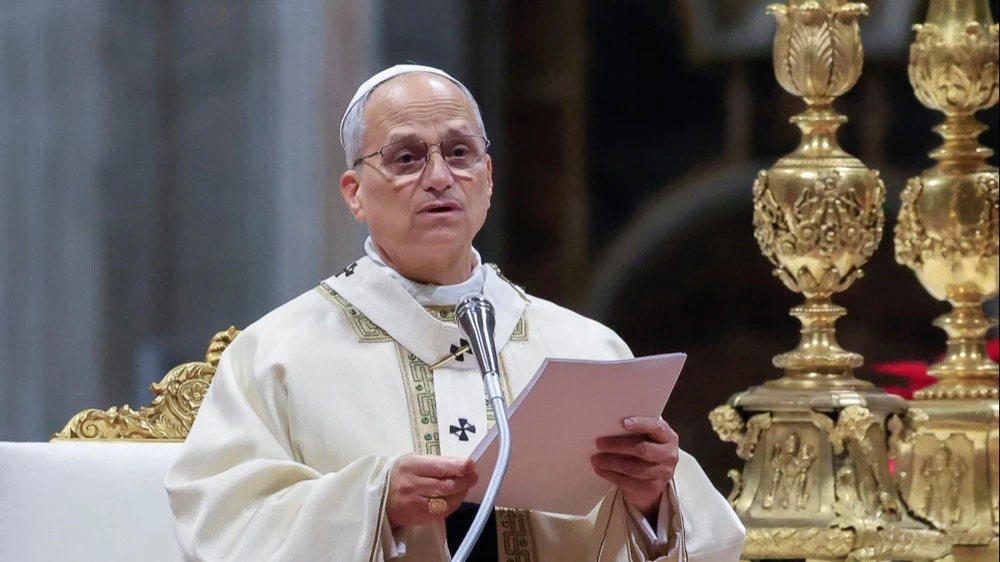
Pope Leo XIV in his first encyclical (message) called for greater external control over AI / Photo: Riccardo De Luca - Update / Shutterstock.com
Pope Leo XIV has called on governments to slow the pace of artificial intelligence development, tightly regulate the development of AI systems, especially those used for military purposes, and "disarm" algorithms, Reuters reports. In his first message to Catholics - a 43,000-word encyclical released on Monday - the pope called for AI to be made more "human-friendly." He said the technology should be freed from monopoly control and away from its use for geopolitical or commercial gain, Bloomberg writes.
What the pope said
"To disarm is to discredit the assumption that technological power automatically confers the right to rule. To disarm is not to reject technology, but to prevent it from dominating humanity," Pope Leo XIV said in an encyclical to the faithful.
The pontiff stressed that AI systems increase misinformation and prioritize escalation when modeling conflicts, which risks leading the world down the path of endless war. The first pope from the United States called for AI data ownership not to be left exclusively in private hands, demanded that politicians protect workers' rights and shield children from the technology, and recommended cooling competition between AI companies.
He also warns that "opaque algorithms" controlled by powerful private companies pose a threat of "new forms of dehumanization," and calls on governments and society to consciously work to reduce the potential negative impact of AI in many areas, including education, the job market and personal relationships, The Wall Street Journal reports.
The pope argues that the key problem is not the technology itself, but the idea behind it, in which some lives are considered "less useful, less desirable and less worthy" than others. "In the name of progress, justifications for 'necessary sacrifices' can begin to be made, placing the burden on the most vulnerable in pursuit of a supposed optimization of the species," the pontiff writes. This is a criticism of the transhumanist and posthumanist vision of influential Silicon Valley entrepreneurs such as Peter Thiel and Elon Musk, says the Financial Times.
Leo XIV demanded "transparency and accountability" for all AI tools used in public life to protect people from a situation where machines limit their potential.
"What is needed is greater political engagement capable of slowing down when things are speeding up," the pontiff said. He called for a "robust legal framework, independent oversight, informed users and a political system that does not abdicate its responsibility."
The Pope also warned of AI's ability to mimic empathy and understanding, "creating the illusion of a relationship with a real person," leading to the risk that people "may gradually lose the very desire to make genuine human connections," the WSJ quoted him as saying.
The pontiff said that society must answer "key questions" about how AI is evolving and the overall direction of world leadership. He made a reference to the biblical story of the Tower of Babel, where people, driven by pride, tried to build a tower so high as to reach the heavens, which provoked the wrath of God. The Pope said the story shows the risk of any endeavor that "seeks to reach heaven without God's blessing." "With the heart of a shepherd and a father, I ask everyone to abandon the construction of another Tower of Babel and join forces for the sake of building the common good," Leo XIV said.
The document, whose main topic was AI, also condemned the number of wars shaking the world, deplored the weakening of international organizations and said that the profits of the arms industry were one of the driving forces behind the clashes. "The last 60 years have been marked by conflicts of astonishing brutality, often affecting civilians on a huge scale," Leo XIV said. - Humanity is slipping towards a violent culture of force, where peace is no longer seen as a responsibility to be taken on, but only as a fragile gap between conflicts."
Anthropic agrees with the Vatican
Anthropic co-founder Chris Ola was present at the Vatican event where the message was read out, Reuters reports. Anthropic is one of the leaders in the AI field, having created the chatbot Claude. Ola thanked Leo XIV for addressing the challenges that new technology poses. He agreed that companies like Anthropic face strong commercial pressures and need external oversight.
"Every advanced AI lab, including Anthropic, operates inside a set of incentives and constraints that can sometimes conflict with doing the right thing," Ola told Reuters in a statement. According to the top executive, there is a "real possibility" that AI will displace human labor "on a very large scale."
"If that happens, supporting those who are displaced will become a moral imperative of historic proportions," Ola said(quoted by Reuters).
Ola welcomed the Catholic Church's involvement in the debate on the rapidly evolving technology, saying the ethical questions AI raises go far beyond engineering. Ola identified three areas that he said require urgent societal attention: the risk of large-scale job losses, the need to ensure that the benefits of AI are spread around the world, and the unresolved question of how to interpret the increasingly complex and sometimes opaque behavior of AI systems.
AI startup Anthropic lost contracts with the Pentagon this year because it forbade the Defense Department from using its AI for fully autonomous weapons or mass domestic surveillance of Americans.
This article was AI-translated and verified by a human editor