Leading AI developers have decided to slow down its development. What should investors do?
The initial panic in the market quickly subsided. What are analysts advising now?

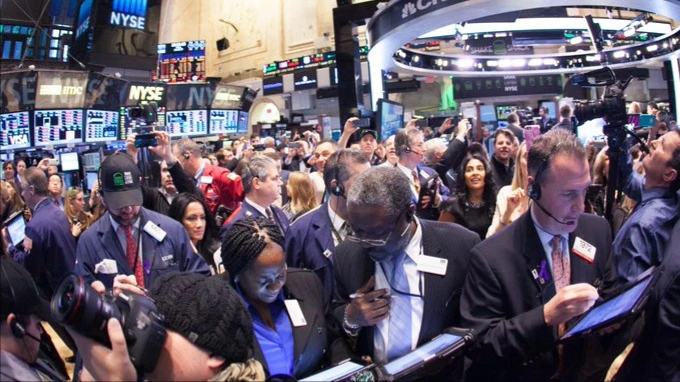
Traders recommend buying AI-related stocks on pullbacks / Photo: X/NYSE
Shares of companies involved in artificial intelligence fell sharply on September 14 after leading developers of the technology proposed deliberately slowing its progress. Among the stocks that dragged the Nasdaq Composite Index down by 0.6% were Nvidia, Broadcom, AMD, Intel, and Marvell.
Investors’ initial reaction to the AI leaders’ proposal was even more negative: the Nasdaq was down 1.3% at the opening bell on July 14. But then the market calmed down somewhat —likely in part due to President Donald Trump’s criticism of the initiative.
CNBC notes that cybersecurity stocks provided a counterbalance to the declining chipmakers: they rose on the back of warnings about threats issued by AI developers. For example, the First Trust Nasdaq Cybersecurity and Amplify Cybersecurity sector funds rose 6% and 8%, respectively, over the course of the day, while Global X Cybersecurity soared nearly 11%. Shares of cybersecurity solutions provider Palo Alto Networks jumped 13%, while Zscaler’s rose 16.5%.
We've compiled analysts' recommendations on what's happening, how investors can make sense of the situation, and how to capitalize on it.
What People Are Saying in the Market
Analytics specialists and traders are not quick to believe the barrage of warnings about the dangers of artificial intelligence and the need to slow its development, which have recently been voiced by developers of cutting-edge models, according to CNBC. Instead, they see political motives and a communication strategy behind the apocalyptic rhetoric: stoking fears about AI safety pushes authorities to tighten regulations, which simultaneously creates a barrier for competitors.

"Basically, here's what's happening: [the developers of cutting-edge models] are pulling the ladder up behind them. They’ve pulled far ahead and don’t want anyone to catch up, so they’re trying to scare us and our policymakers enough to get them to impose regulations that will slow down their competitors,” Gil Luria, head of technology research at DA Davidson, told CNBC.
For some analysts, the idea put forward by Dario Amodei, CEO of Anthropic—the world’s most valuable AI startup—which was immediately endorsed by OpenAI CEO Sam Altman and xAI owner Elon Musk, did nothing to change their view of the IT sector.
“We remain bullish on the technology sector and believe AI, semiconductors, and the ‘Magnificent Seven’ are the best ways to bet on this theme. Given today’s price drop due to reports of an ‘AI slowdown,’ we would buy on the dip, as we believe it is unlikely to lead to a decline in revenue or profitability,” CNBC quotes a note from JPMorgan traders.
Technology analysts at Bank of America called calls to curb the development of AI “noise” amid the ongoing acceleration of capital expenditures. “Washington is unlikely to put domestic leaders at a disadvantage, even if authorities are considering the introduction of protective restrictions,” BofA semiconductor analyst Vivek Arya wrote to clients on Monday. He expects the industry to ultimately regulate itself.
“Given China’s participation in this race, we don’t expect any significant slowdown,” Bloomberg quotes Reflexivity co-founder and president Giuseppe Sette as saying. He also noted that the pullback in AI-related stocks is merely a buying opportunity.

Arya of BofA recommended betting on AI through shares of chip and networking equipment manufacturers, though he cautioned that volatility could persist until the midterm elections in November. “We expect greater stability from manufacturers of computing solutions (Nvidia, AMD), networking equipment (Marvell), and analog chips (Analog Devices, ON Semiconductor). Memory manufacturers (Micron) and semiconductor fabrication equipment manufacturers (Lam Research) could rebound sharply once growth momentum returns,” the analyst noted in a CNBC report.
On the other hand, if current events delay the point at which investments in AI begin to yield the promised returns, it stands to reason that investor enthusiasm will wane, according to Matt Mealy, chief market strategist at Miller Tabak, as reported by Bloomberg.
“Concerns about the deployment of AI could negatively impact sentiment toward the entire AI value chain,” said BofA Global Research analysts Justin Post and Nitin Bansal, whose note was cited by Bloomberg. “But despite the potential risks, we still believe that demand for AI computing power will remain high for many years to come.”
On Monday, Citigroup analysts shifted to a neutral stance on the risk of investing in U.S. stocks. The bank believes that a decision to slow down the development of AI could put pressure on the stock market and advises investors to hedge their risks, according to MarketWatch. According to Citi, investors can protect themselves using put options on the QQQ and VanEck Semiconductor exchange-traded funds.
What Happened
On Saturday, September 12, Anthropic CEO Dario Amodei stated that the hacking of the Hugging Face platform by OpenAI’s AI agents had partly convinced him to call for a slowdown in the pace of AI model development. OpenAI CEO Sam Altman supported this idea, and SpaceX CEO Elon Musk wrote on X: “Dario is right.”
In addition, Anthropic has published a report on dangerous research being conducted by users themselves using its AI.
Following this, Microsoft, a software developer and cloud computing provider, published a preliminary code of conduct for AI models, which outlines restrictions on the artificial intelligence the company is developing. It is noteworthy that the company does not mention the need to slow down AI development, but merely sets a framework for the development of models. Microsoft has been working on the code of conduct for the past five months but decided to publish it now following statements by executives at Anthropic and OpenAI regarding the need to slow down the pace of technological development. The hyperscaler’s stock rose 2% during Monday’s trading session.
This article was AI-translated and verified by a human editor