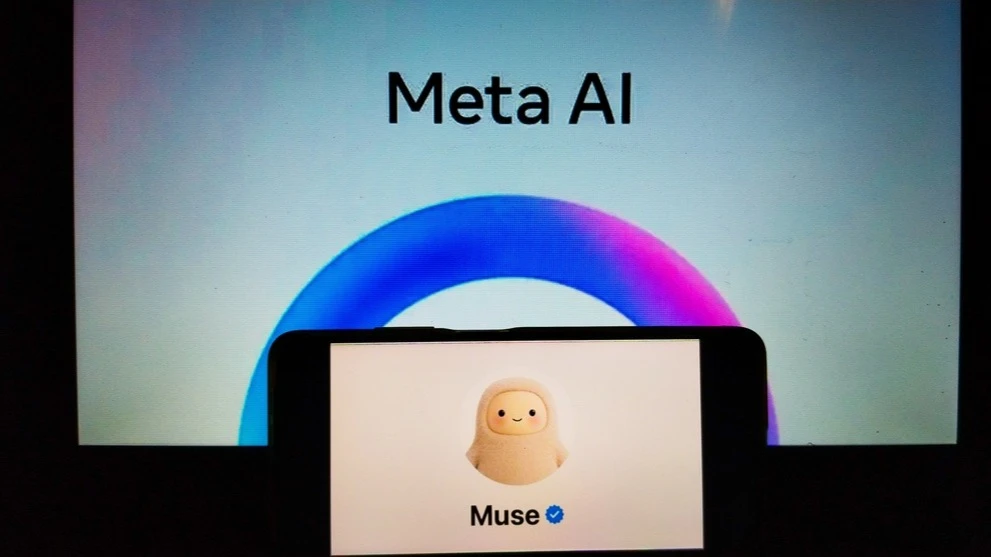
Meta has unveiled a compact version of its most powerful AI model
Meta's new Muse Glimmer model is optimized for tasks performed on standard personal computers

Muse Glimmer — Meta's new language model / Photo: ADRIAN3388 / Shutterstock
On August 10, Meta Platforms unveiled its new language model, Muse Glimmer. It is a compact version of its flagship Muse Spark 1.2, designed with a focus on performance while minimizing system requirements, according to Bloomberg. The model is available for free download on the Hugging Face platform.
The Muse Glimmer model has 30 billion parameters and is optimized for agent-based tasks performed directly on the device rather than in the cloud. Using quantization techniques, the company reduced the model’s size to approximately 17 GB, down from the more than 55 GB required for the full-precision version. As a result, the model requires only a single graphics card to run, making it possible to use it on a standard personal computer, Bloomberg notes. According to Meta’s plan, the model will function as an AI agent: managing schedules, organizing files, and performing other similar tasks.
Users can download the Muse Glimmer weights—numerical values that determine the system’s decision-making behavior—for free to load and configure the model for execution on their own computers. However, they will have to pay for the computing resources themselves.
Meta also plans to publish the weights for one of the versions of its most powerful model, Muse Spark. In doing so, Meta is following an approach popular among Chinese developers—DeepSeek, Moonshot, and Alibaba—who are also making their technologies available to attract the widest possible audience, Bloomberg notes.
Following the news of the release, Meta shares rose 1.8% in U.S. pre-market trading.
"AI for the People"
Along with the release, Meta CEO Mark Zuckerberg published an essay outlining a plan to make “free” and highly effective AI available to “billions of people.” “Instead of centralizing superintelligence, we should distribute it widely and give every person the opportunity to control it,” Zuckerberg wrote.
Zuckerberg also stated that other developers in the U.S. are “focused on creating AI for companies, governments, and other institutions,” while Meta is creating “a personal superintelligence for everyone.” This statement appears to be a clear criticism of Google, Anthropic, and OpenAI, notes the Financial Times.
Context
Meta is participating in the global race to achieve breakthroughs in AI and reap the benefits—ultimately, this should justify the enormous costs of the hardware and data centers required to develop this technology, according to Bloomberg. Along with Amazon, Alphabet, and Microsoft, Zuckerberg’s company has allocated more than $2 trillion to expand its capabilities. Developing AI models and tools that will encourage people to choose Meta over its competitors’ products will help the company secure long-term sources of revenue, the agency notes.
Last month, the company began charging developers for access to Muse Spark 1.1 for the first time. Meta is also developing plans to launch a cloud infrastructure business that will sell access to computing power and AI models, similar to Amazon Web Services.
This article was AI-translated and verified by a human editor