Meta has unveiled a “Tamagotchi” for its AI agent Muse—a keychain with a screen, an avatar, and a voice
Zuckerberg also unveiled $1,300 VR headsets, with which he hopes to give Apple a run for its money

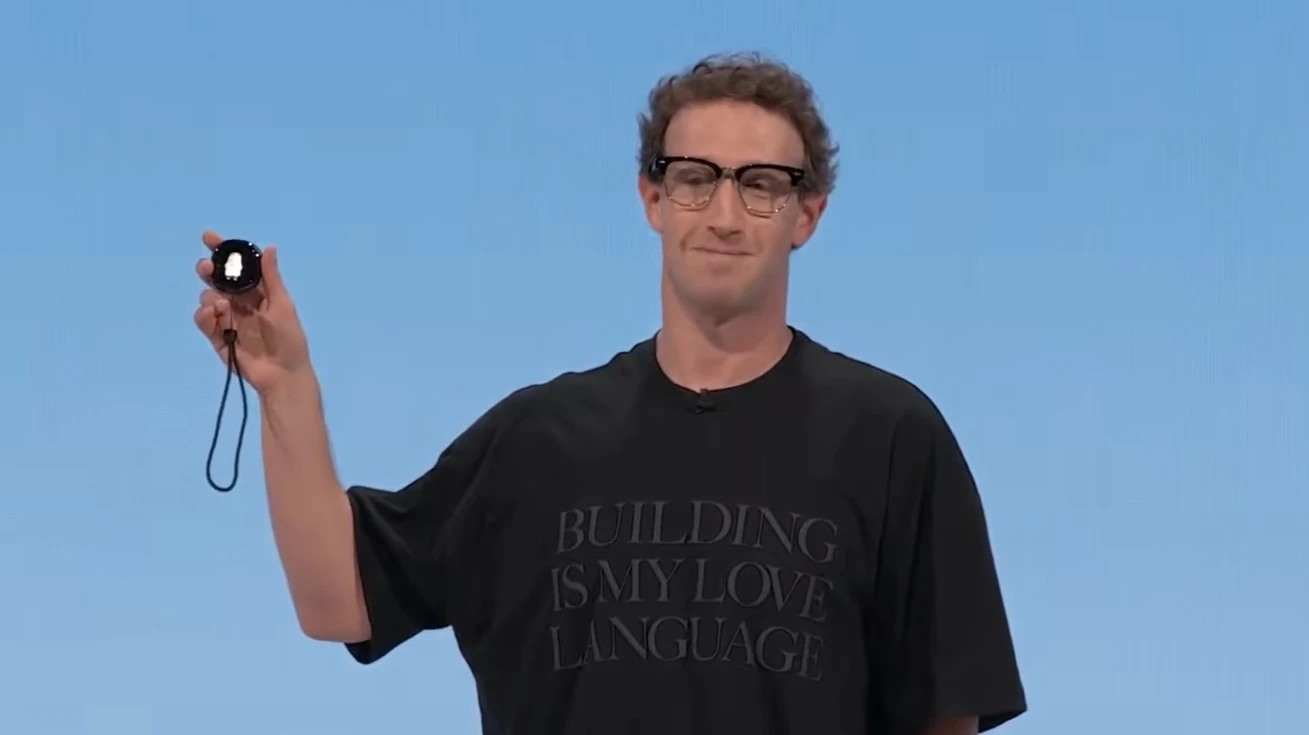
Meta Platforms CEO Mark Zuckerberg unveiled an AI keychain resembling a Tamagotchi at the Meta Connect event / Photo: YouTube/Meta
Mark Zuckerberg’s Meta Platforms unveiled the Muse Charm—a keychain for interacting with an AI assistant that resembles a Tamagotchi—at its annual Connect event on the night of September 24. The company also unveiled new VR headsets priced at $1,300, which Barron’s described as a lighter and cheaper alternative to the Apple Vision Pro. Another new product is a pair of smart glasses without a camera: Meta’s response to critics who dubbed its previous devices “pervert glasses,” according to TechCrunch.
"Muse" on a keychain
Muse Charm is a small device that attaches to a keychain and is activated by a fingerprint sensor, according to the Financial Times (FT). The screen displays the Muse avatar, and users can communicate with the agent via voice in real time. The new product will go on sale in December. “If you’re not wearing glasses, this will be the fastest way to talk to your Muse and show it what’s going on around you,” Zuckerberg said.
AI wearables have already become a tech cliché—devices like the Friend AI pendant make many consumers roll their eyes, TechCrunch notes ironically. But that hasn’t stopped Meta from offering its own version, the publication notes.
Muse itself handles everyday tasks: it orders groceries, books trips, and helps manage finances. After its launch on September 8, the app became the most downloaded app in the Apple and Android app stores in the U.S., the FT notes. According to the Wall Street Journal, Meta aims to let users interact with the AI agent without even opening its mobile app.
Fewer cameras, more IMAX
Ray-Ban Meta Audio became Meta's first smart glasses without a camera. The model has a "clumsy" name, as TechCrunch put it, and works exclusively with audio: you can listen to music and podcasts, make phone calls, use speech translation, and interact with Muse. By removing the camera, the glasses have improved in terms of weight, price, and battery life, according to Barron’s. Meta emphasizes that audio has been the most popular feature of its glasses from day one.
TechCrunch believes that audio glasses could help the brand partially restore its reputation. Some users dubbed the company’s previous generation of AI glasses “pervert glasses”: critics pointed out that people—mostly men—were using them to record videos without the consent of those caught in the frame. Meta tried to address the issue with an update that turns off the camera if someone interferes with the recording indicator. “However, the creepy factor remains,” the publication notes.
Zuckerberg said the company has decided to “focus a little less on the metaverse for now,” even though it changed its name for the sake of the metaverse just a few years ago. He made an exception for a recent “breakthrough”—new VR glasses, according to the WSJ. Meta VR Glasses will go on sale in the spring of 2027 for about $1,300. TechCrunch considers the new product “quite promising” thanks to its significantly lighter weight and new entertainment features. Among them is compatibility with IMAX.
What Else Did Meta Reveal?
Muse in smart glasses. According to the WSJ, an AI agent will be built into smart glasses in the coming months. Users will be able to activate it with a voice command and use it completely hands-free. Zuckerberg demonstrated the feature live: he asked the agent through the glasses to schedule a meeting with CTO Andrew Bosworth;
Muse Voice Mode. Currently, you can only chat with the agent within the app. Soon, users will be able to speak with it directly and give it tasks;
Holographic video calls. Owners of Meta Ray-Ban Display augmented reality glasses will be able to appear on calls as a photorealistic digital avatar. The glasses themselves cannot capture the wearer’s face, notes the FT;
Ray-Ban Meta Update. The company has released a new generation of its popular glasses and expanded its selection of frames. According to Barron's, the glasses themselves have changed only slightly.
Muse's new partners. Retailers Walmart, Sephora, Best Buy, and Gap have joined the platform. Amazon, on the other hand, blocked Muse from making purchases on its platform over the weekend, stating that the platform did not have permission to do so, according to the WSJ.

Wall Street's Reaction
Meta shares rose 1% at the close of the main trading session on September 23 in New York, even before the new products were unveiled, but then fell 1.4% in after-hours trading. However, since the beginning of September, they have risen 30%, partly thanks to a rally earlier this week, and are on track for their best monthly performance since July 2013, notes the WSJ.
On the day of the annual event, analysts at KeyBanc raised their price target for Meta shares to $900 from $780, while those at Cantor Fitzgerald raised theirs to $860 from $680, according to MarketScreener. Both firms maintained their “Overweight” rating. RBC reaffirmed its “Buy” recommendation, keeping its price target at $770. The consensus among the 62 analysts covering Meta is “Buy,” and the average price target of $766 per share implies 3% upside potential.
Context
Reality Labs, the division responsible for Meta's glasses and VR devices, lost $19 billion last year. Whether the new products will improve these figures will likely depend on how successfully Muse is integrated into them, whether Meta offers a compelling set of apps and use cases capable of attracting new users, and whether it can allay consumer concerns about privacy and trust, according to Barron’s.
This article was AI-translated and verified by a human editor