Money That Never Sleeps: How the ATM Came to Be
The inventors of the ATM had to contend not only with technical limitations but also with skepticism from bankers themselves, who didn't believe that customers would trade face-to-face interaction for a machine

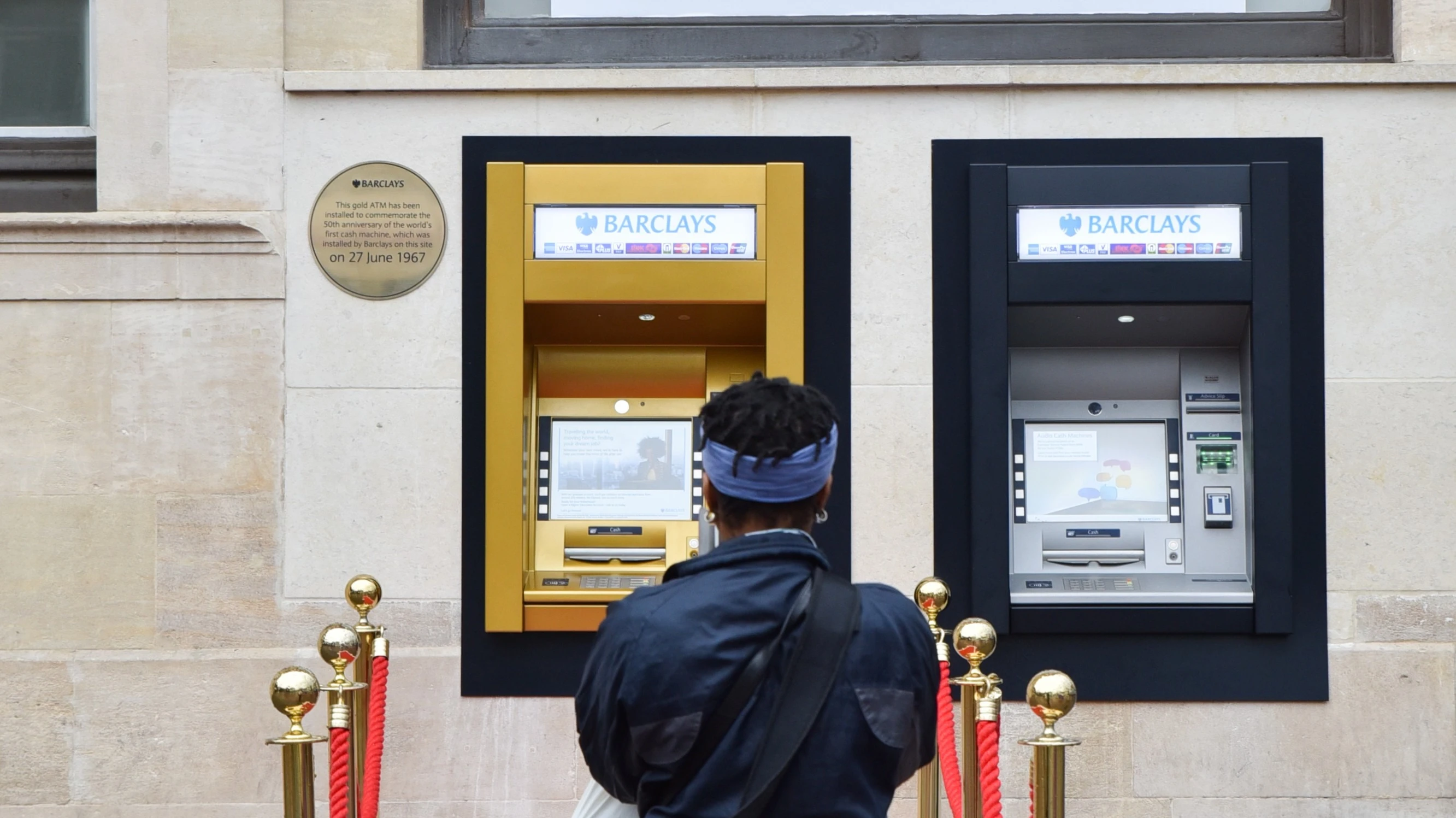
In 2017, Barclays installed a "golden" ATM at its Enfield branch to mark the 50th anniversary of the installation of the first ATM. Photo: Getty Images
Until the late 1960s, cash could only be withdrawn during bank hours: if a branch closed, customers had to wait until the next business day. Therefore, the advent of the first “ATMs” changed not just the way cash was dispensed, but the very principle of banking services—customers no longer had to stand in line or interact with a teller.
The idea seemed risky: bankers doubted that customers would give up interacting with a real person, and were wary of dispensing cash without immediately verifying the account balance. The inventors of ATMs had to overcome not only technical challenges but also the conservatism of the financial sector.
The history of the ATM is not a story of an overnight technological triumph. Rather, it is an example of how infrastructure itself shapes new expectations faster than institutions can revise their perceptions of customers.
British Firstborn
On June 27, 1967, a prototype ATM went into operation at a Barclays branch in Enfield, in north London: Barclaycash, a “robot teller,” dispensed cash even after the bank employees had gone home. The bank’s vision was extremely simple: the service had to be available 24 hours a day, 365 days a year.
Carol Greigus, who was working as a teller in Enfield at the time, recalled: “It was a truly big event, and we were so excited that our branch in Enfield was the one chosen. The bank was only open until 3:30 p.m. back then, so when the ATM was installed, customers were able to get cash outside of banking hours, which, I suppose, significantly improved people’s lives.”
The first user of Barclaycash was the popular comedian Reg Warney. His image was a good fit for the advertising campaign: Warney was seen as a good-natured, working-class guy who had made it big. The bank hoped that a familiar face would help humanize the unusual machine and make it more understandable to customers.
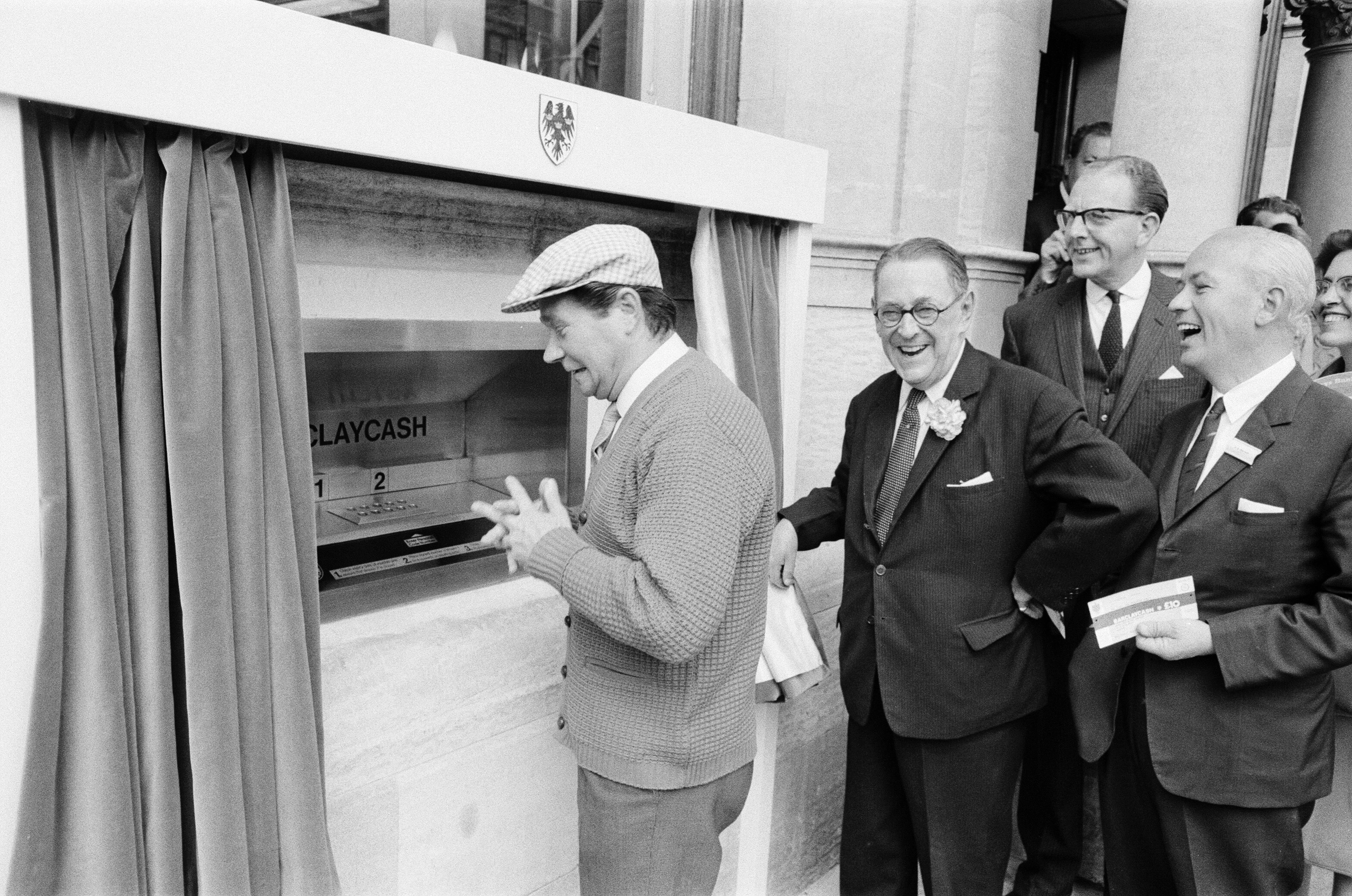
Comedian Reg Varney (pictured wearing a cap) became the first Londoner to withdraw money from a Barclaycash machine (1967). Photo: Getty Images
Barclaycash is often referred to as the world’s first ATM, but it was very different from a modern ATM. The machine did not accept bank cards, was not linked to a customer’s account, and could not verify whether there were sufficient funds in the account. Essentially, it served a single purpose: to dispense a fixed amount.
To do this, customers first had to go to the bank and get a special paper voucher worth £10 (which was enough to buy about 140 liters of gasoline or 80 pints of beer). It contained a carbon-14 marker—a weakly radioactive isotope that the machine used to verify authenticity. The customer would insert the voucher into the Barclaycash machine and enter a personal code. If the verification was successful, the machine would retain the voucher and dispense £10 to the customer, and the bank would later deduct that amount from the account.
This cumbersome system was devised by John Shepherd-Barron, managing director of De La Rue, a company that printed securities and manufactured banking equipment. One day, he arrived late at the bank and was unable to cash a check. That’s when Shepherd-Barron thought of chocolate vending machines and asked himself a simple question: if a machine can dispense chocolate around the clock, why couldn’t it dispense money as well?
The service proved to be in high demand. As early as the 1970s, the capabilities of Barclays’ ATMs expanded: they began processing bank cards and PINs, issuing account statements, and accepting deposits.
American Debut
On September 2, 1969, Chemical Bank announced: “Today, our bank will open at 9:00 a.m. and will never close again.” The bank opened the first public ATM in the U.S.: the machine was installed at a branch on Long Island. It already looked much more like a modern ATM: customers used a plastic card with a magnetic stripe and encoded data.
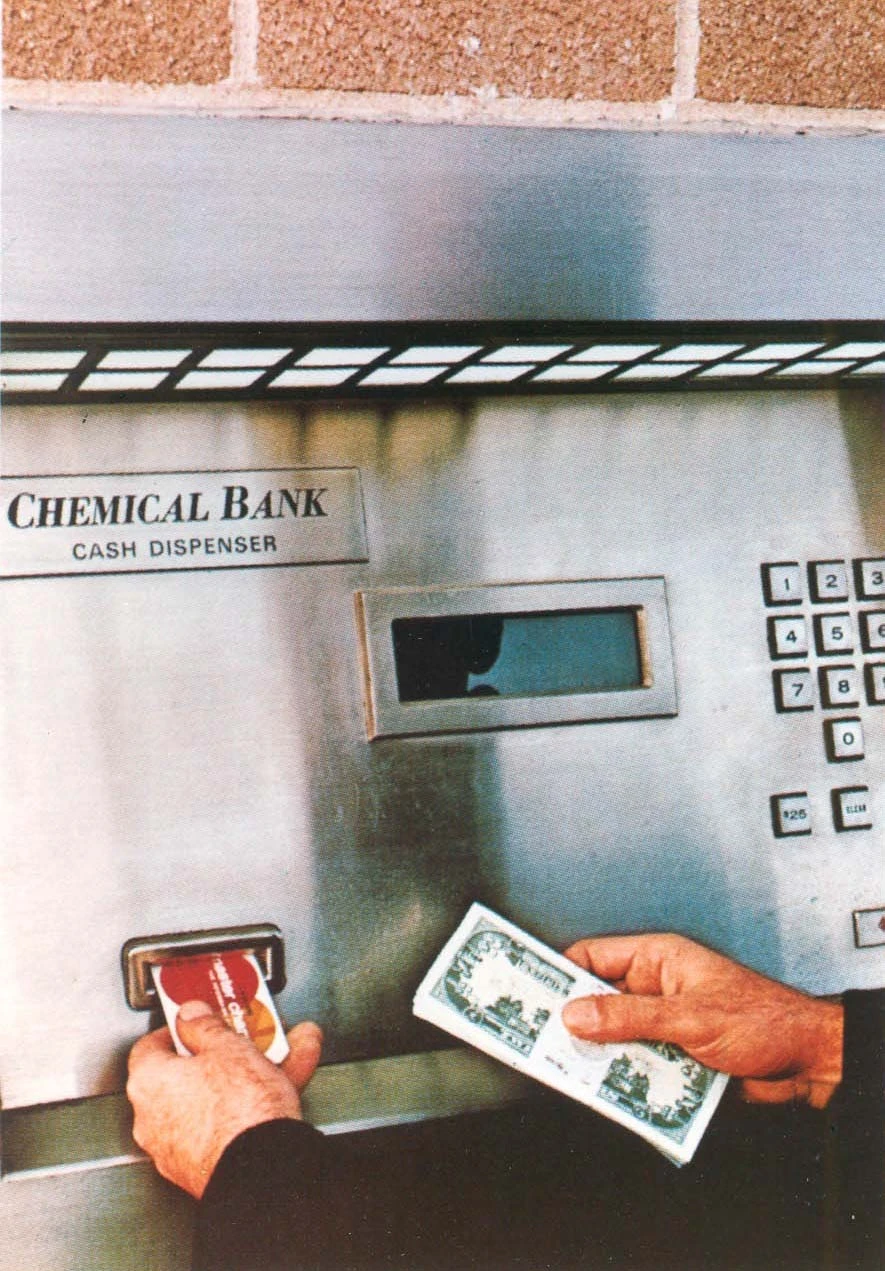
Chemical Bank ATM. Source: JPMorgan Chase Corporate History Collection
The ATM was developed by Docutel, a Texas-based company that manufactured automated baggage-handling equipment. Its vice president, Donald Wetzel, recalled that the idea came to him while he was standing in line to get cash: he decided that a machine needed to be created that could replace a teller—dispensing cash, accepting deposits, displaying account balances, and transferring funds.
The development of the machine, which was named Docuteler, cost approximately $4 million. The risk was high: the company was entering the banking equipment market for the first time, and the engineers had to solve numerous technical problems, but Docutel did not invent every component of the machine from scratch. Wetzel acknowledged that cash-dispensing mechanisms and printers already existed, and the team mainly had to modify available technologies and integrate them into a single system.
Engineering Challenges and Skepticism from Financiers
In the late 1960s, the computerization of banks was just getting started, and it was practically impossible to link an ATM to a customer’s account in real time: there was neither a network of terminals nor the necessary software to do so. Therefore, the Docuteller operated offline: the machine dispensed cash but could not check the balance on the customer’s account. The balance check was replaced by a system of limits: Docuteller dispensed a fixed amount per transaction, and the magnetic stripe on the card recorded how many times a customer could use the ATM during the day.
Another problem was the cards themselves. During hot stamping, the magnetic stripe would warp, and Docuteller would stop reading it. According to Wetzel, this nearly jeopardized the project. In addition, the data on the strip had to be protected from copying and decryption. Docutel had to develop its own module, which was integrated into the card manufacturers’ equipment: the magnetic stripe was encoded directly during production. A Docutel engineer who had previously worked for the government helped develop the encryption system.
The Docuteller ATM looked more like a safe: its stainless-steel casing was 16 mm thick. “According to our calculations, it would have taken about eight hours to cut through it with a blowtorch. We later realized that such protection was excessive, but at the time, it was very important to the banks. They were used to massive vault doors and safes, so they needed to be sure that the money in the ATM would be safe, too,” recalled Wetzel.
But the main problem with the project remained the skepticism of the banks themselves. According to Wetzel, bankers believed that customers came to the branch in part to interact with a teller. Wetzel thought this was nonsense: based on his observations, customers usually chose the shortest line rather than a teller they knew, and the tellers themselves wanted to complete the transaction as quickly as possible and move on to the next customer.
Docutel decided to see if people were ready to use ATMs and commissioned students at the University of Dallas to conduct a nationwide study. The results were positive, especially among young people. The first American ATM went into operation on payday—the perfect time to test the new machine. The experiment proved successful, and Chemical Bank expanded the program. Soon, other American banks began installing ATMs as well.
Banks themselves helped popularize ATMs: before they appeared, Americans rarely opened bank accounts. They received their paychecks in cash and used that cash to pay their bills. With ATMs, these services became much more convenient. Using them became the norm, and their popularity remained even after banks began charging customers fees for using ATMs in the 1990s.
The ATM Controversy: Who Came Up with the Idea?
There is no single, undisputed inventor of the ATM. In the 1960s, several engineers and companies were simultaneously developing devices that automated specific banking transactions.
In 1961, American-Armenian inventor Luther Simjan installed the Bankograph in New York—a machine that accepted cash, coins, and checks but did not dispense money itself. The project lasted only half a year: customers hardly ever used the machine.
In 1962, British inventor Adrian Ashfield proposed another key component of the future ATM—a card system that allowed for automatic user identification and transaction tracking.
In 1966, the "Computer Loan Machine" was introduced in Japan: upon presentation of a credit card, it dispensed cash—though not from the customer's account, but as a three-month loan at 5% per year.
In that same year, 1966, Scottish engineer James Goodfellow patented a design that more closely resembled a modern ATM. The customer would insert a coded card or token, enter a personal numeric code, and after verification, the machine would dispense cash.
John Shepherd-Barron also claimed to be the first: his Barclayscash machine was the first to be installed on the street and begin serving customers on a large scale.
Docutel filed a patent application in 1970, but the documents had to be revised and resubmitted. The company did not receive the patent for the “currency dispenser” until 1973. Wetzel himself emphasized that the patent did not grant Docutel exclusive rights to all ATM technologies. However, in 1995, the Smithsonian Institution’s National Museum of American History recognized Donald Wetzel as the inventor of the ATM.
How an ATM Became an ATM
The first ATMs served a single purpose—they allowed people to withdraw cash at any time. But by the early 1970s, they had begun to evolve into multifunctional banking terminals, offering services such as accepting deposits, transferring funds between accounts, and other transactions.
In 1986, several British banks merged their networks. People could now withdraw cash not only from their own bank’s machines but also from ATMs operated by other members of the network. Later, other financial institutions joined the agreement.
Gradually, ATMs spread beyond bank branches to stores, airports, gas stations, and other non-bank locations. In 1990, one of these machines was installed as a working exhibit at the Science Museum in Kensington, and in 1998, the UK introduced an ATM for drivers—allowing them to withdraw cash without leaving their cars.
By 1999, the Barclays network alone had 3,200 ATMs. Today, there are about 2.9 million ATMs in operation worldwide—but due to the rise of cashless payments, their number is decreasing by about 2% each year.
This article was AI-translated and verified by a human editor