New AI, hardware for neural networks, quantum chip: what Microsoft showed to developers
The company has created an AI assistant that has its own identity and acts as a digital office employee

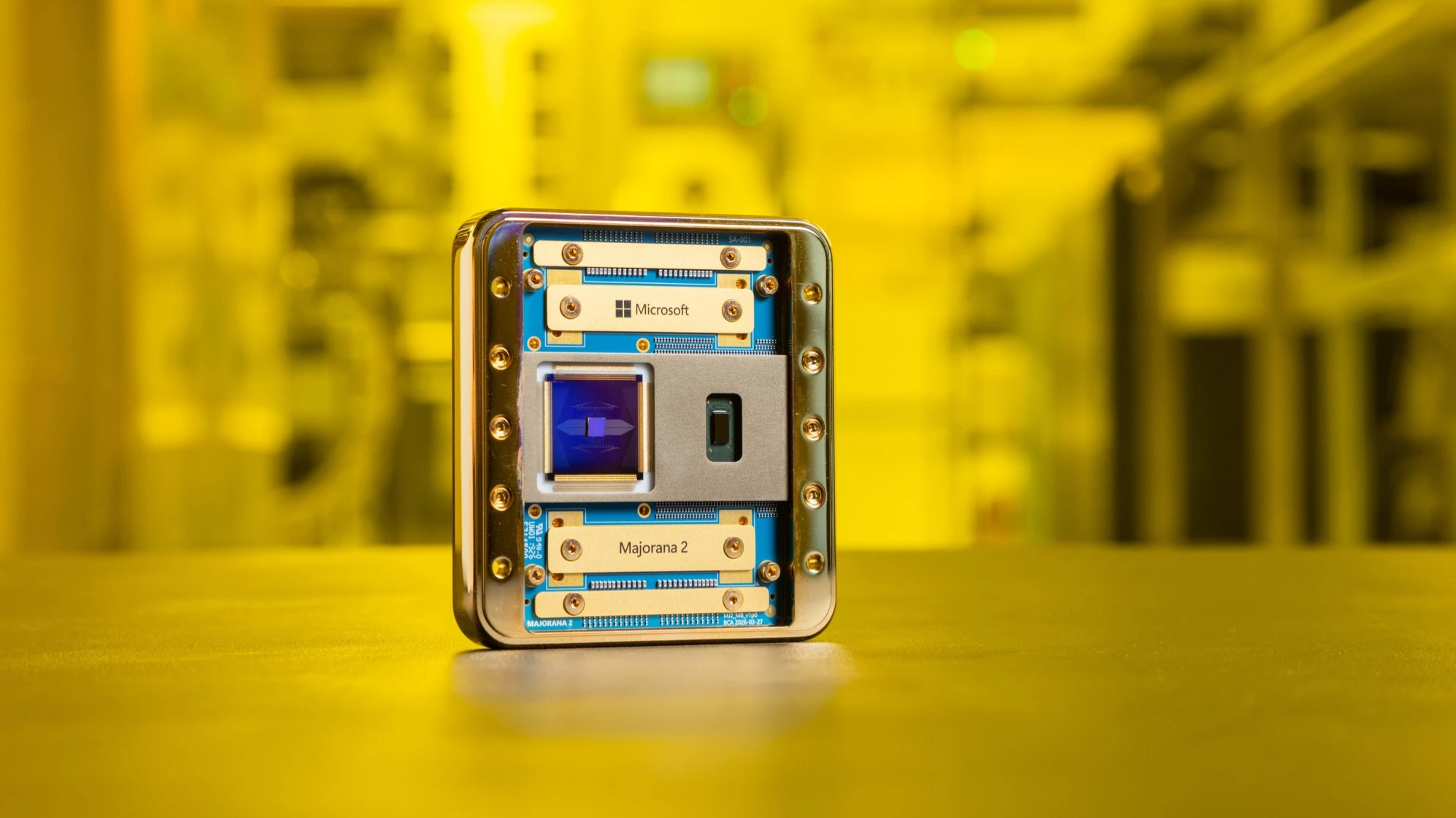
Microsoft unveiled an updated Majorana quantum chip and plans to unveil a commercial quantum computer model in three years / Photo: Microsoft
Microsoft held its annual Build developer conference in San Francisco, where it unveiled a host of new products and technologies in artificial intelligence and quantum computing. The company showed the Scout AI assistant, which will be able to act as a full-fledged digital employee, announced a new device platform for AI agents called Project Solara, and unveiled computers for running AI models and web agents. The software developer and Azure cloud service owner also talked about its updated Majorana quantum chip, which should bring Microsoft closer to building a commercial version of a quantum computer by 2029.
New AIs
Microsoft showed off the developments of its superintelligence team, formed late last year. In an effort to close the gap with Anthropic and OpenAI, the division presented a speech recognition model, which it called the most effective among all major cloud providers, as well as an image generation model designed to compete with Google's development, Reuters writes.
Microsoft's first reasoning-enabled model, MAI-Thinking-1, has shown performance on par with Anthropic's Claude Opus 4.6, said Microsoft's head of AI, Mustafa Suleiman. Meanwhile, Anthropic had already unveiled Opus 4.8 last week.
Microsoft also talked about the Scout AI assistant. Unlike ChatGPT from OpenAI and Copilot (developed by Microsoft itself), Scout will appear in internal e-mail and calendar systems as a separate employee, Bloomberg writes. He will be able to, for example, ask to reschedule a meeting in case of a scheduling conflict or answer employee questions on behalf of a manager. "He has his own identity, so his services can be used by other employees," Bloomberg quotes Charles Lamanna, head of business applications and AI for Microsoft workflows, as saying.
Microsoft also unveiled Web IQ technology, an AI agent that can autonomously search for information on the Internet.
"Iron" for AI agents
Microsoft has unveiled Project Solara, a family of prototype devices about the size of a smart speaker. The platform is based on Qualcomm and MediaTek chips. These devices are equipped with screens and microphones, but instead of an operating system and applications, they use AI agents interacting with cloud systems to perform specific tasks, Reuters writes.
As an example, Microsoft showed a device that can automatically document a patient's visit with a nurse. "It's a new platform, but perhaps even more importantly, it sets new rules that do little to limit the ability to create new solutions," Microsoft CEO Satya Nadella said during a speech at the conference.
Custom computers for AI
Microsoft has unveiled a Surface RTX Spark Dev Box computer with a processor optimized for AI tasks. According to the company, the device uses a new Nvidia chip to run complex AI models directly on the PC. During the demonstration, Microsoft showed the model running with 120 billion parameters, which most conventional PCs are unable to load, Reuters writes.
Nadella called the new Surface RTX Spark Dev Box a "dream computer." According to him, there is already a waiting list for orders of the device, and he himself has signed up for it. The new line of PCs will compete in price with Apple's premium devices.
Majorana 2 quantum chip
Microsoft has unveiled an updated Majorana 2 quantum chip. It contains 12 qubits - the basic computing elements of a quantum computer - against eight in the previous version. The increase in the number of qubits and their stable operation time is considered an important step towards the creation of powerful quantum systems suitable for practical applications.
While other developers measure the "lifetime" of a qubit in microseconds, Majorana 2 provides an average qubit lifetime of 20 seconds, and in some cases up to one minute, Microsoft said. This improvement is roughly comparable to the invention of a phone battery that could hold a charge for nearly three years instead of one day of use, the company notes. At the heart of Majorana 2 is a new combination of materials, thanks to which the reliability of qubits increased by 1000 times compared to the previous generation of technology, said Microsoft.
"Given such rapid progress, we're accelerating our roadmap to a scalable and practically useful quantum computer," Bloomberg quoted Microsoft's head of quantum hardware Chetan Nayak as saying. - We've cut the timeline in half and now expect to reach that goal by 2029."
This article was AI-translated and verified by a human editor