Small gold miners are outperforming gold in 2026. Here are four names to watch.

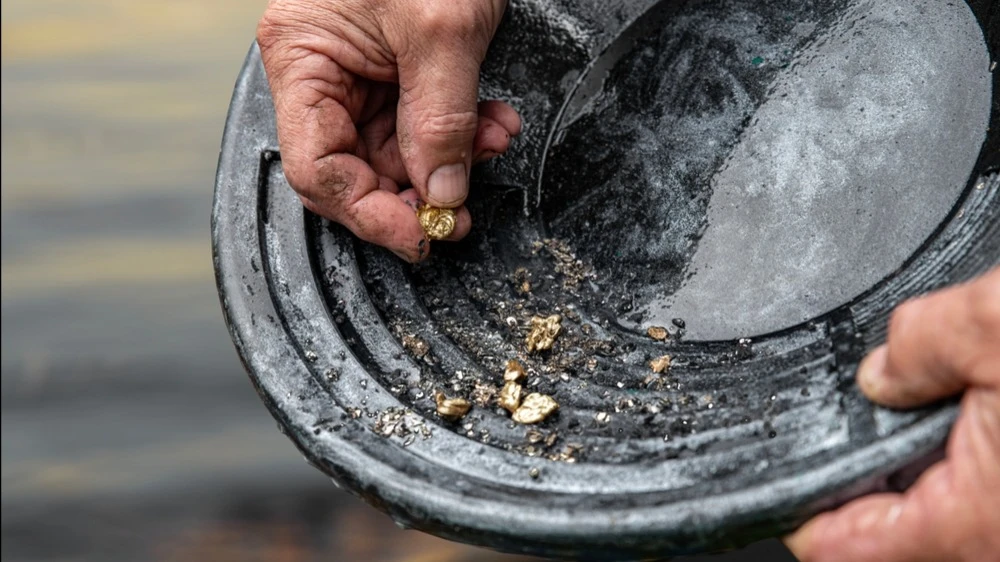
In August, UBS left its end-2026 gold forecast unchanged at $4,600 per ounce / Photo: Shutterstock.com
Gold has already changed direction sharply a few times this year: it surged to an all-time high of around $5,600 per ounce early in the year, then lost around a third of its value by the end of June, before rebounding to around $4,600 per ounce in August. Since gold miners’ costs do not change as quickly as the market price of the metal, this can drive sharp increases in their profits. This factor sent their stocks higher in August, with gold miners significantly outpacing the yellow metal itself and the broader stock market.
A roller-coaster ride
Gold hit an all-time high of $5,597.23 per ounce on January 29, only to fall below $4,000 per ounce by the end of June. The trend reversed again in August, with the price rising to around $4,600 per ounce by the end of the month. Gold-mining stocks also turned higher in August: the MSCI ACWI Select Gold Miners Investable Market Index gained 43% during the month.
Demand from central banks also remains high. They bought 289 tons of gold in the second quarter, 62% more than a year earlier. In August, UBS maintained its bullish outlook for gold: the bank still expects the price to reach around $4,600 per ounce by the end of 2026 and $5,400 by September 2027.
For gold miners, however, it is not only the price of the metal that matters but also how much money is left after production costs. One of the sector’s key metrics is all-in sustaining costs, or AISC. In the second quarter of this year, for example, gold miner Orezone sold gold at an average realized price of $4,401 per ounce, while its AISC was $2,449 per ounce.
Oninvest gold index performance
In 2025, an Oninvest-compiled equal weight index of small gold miners delivered impressive returns, rising 202.5%, while gold itself gained 64.5%. Oninvest subsequently expanded the index constituent list from 45 to 54 companies, listed in the U.S., Canada, Australia, London, and Istanbul, and recalculated the returns in dollars.
The first half of 2026 saw a pullback: the equal weight version of the index (where each company accounts for 1.82%) fell 9.5%, while the cap weight version declined 7.3%. Over the same period, gold lost 7%, while the S&P 500 rose 9.6%.
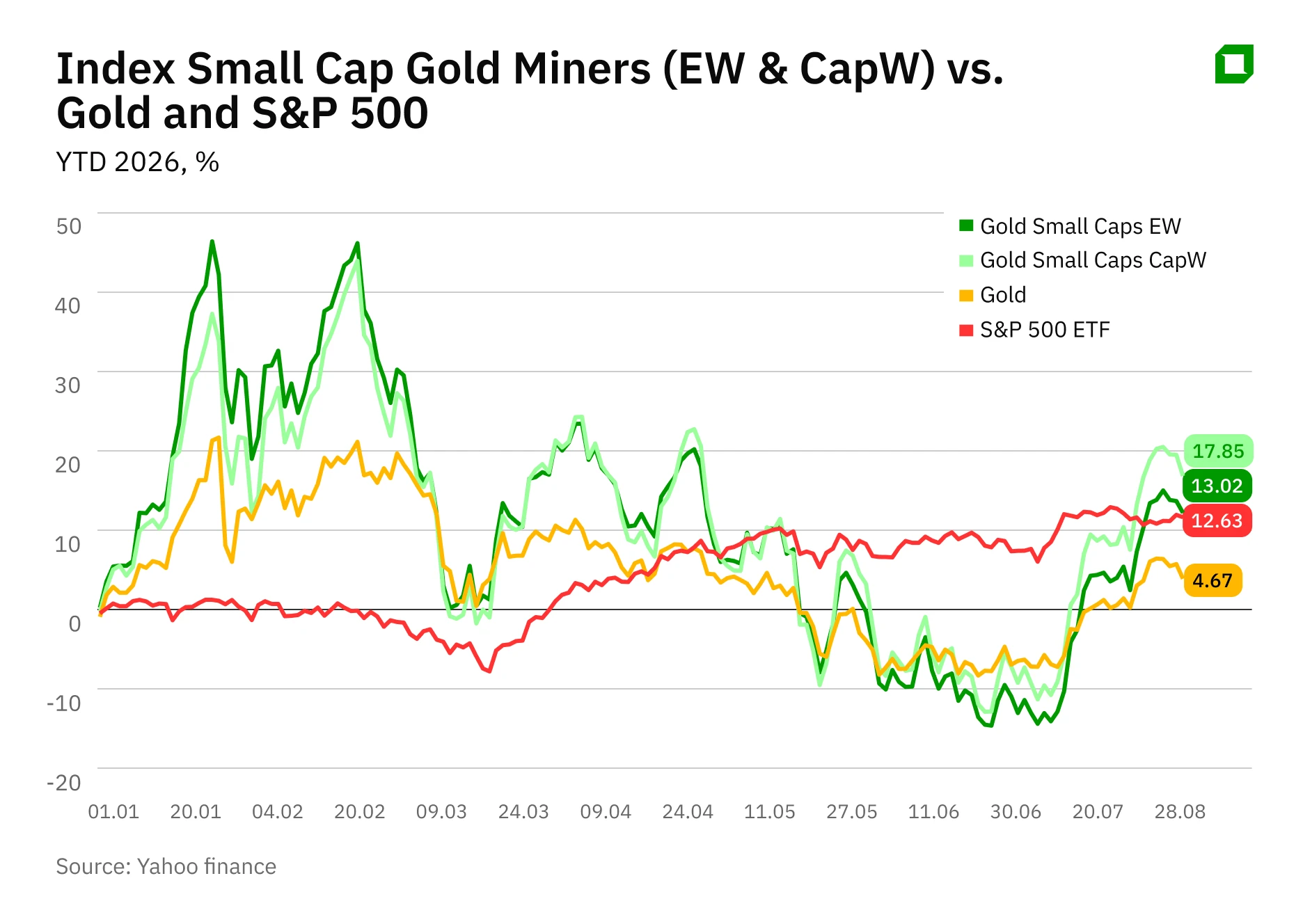
However, the picture has changed since then. From June 30 through August 28, the equal weight version gained 24.9%, while the cap weight version rose 27.1%. Gold advanced 12.6% over the same period, while the S&P 500 added just 2.8%. Small-cap gold miners are in positive territory year to date: the equal weight version of the Oninvest index is up 13.0%, while the cap weight version has gained 17.8%. Gold, meanwhile, has risen 4.7%, and the S&P 500 12.6%.
Gold miner ideas
If gold continues to rise, low-cost miners could grow their profits significantly faster than the metal appreciates. We selected four companies from our index that are of the greatest interest to investors.
Montage Gold (up 97% YTD)
The company (TSX: MAU) is building the Koné mine in Côte d’Ivoire, its first producing asset. According to an updated feasibility study, the project has an estimated mine life of 16 years and is expected to produce more than 300,000 ounces of gold annually over its first eight years.
In its second-quarter earnings report, Montage confirmed that it expects to pour first gold in the fourth quarter. Construction remains on schedule: the company has committed $714.4 million, around 81% of the project’s $885 million budget, versus 63% in January. Its $309 million of liquidity is sufficient to cover the remaining capex. The company is simultaneously ramping up exploration. In the first half, drilling increased to 105,454 meters from 83,280 meters a year earlier.
Its second asset is Didievi, a resource-stage project. Montage obtained it through its acquisition of Australia’s African Gold in April. The deposit’s resources are estimated at 989,000 ounces of gold. In August, the company increased its stake in the project from 80.0% to 95.5%, paying $57.7 million.
Montage’s main risk is that it effectively has just one producing asset under construction, while both of its potential projects are in the same country. For now, construction appears to be proceeding without major disruptions, judging by the safety metrics.
On August 12, ATB Capital Markets raised its target price on Montage from CAD19 to CAD22 per share and maintained its “outperform” rating (the note was seen by Oninvest). It assumes a 19-year mine life for Koné, annual production of more than 300,000 ounces of gold over the first 11 years, and an AISC below $1,400 per ounce. That would make Koné one of the largest and lowest-cost gold mines in West Africa.
Mako Mining (up 73.5% YTD)
The company (Nasdaq: MAKO) produces gold at the San Albino mine in Nicaragua, which it describes as one of the world’s highest-grade open-pit gold mines, and at the Moss mine in Arizona. Mako is also preparing its fully permitted Mt. Hamilton heap-leach project in Nevada for construction and owns the Eagle Mountain project in Guyana, at the preliminary economic assessment stage.
In the second quarter of this year, Mako’s revenue rose 61.8% year over year to $62.6 million, while the net income increased to $13.9 million from $8.8 million. Its AISC, however, rose to $2,286 per ounce from $1,668 per ounce.
The main risk with Mako is geographic. A significant portion of its operating business is tied to Nicaragua, while its new projects are in other jurisdictions with their own political and regulatory risks, including Guyana.
Mako began trading on the Nasdaq on March 30. On August 14, Stifel analyst Ryan Walker reiterated his “speculative buy” rating at target price of CAD20 per share (the note seen by Oninvest).
Orezone Gold (up 52% YTD)
The company (TSX, ASX: ORE) has two operating gold mines, one of which it acquired only in March. The first is Bomboré in Burkina Faso, in which Orezone owns a 90% interest. Commercial production from its oxide operations began in December 2022, and the company commissioned the first stage of a hard-rock expansion in December 2025. It is expected to increase total gold production by 45%.
The second asset is Casa Berardi in Quebec, an operating mine with both underground and open-pit production. The acquisition closed on March 25. The impact of the deal was felt quickly. In the second quarter, gold production rose to a record 58,566 ounces from 27,548 ounces a year earlier. Revenue more than doubled to a record $271.6 million from $94.5 million, while adjusted EBITDA almost tripled to $134.5 million. Net income came in at $45.2 million, or $0.07 per share. Its AISC, meanwhile, rose to $2,449 per ounce from $1,830 per ounce.
Orezone Gold also faces country risk. Further production growth in Burkina Faso depends not only on the project’s economics but also on decisions by the authorities there, who are increasing state ownership in mining projects.
National Bank Financial sees further upside. On August 13, it raised its target price on Orezone from CAD3.25 to CAD3.50 per share and maintained its “outperform” rating (the note seen by Oninvest). It also increased its 2027 EBITDA forecast by 5% to $665 million. According to MarketScreener data, the stock has three “buy” calls versus one “hold.” The average target price of CAD4.28 per share implies 58.5% upside.
i-80 Gold (up 24% YTD)
The company (TSX: IAU; NYSE: IAUX) produces gold in Nevada while building its own regional hub-and-spoke mining and processing system. Ore from three underground mines will be processed at Lone Tree, the system’s central processing hub. The mines are the producing Granite Creek, Archimedes (expected to begin production in late 2026), and Cove.
i-80 Gold is one of only two gold companies in Nevada with its own autoclave processing plant, which can process refractory sulfide ore and extract gold that is difficult to recover through conventional leaching. The other facility belongs to Nevada Gold Mines, a joint venture between Barrick and Newmont.
The infrastructure is not yet operating at full capacity, leaving the company short of processing capacity. In the second quarter, i-80 Gold produced 11,098 ounces of gold versus 4,178 ounces a year earlier, but sold only 5,335 ounces. More than 5,300 recoverable ounces remained in process. The ore is processed at a third-party facility under a toll-milling agreement, and that facility lacked sufficient capacity. As a result, quarterly revenue fell to $24.3 million from $27.8 million a year earlier. Nevertheless, first-half revenue was up 83% at $76.7 million.
The quarterly net loss, meanwhile, widened to $52.5 million from $30.2 million a year earlier, mainly due to a noncash fair-value reassessment of financial instruments. The company had $464.6 million in cash at the end of the second quarter. By 2028, i-80 Gold aims to produce 150,000-200,000 ounces annually, when in-house processing is expected to remove the current capacity constraints.
i-80 Gold has not yet declared reserves at any of its properties under SEC rules, meaning its production targets are based on resources rather than proven reserves. The company plans to publish its first feasibility studies for Granite Creek and Cove in the third quarter.
On August 11, National Bank Financial analyst Don DeMarco reiterated his “outperform” rating at a target price of CAD3.75 per share. On August 12, ATB Capital Markets analyst Richard Gray reiterated his “outperform” rating at a target of CAD3.50 per share (both notes seen by Oninvest). The TPs imply 40-50% upside from the current price. According to MarketWatch data, all six analysts covering the stock have “buy” calls. The average target price of $3.11 per share implies around 75% upside from Monday’s close.
This text is for informational purposes only and does not constitute personalized investment advice.