Oninvest Index: Space-Sector Small-Cap Stocks Have Lost Their Half-Year Gains. What's Next?


Canada's Telesat is migrating its business to a constellation of 198 Lightspeed satellites in low Earth orbit / Photo: X / Telecom
The space sector received a major boost in the first half of 2026 thanks to SpaceX’s initial public offering. On June 12, the company held the largest IPO in history, raising $75 billion at a valuation of approximately $1.8 trillion. However, investors had already begun betting on the industry even earlier: in late May, shares of satellite and rocket companies were soaring amid expectations of the IPO. According to estimates by the World Economic Forum and McKinsey, by 2035 the global space economy will grow to $1.8 trillion from $630 billion in 2023—growing nearly twice as fast as global GDP.
However, as early as July, the market served as a reminder of just how speculative the space sector remains: by July 20, the top performers of the first half of the year had lost a significant portion of their gains. At the same time, Goldman Sachs—whose basket of space stocks had risen by more than 360% over two years— described the sell-off as a sharp correction rather than a sign of structural problems.
There were several reasons for the correction. First, investors were taking profits following a sharp rise in the sector’s leading stocks: some shares gained 25–30% in just one week, making the correction entirely expected. Second, SpaceX’s IPO stripped public competitors of part of their scarcity premium: investors can now buy shares of the industry leader directly. Finally, the sector came under pressure from rising yields on U.S. Treasury bonds and a wave of additional stock offerings and convertible bond issuances, which increased the supply of securities. Most space companies remain unprofitable, so these factors are particularly damaging to their valuations.

Oninvest has calculated its own index of space companies, which includes 29 publicly traded small-cap firms: ten from the U.S., seven from Europe, four from Japan, four from South Korea, two from Canada, and one each from Israel and Hong Kong. The index covers virtually the entire space ecosystem—from satellite communications, Earth remote sensing, and satellite manufacturing to rockets, spaceports, lunar programs, and in-orbit spacecraft maintenance.
At the end of the first half of the year, the equally weighted version of the index— the Space Small Caps EW —rose by 50.2%, compared with a 21% gain for the Russell 2000, 9.6% for the S&P 500, 31.3% for the Procure Space ETF, and 17.7% for the ARK Space Exploration ETF. The market-capitalization-weighted Space Small Caps CapW index gained 37.8%.
However, the July correction was so severe that by July 20, the Space Small Caps EW had seen its year-to-date gain shrink to 24%, and the Space Small Caps CapW to 8.8%.
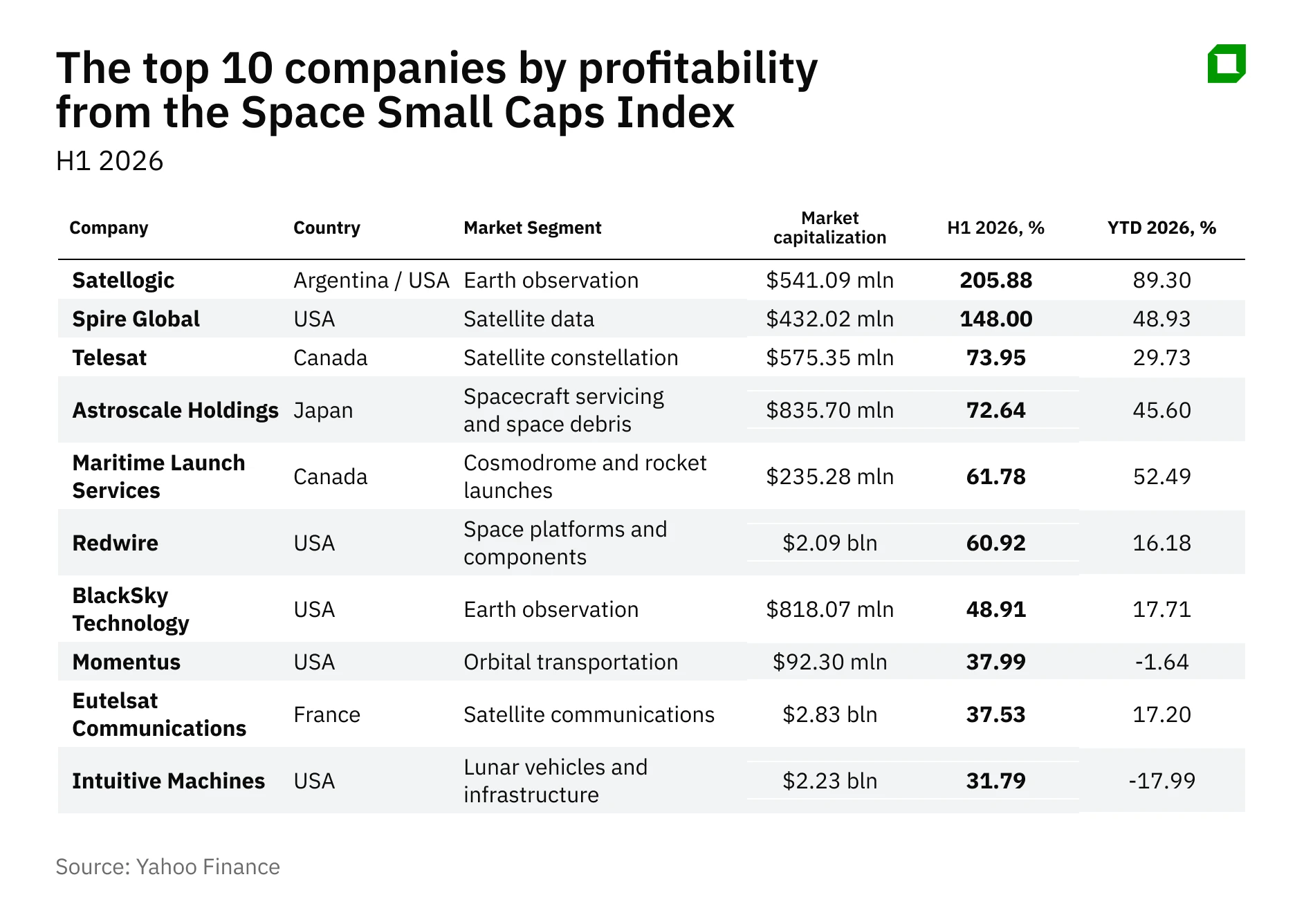
We have selected several companies from the Oninvest index that are of the greatest interest to investors:
Satellogic (SATL)
The company was founded in 2010 in Buenos Aires and is now headquartered in the United States. Satellogic manufactures Earth observation satellites and sells imagery and analytics to government and commercial clients. At the end of the first half of the year, its stock was the top performer on the Oninvest index, rising 205.9%.
In the first quarter of 2026, Satellogic’s revenue grew 80% year-over-year to $6.1 million. The company reduced its adjusted EBITDA loss by 32%, generated positive operating cash flow for the first time, and ended the quarter with $121.9 million in cash on hand.
The sale of satellites already in orbit could become one of the new drivers of growth. In April, Satellogic signed a $12 million contract with a defense customer for the transfer of the NewSat satellite, and Northland analysts noted in a report (available to the Oninvest editorial team) that they expect new deals of this kind. Another potential catalyst is the Aleph Observer monitoring service: a company, whose name Satellogic has not disclosed, has signed an annual contract worth $18 million. In addition, the company plans to launch the first satellites in the Merlin constellation in October for daily Earth imaging.
Satellogic provides satellite imagery to the Palantir Foundry analytics platform, where it is used for data processing and model training. The five-year agreement, signed in February 2022, expires in 2027, and Northland analysts view its renewal as one of the key drivers for the stock.
Satellogic does not have its own rockets: the company launches satellites into orbit using SpaceX. In 2022, the parties signed an agreement to reserve launch slots for 68 satellites, and in March 2026, a Falcon 9 rocket launched the NewSat 53 and NewSat 54 satellites into orbit as part of the Transporter-16 mission.
On July 23, Freedom Finance added Satellogic to its list of investment ideas, estimating the stock’s growth potential at 42.9%. In late May, ROTH Capital raised its price target for the stock to $15 from $10 with a “buy” recommendation, while Northland raised its target to $11 from $9 with an “outperform” rating. The main risk is dependence on large contracts: a delay in even a single deal could significantly worsen financial results and market expectations.
According to MarketWatch, the company has a total of five analyst ratings, all of which are “Buy,” with an average price target of $11.8; this means the stock could more than double from its closing price on July 28.
Spire Global (SPIR)
The U.S.-based company Spire collects weather and radio frequency data from its own constellation of small satellites and sells it on a subscription basis.
In the first quarter, revenue fell by 34% to $15.8 million due to the sale of the marine business, but excluding that sale, revenue rose by 13%, exceeding the company’s own forecasts. In April 2026, Spire conducted a $65.5 million private placement, which, according to management, was a response to a surge in demand from institutional investors. The company has no debt. During the quarter, Spire launched 19 satellites into orbit across three missions; in total, it has launched more than 240 satellites in over 40 campaigns.
The main drivers of growth could be NOAA’s $8 billion program to procure commercial weather data, under which Spire is bidding for approximately $150 million in contracts in 2026, the start of HyMS data commercialization, and the scaling up of the radio frequency geolocation service. According to Canaccord (report available on Oninvest), 76% of projected annual revenue has already been contracted, and positive adjusted EBITDA is expected around the turn of 2026–2027.
In May, Canaccord Genuity reaffirmed its “buy” rating and raised its price target to $22.5 from $22. The main risks are the shift of most revenue to the second half of the year and the dependence of government contract timelines on the U.S. budget process.
According to MarketWatch, three analysts recommend buying the company's stock, and one recommends holding it. The average price target is $20.9, with an upside potential of 83% from the closing price on July 28.
Telesat (TSAT)
Canada’s Telesat is shifting its business from an aging constellation of satellites in geostationary orbit to the Lightspeed project—a network of 198 satellites in low Earth orbit. Under a $2.1 billion contract signed in 2023, the satellites are being built by Canada’s MDA Space, the country’s largest space contractor. The network will provide lower signal latency and speeds comparable to fiber optics.
In the first quarter, revenue fell 25% year-over-year to 87 million Canadian dollars ($62 million), while the net loss widened to 151 million Canadian dollars ($107 million) due to a goodwill impairment charge (a non-cash accounting expense). However, investors are betting on Lightspeed: the project’s contract backlog has reached 1.1 billion Canadian dollars ($780 million), including agreements with the Canadian government, satellite operator Viasat, and French telecom operator Orange.
The defense sector could serve as an additional driver: On July 8, the Canadian Armed Forces selected Lightspeed for the ESCP-P Arctic communications program, with a quarter of the network’s satellite spectrum reserved for secure military communications.
ATB Cormark reaffirmed its “outperform” rating with a price target of 99 Canadian dollars ($70), and on July 13, Scotiabank initiated coverage of the stock with a “sector-neutral” rating and a price target of 80 Canadian dollars ($57). The main risk is a legal dispute with creditors over Lightspeed’s assets and upcoming debt maturities: approximately $1.7 billion in December 2026 and another approximately $450 million in 2027.
According to MarketWatch, two analysts recommend buying the company's stock, two recommend holding it, and one recommends selling it. The average price target is $53.49, with an upside potential of 44.6%.
What Matters to Investors
It is noteworthy that the space industry is gradually evolving into a unified ecosystem: some companies build satellites, others launch them or provide the infrastructure, and many serve as both contractors and customers for one another. For example, MDA Space builds Lightspeed satellites for Telesat. SpaceX launches Satellogic satellites, and under a 2023 contract, it will also deploy a Telesat constellation into orbit.
However, nearly all of these companies are currently operating at a loss, and their valuations are based on defense budgets, sovereign space programs, and confidence in their contract portfolios. For the rally to continue, contracts must translate into revenue faster than companies dilute shareholders through new offerings. The July correction showed that the space sector is capable of growing faster than the market, but the cost of failure is also significantly higher here.
This is not intended as individual investment advice.