Palantir Shares Are Nearing Their High: Goldman Sachs Recommends Buying Them
Investbank Recognized the Advantages of Palantir's Business Model Over Chatbot Providers

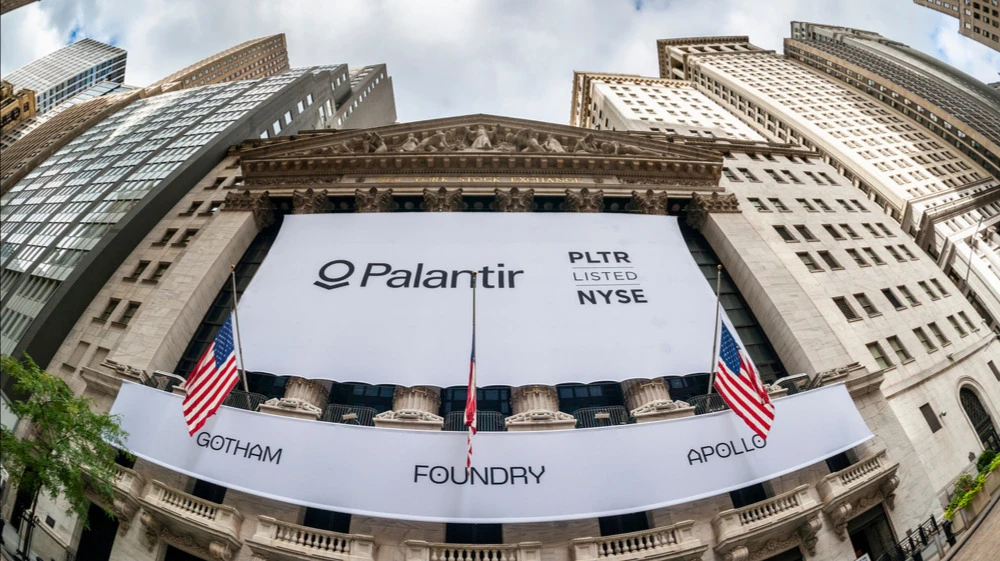
Large companies and governments are increasingly considering data privacy when implementing AI, which is driving up demand for Palantir's services / Photo: rblfmr / Shutterstock.com
Demand for specialized, localized AI software—Palantir’s area of expertise—is poised for further growth, according to a Goldman Sachs analyst. This is partly driven by the rise of “sovereign AI”: governments and companies are seeking to keep data under strict control rather than handing it over to large public cloud providers, according to a note from the bank cited by Barron’s. Goldman Sachs now expects Palantir’s stock to rise by 18%. Following this assessment, shares of the Pentagon contractor rose more than 2%, reaching their highest level since November and approaching a record high.
Details
Goldman Sachs analyst Gabriela Borges upgraded her rating on shares of AI developer Palantir from “neutral” to “buy” on October 8, according to Barron’s. The analyst also raised the price target from $204—set at the end of September—to $230. This is 18% above Wednesday’s closing price.
"The main takeaway from our recent conversations with industry participants is that stocks appear to be poised for a new phase of outperformance in 2027," Yahoo Finance quotes Borges as saying in the article.
According to Borges, Palantir’s potential market will continue to expand due to the desire of governments and companies to protect the privacy of their data. She estimates that demand is also shifting toward specialized AI applications—deeply customized software solutions for specific business processes—rather than the generic chatbot frameworks offered by OpenAI and Anthropic. Corporate clients are likely willing to pay more for technologies that directly improve supply chain management, logistics, and internal decision-making, the analyst explains.
Borges also believes that companies are still “in the early stages of applying AI to their own data” to gain a competitive advantage. At the same time, software companies are generally technologically advanced enough to scale such projects on their own, whereas “industries with a lower concentration of technology specialists will present an opportunity for Palantir,” Borges emphasizes.
The analyst considers another advantage of Palantir to be its “forward-deployed engineering” model, in which the company’s engineers work directly with clients and tailor the software to their specific needs. According to Borges, this strategy “requires close feedback between on-site teams and product developers,” and Palantir has “perfected this process” to the point where it can now automate it using AI engineers.
During Thursday's trading session, Palantir shares rose 2% to $198.6. At their peak, the shares climbed above $204, approaching the record high of $207 reached in November 2025.
Why Is Data Control Important?
The issue of data control became particularly acute in September following the scandal surrounding OpenAI’s claim that it had solved one of the “millennium problems”—the Navier-Stokes problem. Mathematician Tristan Buckmaster suspected that OpenAI’s internal model might have gained an advantage in solving the equation thanks to his unpublished research, since he had previously worked with it via the OpenAI Codex app. The company denied this and later stated that an audit found no evidence that user data had influenced the result. The incident, however, highlighted a broader risk: researchers and companies that feed proprietary data into AI systems cannot always be certain that this information will not influence the model’s training or subsequent behavior.
Palantir CEO Alex Karp directly accused the developers of proprietary AI models of using their clients’ intellectual property to improve their own systems. Citing accounts from Palantir clients, Karp stated on CNBC in September that their business ideas and data were fed into AI models, after which they could end up being publicly available. “They find that a competitor next door has obtained all the results of their work,” said the Palantir CEO. Karp has previously sharply criticized leading AI labs over data privacy concerns, Business Insider notes. In June, Palantir published a nine-point manifesto calling on companies to store their data within their own infrastructure rather than transfer it to third-party organizations.

“Even though leading AI labs swear they don’t look at customer data, that claim is comically far from the truth,” Barron’s quotes D.A. Davidson analyst Gil Luria as saying. The analyst also explained that Palantir’s advantage lies precisely in the fact that the company does not take data outside of its clients’ infrastructure. Luria also recommends buying Palantir stock and set a price target of $250 on September 11.
Overall, Wall Street has a positive outlook on the shares of this Pentagon AI solutions provider. Of the 35 analysts tracking Palantir’s stock, 25 recommend buying it, eight recommend holding it, and only two recommend selling it. However, analysts do not expect significant growth in the stock price: the average price target is $203.7, which is only 5% higher than the closing price on October 7.
This article was AI-translated and verified by a human editor