‘Roller coaster’: What Wall Street expects from SpaceX third-quarter earnings

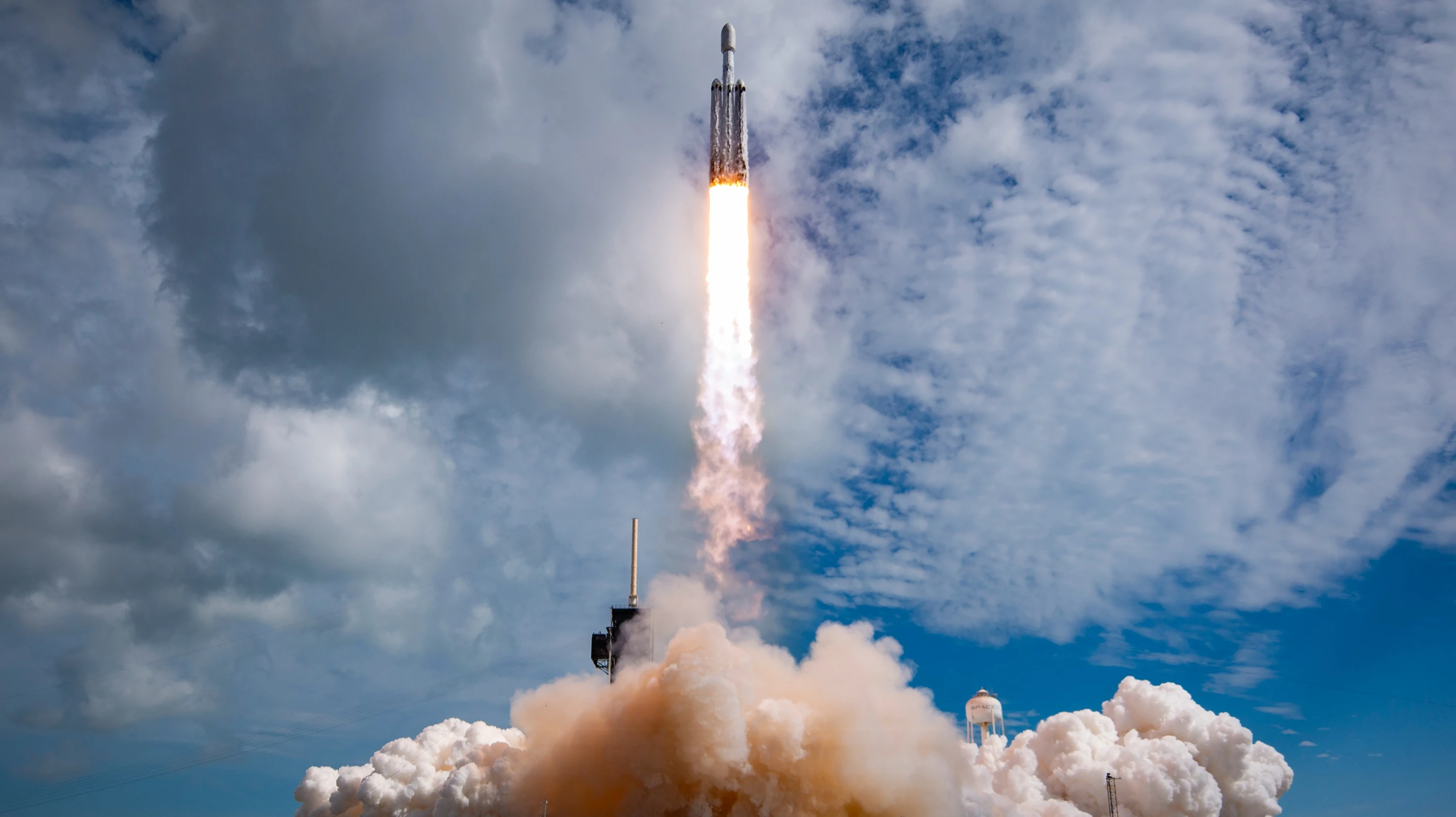
AI is likely to take center stage, MarketWatch writes / Photo: X/SpaceX
Elon Musk’s SpaceX is scheduled to release its second earnings report as a public company after U.S. markets close on Tuesday. Investors’ attention is likely to center on its AI business, MarketWatch notes. SpaceX stock was little changed in Tuesday trading, edging down 0.46%.
What Wall Street expects
Financial results
SpaceX is expected to return to profitability in the third quarter, with earnings of $0.13 per share versus a second-quarter loss of $0.09 per share, according to FactSet data. Quarterly revenue is forecast to reach $12.8 billion, up 64% year over year. Part of that growth will come from the company’s AI business, specifically selling access to the computing resources needed to run AI, MarketWatch writes. Full-year capex is expected to reach $67 billion, according to FactSet data.
Artificial intelligence
SpaceX’s AI revenue will almost triple quarter over quarter to around $6 billion, Deutsche Bank analyst Edison Yu believes. He estimates that SpaceX’s contracts to supply AI computing capacity to several customers could generate $54.5 billion in annual revenue at the current pace. That amounts to more than half of SpaceX’s $100 billion annualized revenue run-rate target, MarketWatch notes. SpaceX generated $18.67 billion in revenue in 2025.
“… [SpaceX] stock has increasingly traded more in line with the AI cohort as opposed to Space,” Barron’s quotes Yu as writing. SpaceX eventually plans to put AI data centers in space, hoping for lower power costs than at terrestrial facilities, Barron’s notes, adding that this may not yet be reflected in the stock.
Additional financing and capex
Funding Musk’s ambitious plans will cost considerably more than the $67 billion in capex analysts expect for SpaceX in 2026. One unnamed analyst cited by MarketWatch estimates that spending could reach $336 billion in 2027. In early October, reports emerged that SpaceX was seeking to raise $40 billion to buy Nvidia chips for its data centers. Just a few months earlier, the company had raised $25 billion in debt.
“Need for additional financing remains a key overhang for sentiment, especially given the recent neocloud debt saga,” Morgan Stanley analyst Adam Jonas wrote. Jonas, who is bullish on SpaceX stock, expects the company to issue another $80 billion in debt next year. “This is the biggest risk to our model, and we do not want to downplay it – although a hypothetical world where SpaceX cannot raise financing likely has much broader implications for the economy and the rest of an investor’s portfolio,” he added.
Space launches
Investors also want to know when Starship will fly again. The rocket is crucial to the development of every part of SpaceX’s business, experts say. Its most recent launch took place in September, when it briefly reached orbit for the first time and deployed 26 new SpaceX satellites. “We believe that SPCX’s unrivaled launch capabilities represent the foundational competitive advantage that enables all other parts of its business,” Citi analysts led by John Godyn wrote.
Deals, mergers, and acquisitions
Analysts are also discussing a potential merger of Musk’s two companies, SpaceX and Tesla, which some expect could be announced by the end of 2027. “We see little standing in the way of the consummation of a merger to create ‘Elon Inc.,’ which we think has long been part of Musk’s master plan,” CFRA analyst Garrett Nelson wrote after last week’s unveiling of Tesla’s next-generation flying Roadster electric sports car.
RBC analyst Ken Herbert has a “buy” rating on Musk’s aerospace and AI company at a target price of $225 per share, Barron’s writes. That implies 52% upside from the last close. “We view the recent spectrum purchase as a positive, and Starship momentum [is] on pace to continue,” he wrote. In October, SpaceX agreed to acquire low-band spectrum, advancing its plans to turn its Starlink satellite business into a full-service U.S. mobile carrier.
Strong demand for AI computing should drive higher earnings estimates for 2027, reckons Wells Fargo analyst Ken Gawrelski. He identifies growing adoption of Grok and Cursor products, Starship development, and the expiration of post-IPO share lockups as catalysts for Musk’s company. Gawrelski has a “buy” rating on the stock at a TP of $214 per share, implying 44.6% upside from the last close.
How the stock might react
“Buckle up for carnival-ride-like volatility,” Barron’s writes. “Sentiment has been such a roller coaster that it’s become challenging for us to pin down. We think investors lean positive on the numbers,” Morgan Stanley analyst Adam Jonas wrote.
Options markets imply a move of around 7% in either direction for SpaceX stock after the earnings release, according to Barron’s. Shortly after its late-June IPO at $135 per share, the stock climbed above $225 per share, only to fall below $105 per share in early August. It recovered to around $125 per share ahead of the company’s first quarterly earnings report as a public company in August, then plunged 14% to $108 per share after the results. SpaceX stock was trading at around $147 per share on Tuesday as of this writing.
Overall, 76% of analysts covering the stock recommend buying it, according to FactSet data. For comparison, the average proportion of “buy” ratings for S&P 500 stocks typically ranges from 55% to 60%, Barron’s notes. The average analyst target price for SpaceX is around $228 per share, implying 54% upside from the last close.