Analysts see 35% upside in label maker Brady on data center demand and Honeywell deal

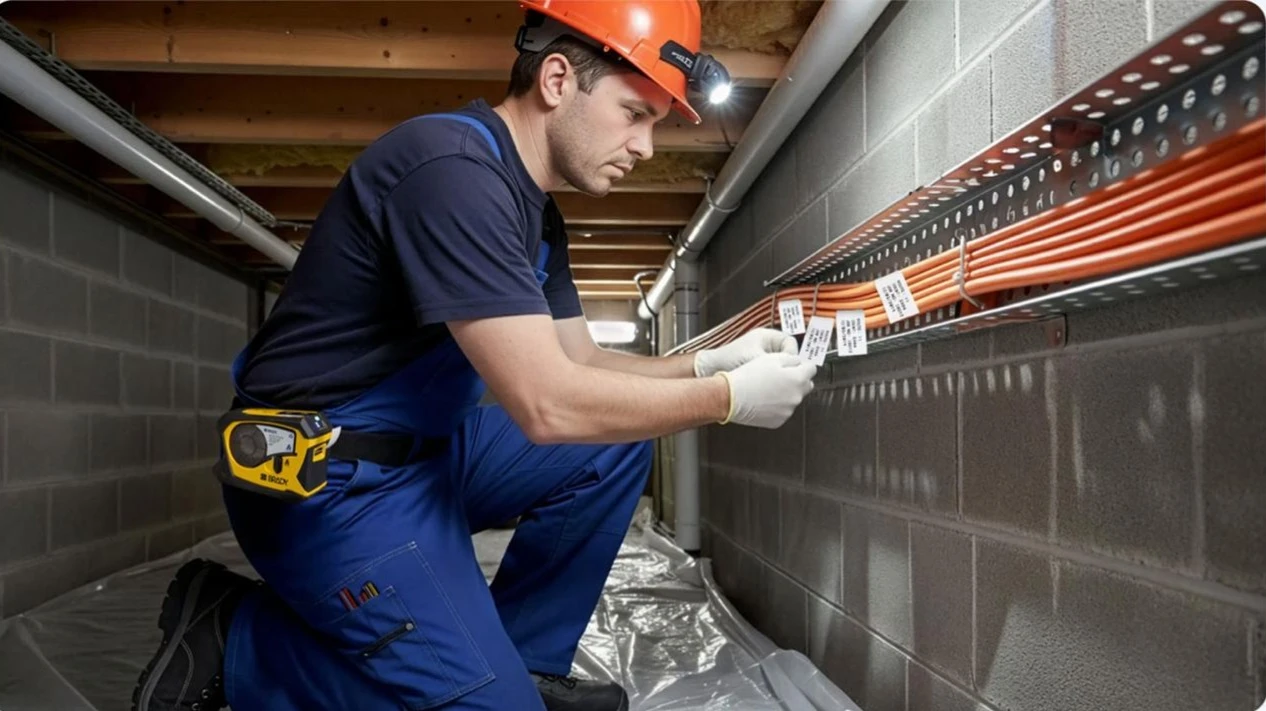
Brady stock is up more than 13% year to date, and analysts see around 35% further upside / Photo: www.bradycorp.com
Labels, markers, and other identification products made by Brady Corporation are used by 88% of Fortune 500 companies. From its beginnings selling advertising displays and photographic calendars, the company has grown into a supplier of identification products for applications ranging from laboratory test tubes to Gemini spacecraft and SpaceX’s Falcon 9 rockets.
Brady is now benefiting from the construction of data centers, where AI-driven demand is fueling a need for wire and cable identification. Following its acquisition of an automation business from industrial giant Honeywell, Brady puts its addressable market at around $14 billion. Oninvest looks at why analysts see consensus upside of a third in the stock, as well as the risks posed by the largest acquisition in the company’s history, completed this year.
Where Brady’s products are used
Brady Corporation sells label printers, barcode scanners, consumables, software, safety signs, and workplace safety solutions. Another part of its business focuses on healthcare identification: patient wristbands, laboratory labels, and specimen-tracking solutions. Customers then return to buy printer consumables, which help drive growth alongside the printers themselves. Together, these categories account for just over 40% of Brady’s sales.
According to the company, 88% of Fortune 500 companies use its products for identification and communication within their organizations. Brady has also made its way into space: its nameplates and component markers were used on Gemini spacecraft in the 1960s and are now used on SpaceX’s Falcon 9 rockets. The company states that its identification products are used on 70% of commercial aircraft worldwide, as well.
Brady’s identification products address specific operational problems, helping companies improve efficiency. At Airbus Helicopters, for example, Brady introduced printers to label two-component compounds with preset expiration times. Employees had previously written the times by hand, sometimes making mistakes that left mixtures to harden before they could be used.
For Royal Lactalis Leerdammer, the maker of Leerdammer cheese and a subsidiary of major dairy company Groupe Lactalis, Brady developed a system to improve employee safety during equipment maintenance.
Expansion beyond labels
The business traces its roots to 1914, when Will Brady founded W.H. Brady Company, selling photographic calendars and creating advertising displays for stores and ice cream parlors. In 1940, the company found a new niche: reliable identification labels that would remain legible on aircraft wiring even at high temperatures. That idea became the foundation for its subsequent growth.
Brady Corporation went public in 1984. Alongside developing and patenting its own products, the company acquired smaller businesses that complemented its operations. In 2012, for example, it bought Precision Dynamics Corporation, a specialist in wristbands and labels for healthcare facilities, for $300 million. The $173 million acquisition of Code Corporation in 2021 added scanners to Brady’s portfolio. This allowed the company to offer customers an end-to-end service, from applying identification to tracking it.
Brady’s acquisition of France’s Gravotech for EUR120 million in 2024 expanded its capabilities in industrial applications, where durability matters, and branding, where products need to be personalized. Gravotech specializes in equipment for laser and mechanical engraving of parts. Danish equipment manufacturer Danfoss has worked with Gravotech, while Stella Artois has used its equipment to engrave glasses. Gravotech’s customers include Audi, BMW, Givenchy, and Lancôme.
A major acquisition
This year, Brady completed its largest acquisition ever, buying the Productivity Solutions and Services (PSS) business from aerospace and industrial tech conglomerate Honeywell for $1.4 billion. PSS, which generated around $1.1 billion in revenue in 2025, specializes in mobile computers and handheld barcode scanners. Turkish retailer LC Waikiki used Honeywell mobile terminals to automate store operations. Japanese pen manufacturer Pilot Ink introduced mobile computers to prevent errors in ink selection. GEPP, a Mexican bottler and distributor of PepsiCo beverages, streamlined its logistics and order processing with Honeywell’s help.
Brady was buying a business large relative to its own, while Honeywell was selling a relatively small division. “One Small Sale for Honeywell, One Big Leap for Brady,” Barron’s wrote at the time. For context, Honeywell’s total 2025 revenue was $37.4 billion, versus around $1.5 billion for Brady.
BNP Paribas analyst Andrew Buscaglia said the sale price was too low and did not reflect the business’s future growth potential, Reuters reported. The U.S. industrial giant was seeking to simplify its structure ahead of spinning off its aerospace division and to move quickly to shed noncore operations. Brady, meanwhile, gained access to larger enterprise customers at an attractive price. Including the acquisition, the company estimates its addressable market at around $14 billion.
Data centers help drive growth
In early September, Brady reported results for its fiscal 2026, ended July 31, with record annual revenue of $1.66 billion, up 9.8%. Adjusted diluted earnings per share also reached a record of $5.29, up 15% versus its fiscal 2025. According to company data, wire identification sales rose 16% in fiscal 2026, supported by demand for patch cord labeling at large data centers.
Brady also issued fiscal-2027 guidance: the management expects adjusted diluted EPS of $6.25-6.75, representing growth of 18.1-27.6%. The Honeywell PSS acquisition is expected to contribute around $0.80 of that EPS, net of the cost of financing the deal.
What analysts say
Northcoast Research analyst Keith Housum reiterated his “buy” rating and target price of $111 per share in a September 3 note seen by Oninvest, implying 35.5% upside from current levels.
“What impressed us most in the [fourth] quarter, besides the 20.3% growth in Asia, was the 25% growth in printer volumes (10% for the full fiscal year)...” Housum wrote. “Investors should be excited about the potential for consumables growth in FY27 as a result of the growth in printers. Brady's strategy of driving high margin consumables growth through more, easy to use printers [is] paying dividends.”
Housum nevertheless pointed to uncertainty over how rising memory costs and related price increases would affect the business acquired from Honeywell. Still, he considers the management’s guidance for that business conservative and expects results to deliver beats.
Before the deal closed, Sidoti & Co. analyst Steve Ferazani upgraded Brady Corporation from “neutral” to “buy” and set a TP of $103 per share, implying 25.7% upside from current levels.
Two analysts cover Brady, and both recommend "buy," according to MarketWatch data. Their average target price of $110 per share implies around 34% upside from the Friday close.