Energy small caps have tripled the S&P 500's gains in 1H26. Who is leading the rally?


According to the International Energy Agency, capital flows to the energy sector are expected to grow to $3.4 trillion in 2026, a 5% rise from 2025 / Photo: Shutterstock.com
Energy small caps surged in the first half of the year, gaining around three times as much as the broader market year to date. Despite a worsening outlook for global demand, smaller companies have benefited from high oil prices, vessel and equipment shortages, and elevated freight rates, which this spring reached their highest levels since 2008. The gains have spread across energy segments, from oilfield services and tanker shipping to LNG and uranium.
Oninvest index performance in 1H26
To measure this effect, we compiled an index of 117 public energy small caps with market capitalizations of up to $2 billion. It includes oil and gas producers, oilfield services companies, tanker owners, LNG operators, and uranium companies. In the equal-weight version of the index, each stock has a 0.85% weighting.
The closest exchange-traded equivalent is the Invesco S&P SmallCap Energy ETF (PSCE), which tracks the S&P SmallCap 600 Capped Energy Index. But the Oninvest universe is broader: PSCE invests exclusively in U.S. companies and held 31 positions as of the end of the first quarter of 2026. We also include foreign issuers listed in the U.S., including Greek shipowners Tsakos Energy Navigation, Imperial Petroleum, Pyxis Tankers, and Dynagas LNG Partners; Bermuda-based Nordic American Tankers, Flex LNG, Borr Drilling, and Teekay; and companies from Canada, the UK, Cyprus, Argentina, Colombia, Australia, Singapore, and China.
This broader selection thus captures a segment that is barely represented in the S&P index: tanker shipping. In 2026, it became an important source of gains for energy small caps in general.
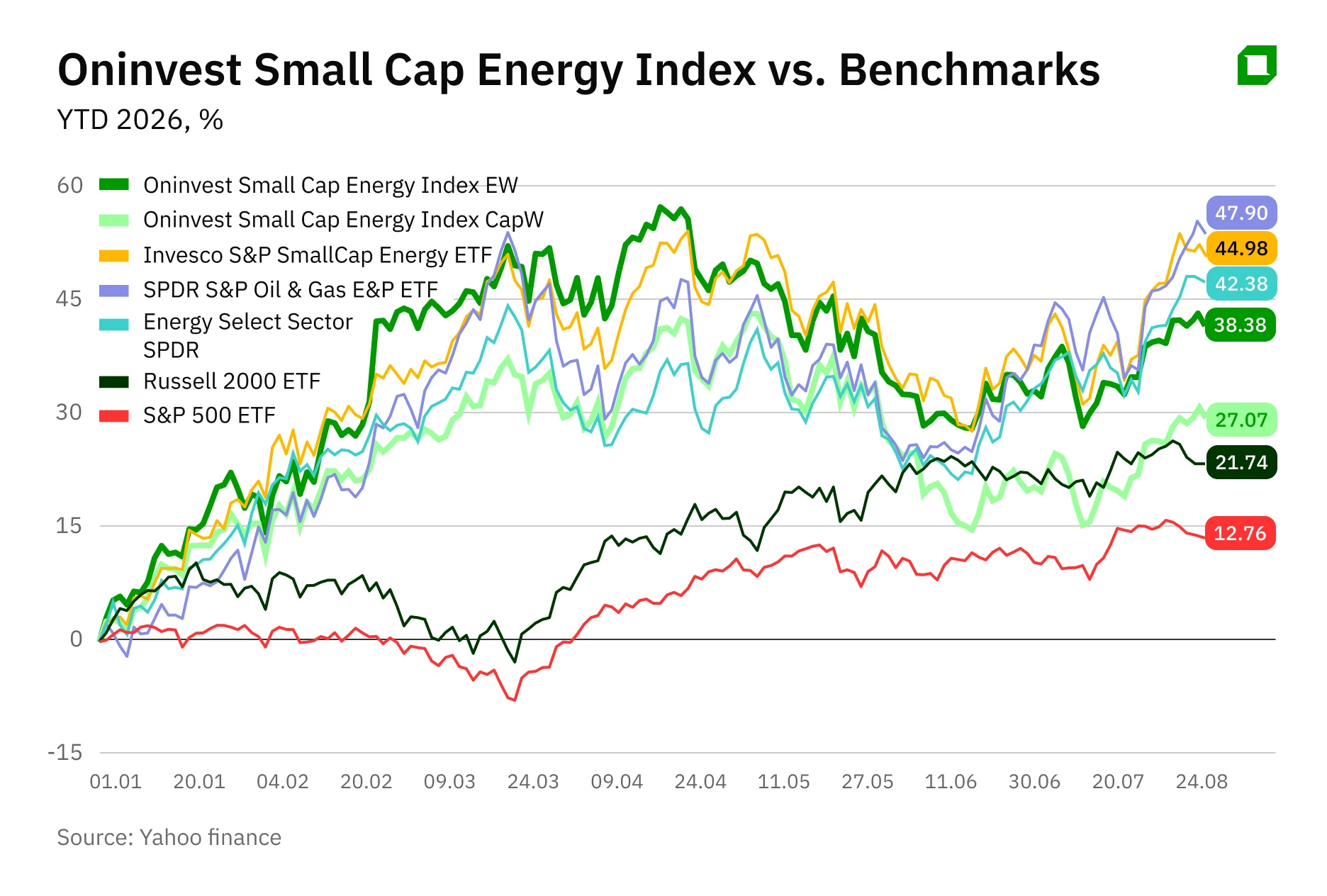
In the first half of 2026, the Oninvest-compiled equal-weight index gained 24.25%, versus 14.59% for the cap-weight version. Year to date through Monday, the equal-weight index was up 38.38%, versus 27.07% for the cap-weight version.
For comparison, the Russell 2000 added 21.74% year to date, and the S&P 500 12.76%. Meanwhile, PSCE advanced 44.98%, the SPDR S&P Oil & Gas E&P ETF 47.90%, and the Energy Select Sector ETF rose 42.38%, as calculated by Oninvest. The picture was entirely different a year earlier. In 2025, the equal-weight Oninvest index rose just 0.78%, while the cap-weight version fell 21.23%.
Keys for small-cap energy investors
The pivotal event in 2026 has been the closure of the Strait of Hormuz, through which around one fifth of global oil supplies passed. Brent crude climbed as high as $120 per barrel in spring. Markets continue to react to every report around the strait, including on negotiations over its future.
The International Energy Agency (IEA) expects global energy investment to reach $3.4 trillion in 2026, up 5% year over year. Around $1.2 trillion is expected to go toward oil, gas, and coal. However, oil investment is set to decline for a third consecutive year to below $500 billion, while natural gas investment is projected to rise to $330 billion, the highest level in a decade.
Oil demand is not supporting the sector either. In its August oil market report, the IEA lowered its forecast and now expects global demand to decline by 1.6 million barrels per day in 2026 before returning to growth in 2027. For smaller companies, however, the price of the commodity here and now matters more. Brent is trading above $85 per barrel, while the U.S. Energy Information Administration expects the average price to remain at around that level in the third quarter.
For small caps, the combination of high oil prices and vessel and equipment shortages may prove far more important than the overall demand outlook. For smaller producers and services companies, current market conditions feed through more quickly to revenue, earnings, and cash flow, and therefore to stock prices. But if the Strait of Hormuz reopens, freight rates and the geopolitical risk premium in oil prices could normalize before companies’ financial results have time to reflect the shift.
Picks from among top performers
We have selected four companies from among the top 10 performers in the first half that may be of interest to investors.
Nordic American Tankers (NYSE: NAT)
Nordic American Tankers is a shipping company that operates a fleet of 18 tankers, each capable of carrying around 1 million barrels. In the first quarter of this year, the company reported net income of $46.3 million, more than it earned in all of 2025, while its quarterly dividend rose to $0.22 per share. This marked its 115th consecutive quarterly dividend since the company went public in September 1996.
The average time charter equivalent rate, a vessel’s daily earnings after voyage expenses, increased to $47,600 per day, versus $27,490 in the fourth quarter of last year. The company had already booked around 90% of its fleet for the second quarter at approximately $68,000 per day, while operating costs are below $10,000 per day.
Nordic American Tankers founder and CEO Herbjørn Hansson bought 100,000 shares on July 10 at $6.03 apiece. Evercore ISI analyst Jonathan Chappell reaffirmed an “underperform” rating on NAT on July 21 at a target price of $4.50 per share, around a third below its market price (Oninvest has seen the note). On his numbers, NAT trades at a premium of around 32% to its net asset value, while the industry has placed a record number of orders for new tankers. Once those vessels enter service, tonnage supply will increase and freight rates will decline, he argues. The average target price on Wall Street for Nordic American Tankers is $6.28 per share, implying around 10% downside from the close on Tuesday. Still, three of the four analysts covering the stock have “buy” ratings.
Kosmos Energy (NYSE/LSE: KOS)
Kosmos Energy produces oil and gas from deepwater assets offshore Ghana, Mauritania, and Senegal, as well as in the Gulf of Mexico.
In the second quarter of 2026, the company reported net income of $185 million, versus a net loss of $87.7 million a year earlier. Revenue increased 54.7% year over year to $607.25 million, while production rose 12% year over year to around 71,400 barrels of oil equivalent per day. Production expenses fell 25% to $25.60 per barrel of oil equivalent. The company expects new wells at its Jubilee field to increase gross production to more than 90,000 barrels per day. Kosmos expects to complete the refinancing of a $1.2 billion credit facility by the fourth quarter.
The main risk for Kosmos is that its net debt exceeds its market capitalization. On August 4, BofA lowered its target price from $1.64 to $1.50 per share and maintained an “underperform” rating. BofA noted that the company had reduced debt primarily through asset sales and equity offerings rather than increasing cash flow. On August 3, Jefferies reaffirmed its “buy” rating at a target price of $2.75 per share. The consensus target price is $3.15 per share, implying around 15% upside from Tuesday’s close.
W&T Offshore (NYSE: WTI)
W&T Offshore operates offshore in the Gulf of Mexico, where it holds working interests in 48 fields, and does little new drilling. It maintains production through low-cost workovers and recompletions of existing wells. W&T has traditionally grown by acquiring mature assets. According to CEO Tracy Krohn, acquisitions and the integration of purchased assets have allowed the company to grow its reserves and production over the last 40 years.
However, the company has made no new acquisitions in recent quarters. The gap between buyers’ offers and sellers’ expectations remains too wide, while competition for assets has intensified with the arrival of new players in the basin. W&T nevertheless has $194.1 million of available liquidity, which it hopes to use for new deals.
In the second quarter, the company reported net income of $12.6 million, versus a net loss of $20.9 million a year earlier. Adjusted EBITDA was up 54% year over year at $54.4 million, while free cash flow rose 8.8-fold to $31.4 million. Net debt declined to $200.9 million from $220.3 million in the previous quarter, while the average realized price per barrel of oil equivalent rose 11% quarter over quarter to $50.23.
The main risk is the company’s asset-retirement obligations, the cost of decommissioning wells. They stood at $548.8 million at the end of June, while the company had a shareholders’ deficit of $196.2 million.
Another consideration is W&T’s litigation against its surety providers. The company has stated that if it prevails, its claims could reach hundreds of millions of dollars, with any damages awarded subject to statutory trebling. With a market capitalization of around $575 million, such an outcome could have a material effect on its valuation. On August 6, William Blair analyst Neal Dingmann reaffirmed an “outperform” call on W&T at a target price of around $4.00 per share. All three analysts covering the company have “buy” ratings, according to MarketWatch data. The average target price is $5.05 per share, implying around 40% upside.
Atlas Energy Solutions (NYSE: AESI)
Atlas Energy Solutions provides oilfield logistics, operates the largest proppant supply network in the Permian Basin, and owns the 42-mile Dune Express conveyor. Proppant is sand used in hydraulic fracturing. Investor attention, however, is increasingly shifting to Atlas’s new business of standalone power generation for data centers.
In March, Atlas signed a framework agreement with Caterpillar covering equipment for around 1.4 GW of power generation. Atlas expects to increase its owned generation capacity to 2.0 GW by 2030.
In the second quarter, revenue increased 10.4% quarter over quarter to $293.2 million, remaining almost unchanged year over year with growth of 1.6%. Adjusted EBITDA fell 30% year over year to $49.5 million, while the net loss increased almost fivefold to $25.1 million. The company also completed construction of a temporary 26 MW facility under a five-year, 120 MW contract. Atlas’s guidance for the third quarter calls for adjusted EBITDA of $30-45 million.
After gaining 76.3% in the first half of this year, the stock was up 29.5% year to date through Monday, Oninvest calculates. Analysts have become more cautious on the name: on August 7, Barclays lowered its target price from $14 to $10 per share and maintained an “underweight” rating. On August 4, RBC lowered its target from $21 to $17 per share while maintaining a “sector perform” rating. The average target price on Wall Street is $18.08 per share, implying 50% upside. According to MarketWatch data, the stock has six “buy,” five “hold,” and two “sell” ratings.
This text is for informational purposes only and does not constitute personalized investment advice.