Strong tenge weighs on Kaspi.kz revenue in 3Q; company eyes 3,000 convenience stores

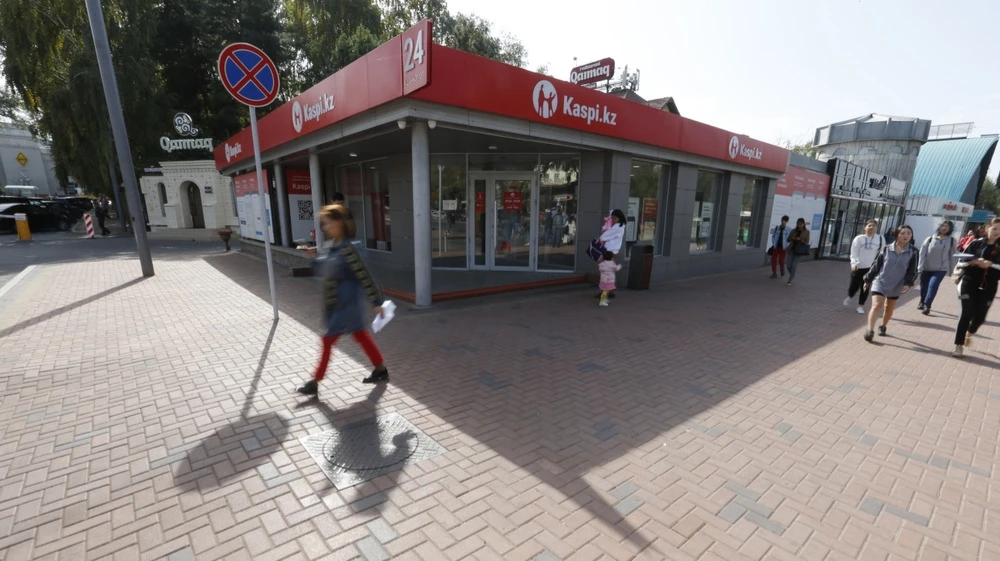
Kaspi plans to open 3,000 neighborhood convenience stores / Photo: Pavel Mikheyev / Shutterstock.com
Kazakhstani fintech Kaspi.kz reported its third-quarter financials on Monday. A stronger tenge slowed reported annual revenue growth to just above zero, but the management still expects to meet its full-year earnings guidance and deliver significantly stronger results in 2027.
Kaspi.kz performance
Kaspi.kz’s consolidated revenue rose 0.6% year over year and 0.5% quarter over quarter to KZT1.12 trillion in the third quarter of 2026 ($2.5 billion, using the company’s exchange rates of KZT440.86 per dollar and KZT8.99 per Turkish lira for conversions throughout). Adjusted EBITDA rose 1.4% year over year and 2.6% quarter over quarter to KZT407.6 billion ($925 million). Net income reached KZT281 billion ($637 million), up 1.1% year over year and 8.5% quarter over quarter.
Fintech remains the main driver of revenue growth. Segment revenue rose 19.4% year over year and 7.5% quarter over quarter to KZT489 billion ($1.1 billion). Adjusted EBITDA fell 1.1% year over year to KZT178.8 billion ($406 million), which the company attributed to high funding costs.
Revenue in the payments segment rose 5.7% year over year and 7.7% quarter over quarter to KZT181.9 billion ($413 million). The segment’s adjusted EBITDA fell 1.2% year over year to KZT104.8 billion ($238 million).
A stronger tenge
Marketplace revenue grew 20% year over year in constant currency, while gross merchandise value (GMV) rose 8%, Kaspi.kz CEO Mikheil Lomtadze said in the earnings release. The segment’s adjusted EBITDA rose 7.8% year over year to KZT124 billion ($281 million). Reported segment revenue fell 15.1% year over year and 8.2% quarter over quarter to KZT466.3 billion ($1.1 billion).
The stronger tenge was the main reason for the drop in reported revenue. In the second quarter, the dollar weakened 7.6% against the tenge year over year and the Turkish lira softened 21%, on the company's numbers. Consolidated revenue still grew 15% year over year that quarter, while marketplace revenue rose 10.7%. The tenge strengthened further in the third quarter, with the dollar weakening 19.7% year over year and the lira weakening 32%.
That reduced the value of the Turkish business’s revenue when translated into tenge. Revenue in Turkey fell to KZT214.1 billion ($485.6 million) in the third quarter, down 18.8% quarter over quarter and 34.7% year over year. In the second quarter, it had still been growing at 6.2% year over year.
The stronger tenge brought down prices for imported goods across Kazakhstan, according to Kaspi.kz. The number of items sold through its e-commerce channels rose 24%, but the average selling price fell 8%, limiting GMV growth to 14%, managing director and head of investor relations David Ferguson said on the earnings call.
“Most items on the Marketplace business are imported into Kazakhstan,” Ferguson explained. Merchants can now buy more for less, he added, and increasingly “that price advantage is being passed on or at least shared in part with consumers.”
Supports for earnings
The management lowered its 2026 constant-currency marketplace GMV growth guidance to around 12% from around 20%. It kept its forecast for around 5% adjusted EBITDA growth and still expects payment volume and the fintech segment’s average loan portfolio to grow around 15% each.
Lomtadze said that Kaspi.kz’s “Payments and Fintech businesses continue to provide a strong foundation for future earnings growth.” The company cut the rate on three-month deposits by a percentage point in August and again in October. The management expects most of the benefit to come through in 2027.
Lomtadze also said that significantly lower investment in Turkey would be “supporting our consolidated earnings outlook” in 2027. Ferguson noted that funds previously used to develop Hepsi Bank and roll out parcel lockers in Turkey would now go toward the new business.
Kaspi moving into physical retail
Lomtadze said Kaspi had successfully piloted 42 Magnum Daily neighborhood convenience stores in Almaty. The stores achieved an EBITDA margin of around 15%, with an estimated payback period of 18 months. Kaspi finances the refitting of existing independent stores, supplies the merchandise, and manages inventory and pricing. Local partners handle day-to-day operations in exchange for 7% of sales.
Kaspi.kz plans to expand the chain to 300 stores across nine Kazakhstani cities by the end of 2027. Its “medium-term ambition” is 3,000 stores, with no specific deadline given. Kaspi estimates that a network of that size could generate KZT1.44 trillion ($3.27 billion) in annual sales and KZT216 billion ($490 million) in annual EBITDA if margins hold at current levels.
On the earnings call, Lomtadze called the Magnum Daily store expansion “a huge opportunity for us and one probably of the most exciting opportunities we have had.” Kaspi also plans to use the stores to deliver e-commerce orders within 30 minutes. In the Q&A, Lomtadze said Kaspi would test the delivery service in November.
Kaspi.kz proposed keeping its quarterly dividend at KZT1,000 per American depositary share.
“In our view, the Kaspi.kz third-quarter 2026 results were neutral. As expected, interest expense continues to grow faster than interest income, though the rate of growth slowed slightly versus the second quarter,” said Daniyar Orazbayev, an analyst at Freedom Broker. He added that the modest 1.1% rise in net income came “in line with expectations.”
Kaspi.kz’s American depositary shares were down 2.23% on the Nasdaq at $89.71 apiece as of 00:30 Tuesday in Almaty.