Tesla's earnings came in one and a half times lower than expected. Its stock price fell
"This is the financial report of an automaker with very low margins, not that of a future robotics company," the analyst said.

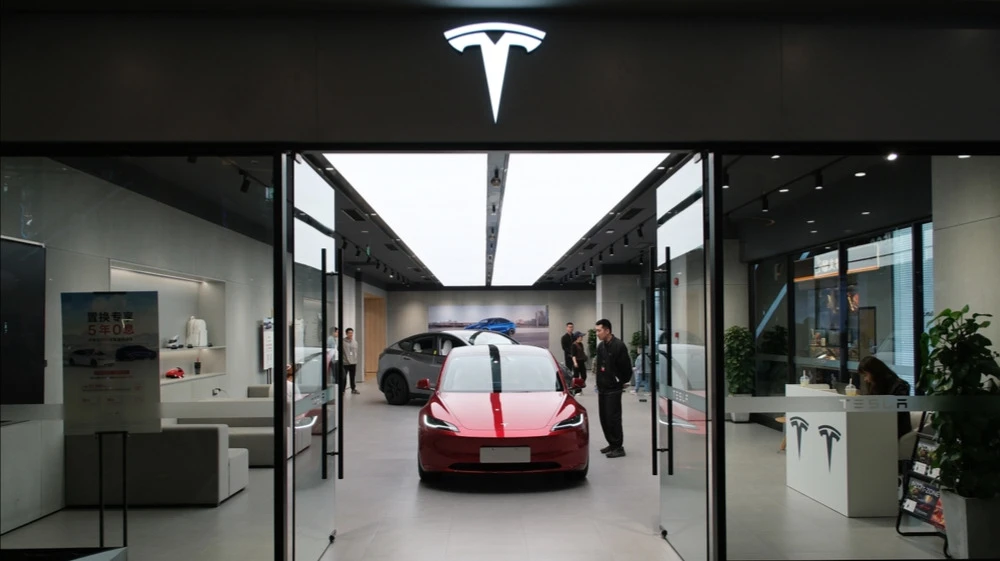
Photo: Robert Way / Shutterstock.com
Tesla's adjusted earnings in the second quarter fell significantly short of Wall Street estimates: they came in at 33 cents per share, compared with a consensus forecast of 51 cents, according to Bloomberg. Net income fell 5% to $1.11 billion.
At the same time, revenue rose 26% and exceeded analysts' estimates: $28.24 billion compared to the expected $25.71 billion, according to CNBC.
The company explained that its current core business—the automotive sector—has come under pressure due to a decline in average selling prices and a reduction in revenue from the sale of regulatory loans. As a result, even with strong revenue in this segment, the gross margin fell from 17.2% to 16.8%, while analysts had expected it to rise to 19.4%.
In addition, profitability was negatively impacted by a nearly 1.5-fold increase in spending on AI, research and development, as well as stock-based compensation and sales expenses. These factors were partially offset by record vehicle deliveries, growth in revenue from subscriptions to the FSD driver-assistance systems, and a reduction in vehicle production costs, CNBC noted.
Free cash flow turned negative in the second quarter, coming in at –$1.1 billion. This was the first time this had happened in more than two years, noted Dave Mazza, CEO of Roundhill Financial. In the first quarter, the figure stood at $1.44 billion.
Why the funds aren't enough
In the second quarter, Tesla allocated $5.8 billion to capital expenditures, and for the first half of the year, the total reached approximately $8.28 billion. Although the company has accelerated its investments, the current pace is still insufficient to reach $25 billion by the end of the year, according to the forecast Elon Musk announced in April, Bloomberg calculated. At this pace, capital expenditures in 2026 will total approximately $16.5–17 billion, the agency notes.
Bloomberg explains: Developing artificial intelligence products—which is exactly what Tesla is focusing on right now—requires enormous expenditures. By comparison, Alphabet spent nearly $45 billion on capital expenditures in the second quarter as part of its expansion of AI projects.
However, according to Ivan Fainset, Chief Investment Officer at Tigress Financial Partners, lower free cash flow burn and capital expenditures indicate that “Tesla is financing the development of autonomous driving much more efficiently than expected.” He described the stock’s pullback as a buying opportunity.
What Other Analysts Are Saying
— Investors were disappointed by both the weak earnings per share and Tesla’s vague statements regarding the prospects for the rollout of Optimus robots and the development of artificial intelligence, according to Max Gokhman, senior vice president at Franklin Templeton Investment Solutions, as quoted by Bloomberg. “Management should stop getting sidetracked by autonomous driving and take the reins again,” he said. He also drew attention to the level of capital expenditures: “Tesla is one of the few companies that should be spending more on AI. The fact that it spends less is puzzling, given how closely the company’s future is tied to the integration of artificial intelligence across all areas of its business.”
— Dave Mazza of Roundhill Financial agrees that the sharp reaction from investors is due to expenses that were less aggressive than expected: “The miss on earnings per share is now less significant, as the market already views Tesla as a company in a phase of massive investment. It is precisely the progress in the development of Optimus and Robotaxi that is driving shareholders to continue funding this investment cycle.”
— “Today’s Tesla report highlights the key contradiction between short-term financial realities and an ambitious long-term vision in the field of AI,” says David Wagner, portfolio manager at Aptus Capital Advisors. According to him, the company is effectively asking investors to finance a large-scale investment cycle. “If the bet on autonomous vehicle fleets and physical AI pays off, the long-term growth potential will be enormous. But any delays—whether technological or regulatory—will make the stock vulnerable if the market continues to value the company primarily based on the performance of its automotive business,” the analyst warned.
— According to Joe Gilbert, a portfolio manager at Integrity Asset Management, Tesla will have to demonstrate significant progress in robotics and autonomous driving by the end of the year; otherwise, “the stock could become ‘dead capital’ for a long time.”
“This is the financial report of an automaker with very low margins, not that of a future robotics company. I don’t see a realistic path to improving profitability,” commented Jay Van Skyver, partner and managing director at Hedgeye Risk Management.
What about the stocks?
Tesla shares fell more than 3% in after-hours trading following the release of the report.
The company's stock price has fallen significantly recently: it dropped by about 11% in July and by 17% since the beginning of the year. This coincided with a plunge in the value of another of Elon Musk’s companies—SpaceX—which, following a record market debut in June, has lost more than 40% from its peak closing price.
Traders betting against Tesla shares have increased their positions over the past four months, notes Matthew Unterman, managing director at S3 Partners; his calculations are cited by Bloomberg. Currently, market participants with short positions hold 3% of the company’s shares, compared with 2.5% a year ago.
Tesla’s massive market capitalization is also hindering any significant rise in its stock price. The stock is trading at a P/E ratio—which measures the price per share relative to future annual earnings—of 167. This makes them the second most expensive stock in the S&P 500 index. By comparison, Apple ranks third with a P/E ratio of 34, the agency notes.
This news story is being updated.
This article was AI-translated and verified by a human editor