The "Panda" Loan: Why Yuan-Denominated Loans Are Attractive Not Only to Kazakhstan


China's financial sector is facing a shortage of assets in which to invest, so the spreads on the instruments being issued are quite favorable for issuers. Photo: Shutterstock.com
Kazakhstan’s activity in the yuan-denominated bond market reflects the emergence of a new avenue for raising funds—on more favorable terms—that is attractive not only to emerging markets but even to Eurozone members.
From the beginning of the year through August 15, 2026, 115 panda bond issuances were made in Chinese jurisdictions, totaling 201.5 billion yuan ($29.89 billion). By comparison, in all of 2025, there were 124 issuances with a total value of 183.6 billion yuan ($27.24 billion).
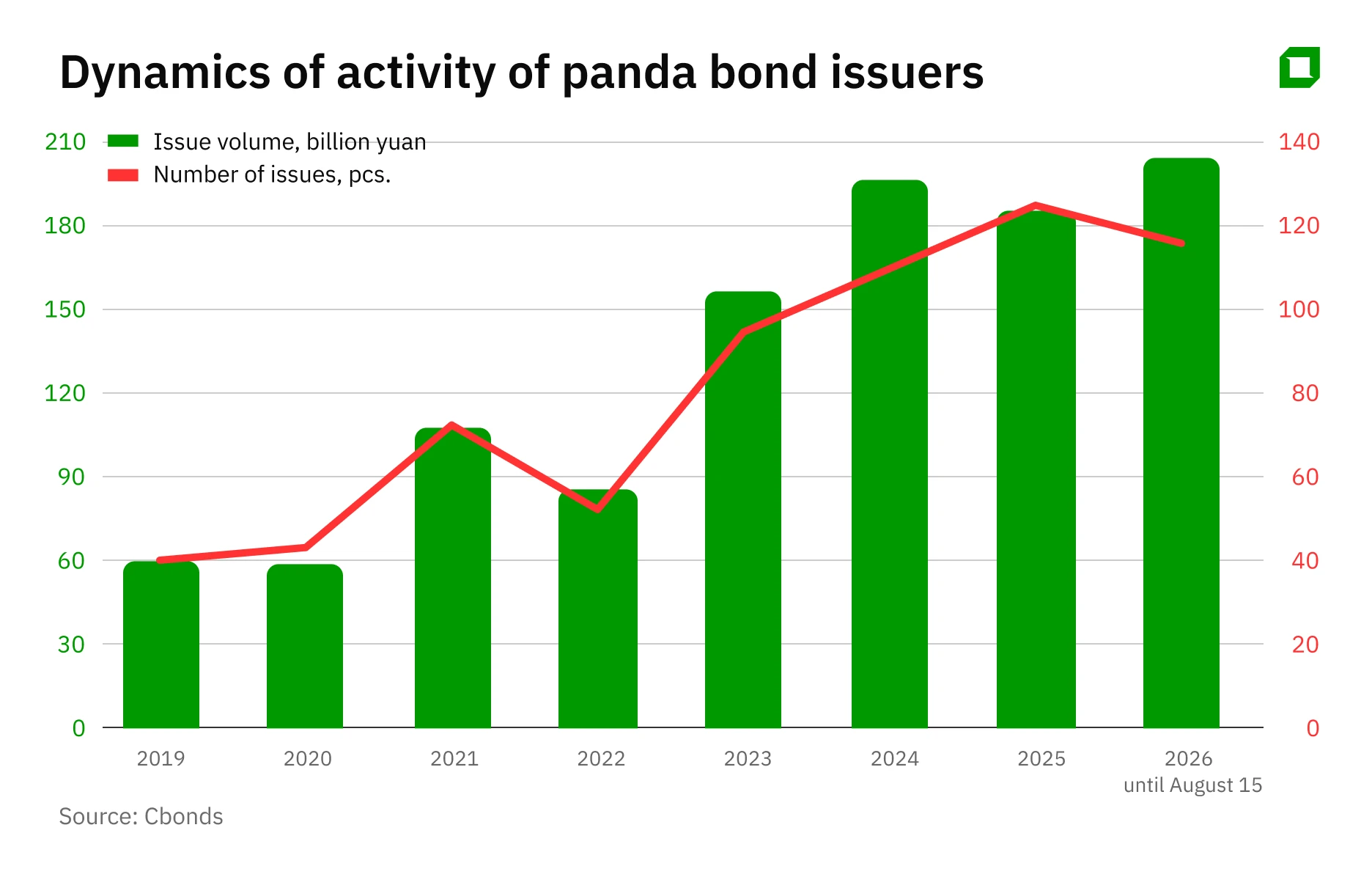
Activity among sovereign and quasi-sovereign (including regional) issuers has increased. By 2026, there had been six such issuances totaling 19.15 billion yuan ($2.84 billion), compared with three issuances totaling 7 billion yuan ($1.04 billion) for the entire year of 2025. The list of issuers in this category in 2026 included: Slovenia, Pakistan, Indonesia, Kazakhstan (two issues totaling 6.4 billion yuan—$0.95 billion), and, separately, the Kazakh sovereign wealth fund “Samruk-Kazyna.”
A shortage of assets for investment
First and foremost, issuers are attracted by the relatively low “cost” of borrowing in yuan. For three-year yuan-denominated Chinese government bonds, the benchmark yield is about 1.25% per annum, which is 2.2 times lower than that of German (euro-denominated) government bonds and 3.4 times lower than that of U.S. (dollar-denominated) government bonds. At the same time, due to a decline in investment in China (fixed-asset investment in the first half of the year was down 5.7% year-over-year) and the associated slowdown in lending activity, the Chinese financial sector is facing a shortage of assets to invest in. As a result, the spreads on the instruments being issued are also quite favorable for issuers. Thus, even taking into account the spread for an issuer with a BBB- rating, the coupon rate and YTM (yield to maturity – Oninvest) on three-year Kazakhstani securities (specifically, direct government issues) this year was only 1.9%.
An Unpleasant Encounter
When it comes to the profitability of an investment, there is one important “but”—namely, the relative dynamics of exchange rates. Issuers who jumped on the bandwagon in 2025 found themselves facing this unpleasant reality: specifically, the Emirate of Sharjah, which issued its three-year yuan-denominated bonds in October 2025. Since April 2025, the yuan has been steadily strengthening against key reserve currencies under pressure from outpacing export growth. For example, compared to early April 2025, the yuan has appreciated by 9% against the dollar and by 7.8% against the euro. Consequently, issuers who issued short-term yuan-denominated bonds last year but receive income in other currencies, have found that the alternatives of denominating debt in euros or dollars have objectively proved more advantageous—both with and without hedging.
In our view, the scope for further appreciation of the Chinese currency is limited—this is due to both the natural increase in pressure on the trade balance caused by the “strong” yuan, as well as the impact of the interest rate differential on capital flows and the Chinese leadership’s reluctance to allow the yuan to appreciate excessively at the expense of the country’s already slowing economy.
However, currency risk is not equally important to all issuers. For multinational corporations (and, de facto, Chinese corporations registered abroad) that conduct a significant portion of their operations directly in China, issuing Panda bonds allows them to align the currency of their liabilities with the currency of their cash flows. In such cases, a natural currency hedge emerges, and low Chinese interest rates become a direct advantage. Such issuers have traditionally been the main drivers of growth in the panda bond market.
First League
There is a second important reason for the growing interest in the panda bond market: the diversification of funding sources, the value of which has increased significantly in recent years. Against the backdrop of escalating geopolitical tensions, issuers face increased risks related not only to the cost of capital but also to the very accessibility of alternative markets (including their payment and settlement infrastructure). The panda bond market provides access to China’s relatively autonomous infrastructure, with its impressive pool of investors, thereby reducing dependence on traditional dollar-denominated and European financing channels. Moreover, this represents a truly large alternative financial ecosystem. According to the latest data from the end of the first quarter of 2026, the country’s financial sector had total assets of approximately $82.5 trillion—putting it in the same league as the EU (approximately $110 trillion) and the U.S. ($157 trillion).
The gradual reduction of regulatory barriers for foreign issuers has provided an additional boost to the yuan bond market. Starting in 2023, China has standardized the rules for issuers regarding the management of funds raised in the interbank and exchange markets: for serial offerings, it is sufficient to open a special account for the first issue, after which it can be used for subsequent tranches as well. At the same time, issuers were permitted both to use the raised funds within China and to transfer them abroad, and to hedge currency risks on Panda bonds using derivatives on the Chinese market. The relaxations also apply to governments and international development institutions. Starting in 2024, the list of mandatory documents for private placements has been reduced for them, and the process for conducting follow-on offerings under an already registered program has been simplified.
Therefore, in the coming months and years, the Chinese market is likely to remain attractive, and the volume of yuan-denominated bond issuances will be substantial.
This article was AI-translated and verified by a human editor