A "Substantial" Difference: Are Tenge-Denominated Loans Still a Promising Opportunity for Investors?

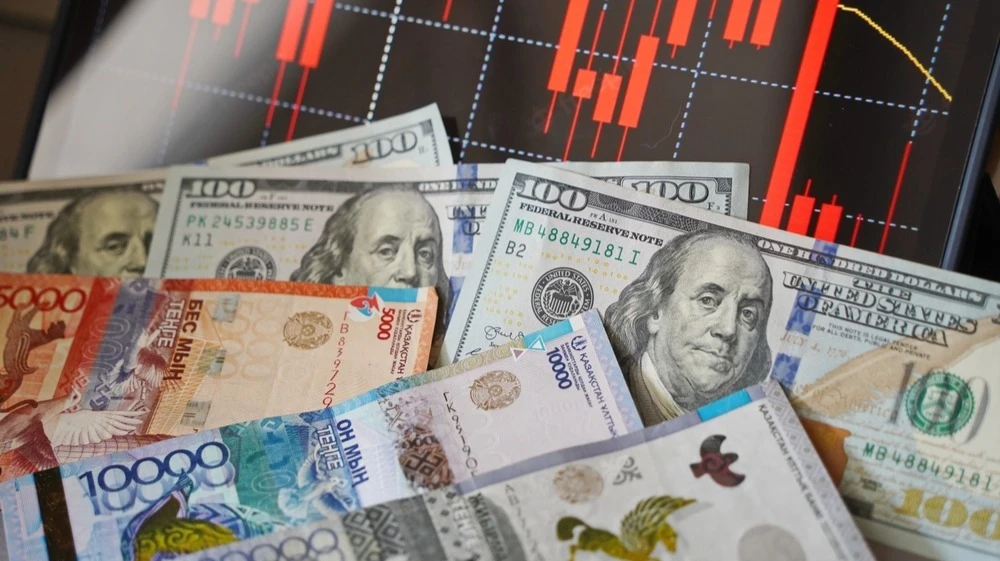
Investors who bought Kazakhstani bonds at the end of 2025 are now reaping double returns. Photo: Vladimir Tretyakov / Shutterstock.com
Kazakhstan remains one of the most attractive markets for carry trades in the post-Soviet space. However, the wide interest rate differential is no longer such a clear-cut argument in favor of this strategy. Potential returns remain substantial, but the margin of safety has narrowed significantly, and currency risks are becoming increasingly important, writes Dmitry Dolgin, ING’s chief economist for the CIS, in a column for Oninvest.
Let’s start with the formal criteria. Kazakhstan does indeed look attractive, as the interest rate differential remains high. If we consider a relatively long-term horizon—around one year—we can use key interest rates as a benchmark. In Kazakhstan, the rate stands at 16.75% per annum, while in the U.S. it is 3.75%, resulting in a substantial 13% difference—exceeding the yields of most instruments available in developed markets.
And this spread will most likely persist. Central bank policy is currently quite inertial. It is unlikely that interest rates in the U.S. and Kazakhstan will change by several percentage points all at once in the near future.
Thus, we can safely assume that the carry trade strategy will remain break-even if the tenge does not depreciate by more than the same 13% over this period. However, for Kazakhstan, this is not a particularly large margin of safety. It corresponds to a rise in the dollar’s value to only 520–525 tenge. The market saw such levels quite recently—at the end of 2025—and a repeat of this scenario cannot be completely ruled out. In other words, even based on the baseline scenario, the strategy turns out to be quite risky.
The Carry Trade: Both a Springboard and a Risk
From the perspective of exchange rates, there is also an opposite scenario: investors who bought Kazakhstani bonds at the end of 2025 can now buy the dollar for less than 470 tenge and are counting on a double return. But it’s important to remember that their entry into the market was itself one of the reasons for the tenge’s appreciation since October. The rise in oil prices occurred later—in 2026. Similarly, in May, during another spike in the exchange rate, we saw an outflow of just $89 million—following a comparable inflow a month earlier—but even that was enough to trigger a reaction in the foreign exchange market.
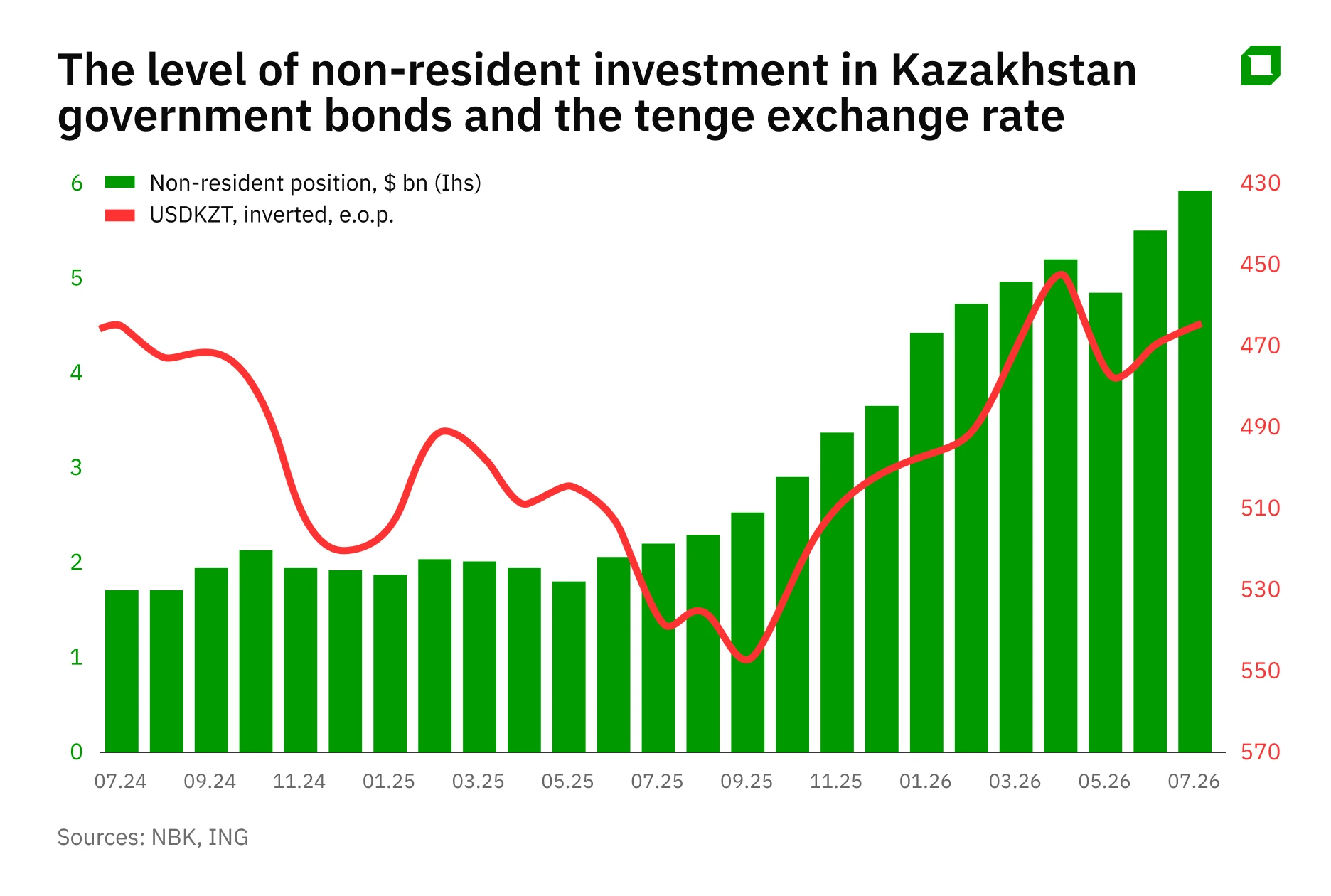
A peculiar paradox arises: investors benefit from the tenge’s appreciation, yet they themselves are one of the causes of that appreciation. And this is precisely what makes capital inflows a source of risk: those who received windfalls upon entry will have to pay the price upon exit. This is not unique to Kazakhstan: such a risk exists in any open capital market. It is generally believed that the share of non-residents in the country’s government securities market is small—about 9%. But over the past year, it has doubled, and this increase has already affected the exchange rate. This factor has become more significant.
That said, the impact of the carry trade should not be overestimated. In Kazakhstan’s balance of payments, portfolio investments continue to lag in scale not only behind direct investments but also behind opaque capital flows classified under “errors and omissions.” Also more significant are the foreign exchange transactions of the National Bank of Kazakhstan and the government: in July, the inflow of non-resident investments in government securities amounted to $321 million. By comparison, transactions by the government and the quasi-sovereign sector in the same month resulted in $811 million in net foreign exchange sales, even after accounting for foreign exchange purchases to meet the needs of the Pension Fund. Therefore, the dynamics of portfolio investments remain a tactical rather than a strategic factor for the tenge.
Competition for Capital
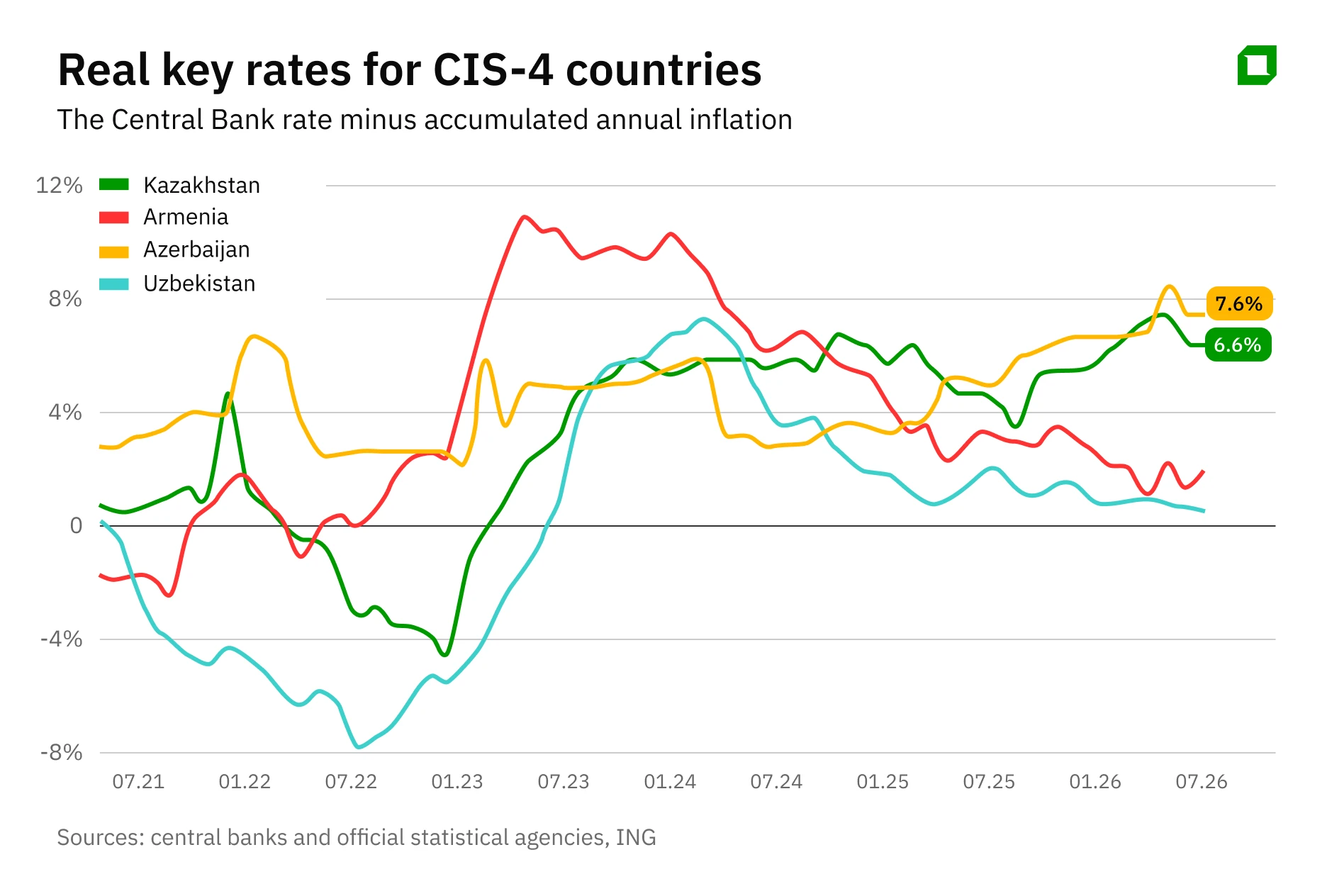
It is important to consider Kazakhstan in the context of international competition for capital. The closest comparable country is Uzbekistan. The two countries are similar in terms of real interest rates—that is, the difference between the key interest rate and inflation: 7.6% in Uzbekistan and 6.6% in Kazakhstan. This is a significant advantage, for example, over Azerbaijan and Armenia, where similar indicators are in the range of 1–2%.
Kazakhstan is currently the largest open economy in the post-Soviet space: it has relatively high financial market liquidity, freer capital flows, and lower barriers to entry for investors. Finally, compared to a broader group of countries with high real interest rates—such as Turkey— Kazakhstan is perceived as a country with low domestic and foreign policy risks, where investors have fewer doubts about the central bank’s ability to pursue a consistent monetary policy.
However, this does not imply that a large-scale inflow of capital is inevitable. For most international funds, such markets represent a small, niche portion of their portfolios. This is true even for emerging markets, let alone frontier markets. Therefore, it is hardly worth expecting that Kazakhstan’s comparative advantages alone will trigger a flood of investment.
A major source of vulnerability for Kazakhstan (as well as Uzbekistan) from the perspective of a global portfolio investor is its negative current account. If you add up the trade balance and dividend flows, the result is a negative balance. This is not a problem in and of itself—many countries import more goods and services than they export. However, Kazakhstan and Uzbekistan have persistent deficits despite their high-margin resource exports. Part of the revenue goes to foreign investors in the form of dividends, and part is consumed by imports.
This makes the foreign exchange market dependent on unpredictable capital flows, which often places an additional strain on government reserves in developing economies. Over the past ten years, there has been only one year when the government did not have to draw on the reserves of the National Bank and the National Fund to cover the current account deficit. That was 2022, when oil prices rose sharply and Kazakhstan received an additional inflow of capital from Russia.
A more balanced situation is achieved when the public sector does not have to systematically prop up the foreign exchange market with its own reserves. Despite the costs, Kazakhstan has managed to maintain high levels of central bank reserves and sovereign wealth funds thanks to oil and gas tax revenues, investment income from the National Fund, and rising gold prices. However, this does not help to strengthen capital inflows from the private sector and foreign investors.
Rates have been lowered; there are no longer any rates
An additional source of profit for investors in domestic bonds can be an increase in their prices: when market interest rates fall, investors become satisfied with lower yields to maturity. The driving force behind this process is the central bank’s monetary policy: an actual or expected reduction in the key (base) rate serves as a signal for growth in the bond market.
Under current conditions, we cannot count on a global decline in interest rates. While expectations for stable interest rates prevailed in key markets at the end of last year, the shocks of 2026 related to the situation in the Middle East have led to growing expectations of some increase in rates.
This does not mean that there is absolutely no room for rate cuts in Kazakhstan. It is worth noting that the nominal interest rate, even after the recent cut to 16.75%, remains high relative to inflation, and the inflation trajectory is outperforming initial expectations, despite the recent VAT increase. However, the National Bank has made it clear that the potential for further cuts is extremely limited because inflationary risks remain high. This refers to both growing private demand and government stimulus through entities such as the “Baiterek” investment holding and other quasi-sovereign institutions. Additional pressure is created by so-called “cost-push inflation,” including rising fuel prices, increases in regulated utility rates, and imported inflation. In the latter case, Russia and China play a significant role, as they together account for 60% of Kazakhstan’s imports.
There is also a positive trend—rising oil prices—which can be seen as a factor supporting the exchange rate, which in turn helps keep inflation in check. However, this supportive factor alone can hardly be called reliable. Furthermore, in recent years, the correlation between oil prices and the tenge exchange rate has been only about 30%.
Therefore, at a time when the world’s major central banks are tightening monetary policy due to inflationary risks, it is difficult to expect Kazakhstan to move in the opposite direction. In the near term, we can expect symbolic rate cuts of up to one percentage point, which will not have a significant impact on investment returns.
Oil Risks
None of this means that investors should rush to sell their Kazakhstani bonds. Kazakhstan has substantial reserves, even excluding its oil funds, which allow it to comfortably smooth out short-term fluctuations in the foreign exchange market. In the coming months, a possible pause or even a reversal in portfolio investments could be offset by actions taken by the National Bank and the National Fund. For example, the 4–5% depreciation of the tenge in May fell within the normal range of volatility for the domestic market and did not, in and of itself, require regulatory intervention.
At the same time, it’s worth remembering that no central bank can or will fight a long-term fundamental trend. For example, a one-time shutdown of the Caspian Pipeline Consortium (CPC)—which accounts for 80% of the country’s oil exports—is not a problem in and of itself. The problem lies in how long it might remain shut down—its operation directly affects how much the country earns from every dollar of the oil price.
The good news is that Kazakhstan has long been accustomed to volatility in oil exports. Shipment volumes often fluctuate for technical reasons. In 2025, exports reached a historic high of 76 million metric tons, whereas in 2021 they totaled only 66 million metric tons—about 15% less. In the first half of 2026, even before the issues surrounding the Port of Novorossiysk, oil exports had already declined by about 8%. In other words, half of this potential decline had already materialized before any issues arose with the CPC, and this did not prevent the tenge from strengthening.
The experience of 2021, when the foreign exchange market was relatively stable, suggests that the market can absorb a roughly 15% decline in oil exports with relative ease. However, a more severe contraction could become a cause for concern. If the total downtime at the CPC extends to about two months over the course of the year, this will put more significant pressure on the balance of payments, and it would not make much sense to offset this by drawing down state reserves.
Therefore, the main question for investors today is no longer whether interest rates in Kazakhstan are high enough. They remain high. The question is whether the returns can offset the risks of the currency market. And while a year ago the answer seemed almost obvious, it is now becoming much less clear-cut.
This article was AI-translated and verified by a human editor