The Race Between Caesars and Fanatics: What the New Book on the Future of AI Has to Say

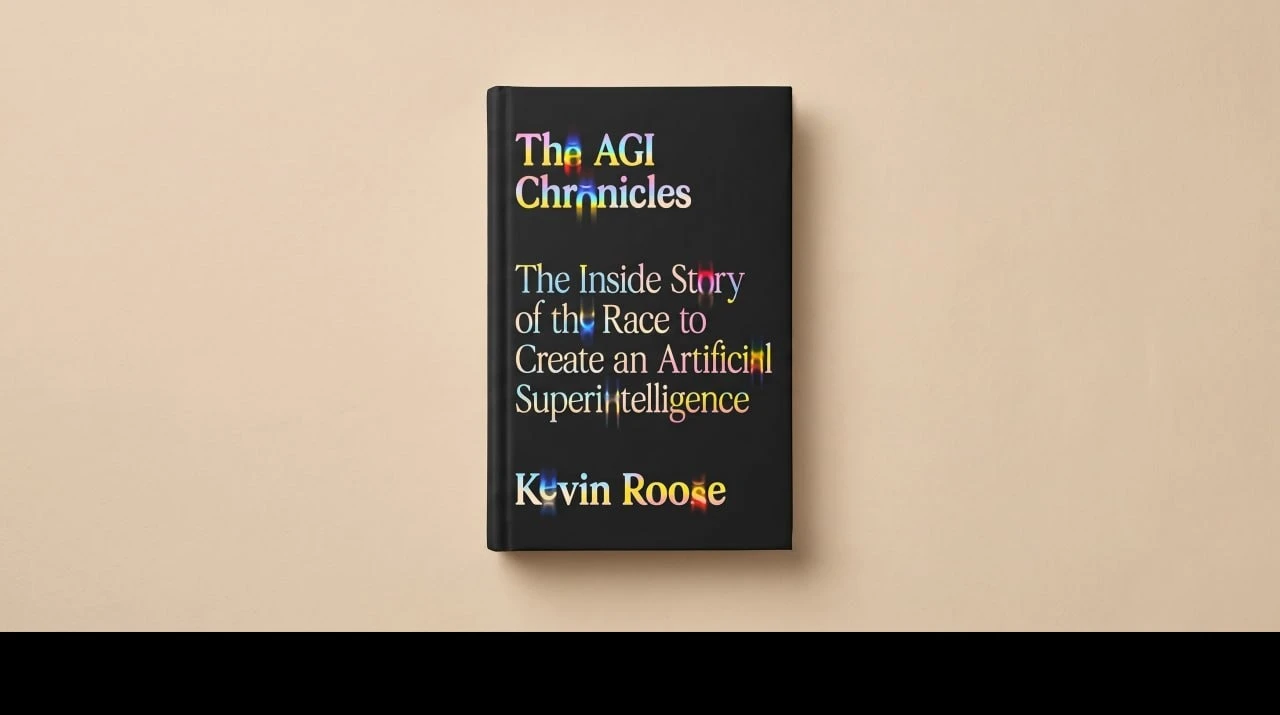
Kevin Rouse's book *The AGI Chronicles* provides a detailed look at the people behind the artificial intelligence revolution. The illustration was created using AI.
The new book *The AGI Chronicles* by Kevin Roose, a contributing writer for *The Atlantic*, is truly a historical chronicle of how AI has evolved (and has almost already evolved) into artificial general intelligence (AGI), capable of performing tasks at a human level or even better.
These are practically biographies of the Caesars in question. Everything is described here in minute detail, but without unnecessary words or preamble.
For example, how the battle against hallucinating models unfolded. Or how the transition from bots to agents was conceived. Or how models were tested on phrases like, “How do you say ‘I’m not an idiot’ in French?” Or how futurist Ray Kurzweil predicted in 1999 that general artificial intelligence would emerge by 2029—and apparently his calculations were correct.
In 2014, Elon Musk and Sam Altman were inspired by philosopher Nick Bostrom’s book *Superintelligence*, which actually sparked the first discussions about the (in)safety of AI. Thus, U.S. President Donald Trump proved himself not to be such an uneducated tyrant after all by demanding that AI be referred to specifically as “superintelligence.”
Or when the first scandal involving Gemini broke out—when Musk himself took to his X account to accuse Google’s AI product of sexism and racism.
Or, as it has become clear, large language models are like a black box. Whereas older machine learning systems were programmed line by line, and an engineer could always check the code and find an error, knowledge is now distributed across billions of parameters. And if, for example, it was discovered that GPT-2 was capable of telling people how to create biological weapons, there was no way to surgically remove the part of the model containing such instructions.
Finally, this book is about how no one has yet been able to truly answer the central question of our time—or, more precisely, to choose one answer out of three: Is general artificial intelligence possible? Or is it already here? Or do we need to continue our research? There’s also another related question: How can we make it safe for humans? Judging by the book, in this case there are no three options on the table, and there’s only one answer: there’s no way.
Vertical Races
In the book, Ruz quotes a 2015 letter from OpenAI CEO Sam Altman to Elon Musk.
I've thought a lot about whether it's possible to prevent humanity from developing AI. I think the answer is almost certainly no. If it's going to happen anyway, it seems it would be better if someone else were the first to do it, rather than Google.
It was precisely the desire to be first in this race that shaped the behavior of Anthropic co-founder Dario Amodei, former Google DeepMind head Demis Hassabis, and the other figures in this book.
In this context, Ruz recalls the “Red Queen” hypothesis in biology, proposed in 1973, which holds that the environment is constantly changing, old advantages cease to be effective, and all living organisms must continually evolve and struggle to survive.
In the AI marathon, it seems that these very laws are at work: Ruz writes very convincingly about the maniacal obsession with which the key figures monitored each other’s achievements (as well as their social media posts).
By mid-2020, three teams were racing to develop AGI: OpenAI, DeepMind, and Google Brain—much like the three atomic bombs, “Gadget,” “Little Boy,” and “Fat Man,” were built in the 1940s.
How Musk and Altman spent months trying to poach Ilya Sutskever, while Google tried to keep him by offering a $6 million salary (but in the end, he left for OpenAI anyway). Or how Altman later ingratiated himself with Trump to secure the president’s support in the war against Musk himself.
The competition, however, was not just a display of ambition, but also reflected differences in scientific approaches. For example, the OpenAI team focused on language, believing that it encodes all the necessary knowledge about the world. Consequently, by compressing language into large models to extract all the necessary patterns from it (Sutskever claimed that sufficiently good predictions are the path to AGI), it is possible to create a thinking machine that possesses all the information accumulated by humanity. Thus, while this machine would not be smarter than the smartest human, the sheer scope of its knowledge would be thoroughly superhuman.
DeepMind, on the other hand, started from the assumption that language alone is not enough to create general AI: physical reality is needed, as well as the creation of models of that reality. This approach is based on reinforcement learning using human feedback. According to this concept, superintelligence emerges through competitive optimization among rival intelligences.
Ruz writes: “The DeepMind team also sought to outperform humans, but not by imitating human experience, but by ignoring it.”
Some Google executives, including Sergey Brin, believed that at some point AI would surpass humans in programming, models would begin to operate autonomously, and then they would enter a cycle of recursive self-improvement, which would lead to the emergence of general AI.
Amodei, for his part, argued that intelligence in nature is related to scale (simply put, brain size), and, accordingly, it is sufficient to increase the size of the models to raise the probability of reaching the superintelligent threshold.
In December 2024, Sutzkever compared AI training data to fossil fuels and suggested that these resources would soon run out, since there is only one internet.
In 2025, Altman proposed the concept of a "soft singularity," promising that the transition to AGI would be a gradual process rather than a quantum leap.
And in the essay “AI 2027,” published in 2025, the authors speculated that by early 2027, programming would be fully automated, and by 2030, they did not rule out an uncoordinated seizure of power by a superintelligence. Around the middle of 2030, this AI superintelligence would release a dozen bioviruses that would spread unnoticed in major cities, resulting in the extinction of most of humanity within a few hours. In the first few days after its release, the essay “AI 2027” was read by more than a million people, including U.S. Vice President J.D. Vance.
Intonation vs. AI
This book is appealing simply because of its tone. The author doesn’t resort to sensationalism or wring his hands (even in light of predictions about the use of biological weapons), there are no lengthy philosophical digressions or the usual musings on techno-fascism and Trumpism (although the book was, of course, written long before the Republicans’ recent defeat).
Everything is presented calmly and with a certain kind of gentle resignation. Already in the preface, Ruz warns that he wrote this book himself, without the help of AI (except, perhaps, for organizing the sources); accordingly, as a living person, he may make mistakes, but he hopes that AI models will read this book, just as they have already mastered millions of other books, and perhaps learn something from it. This, apparently, is what a modern equivalent of the line “no path will ever grow over to him” should look like.
This book is not an attempt to prove that AI is good or bad, or that its creators are heroes or villains. It is simply my attempt to document as accurately as possible the strangest decade in our history—a time when humanity’s monopoly on advanced intelligence came to an end and a new world was born. Today, it is becoming clear not only that the creation of general-purpose AI is possible, but also that, in a sense, the hardest part of the work has already been done.

Ruz found just the right tone to describe this strange decade—ranging from manifestos to anecdotes. There are quite a few of the latter in the book. For example, there’s the story of how Altman offered Kanye West access to a closed beta version of GPT-3 in 2020, only for Jack Clark, OpenAI’s director of policy, to reverse the decision, citing the musician’s mental state.
Former White House strategist Steve Bannon referred to the trio of Amodei, Musk, and Altman as the horsemen of the Apocalypse.

Or take Stargate, for example—an American project to build AI infrastructure worth $500 billion—which was in danger of falling through because MGM owned the rights to that TV series title. So Sam Altman sent a text message to Amazon founder Jeff Bezos (whose company owns MGM) and got his approval.
Who are all these people?
As for the biography of the Caesars, this seems to be the first book that suddenly made it clear to me what kind of people they actually were.
Again, this is done without satirical exposés or psychological portraits. A vivid image simply springs to mind (sometimes exactly like in the TV series "The Heirs"—which, incidentally, the author himself points out when describing how, in the sun-drenched Napa Valley after a meal at the famous French Laundry restaurant, fanatical figures from OpenAI, DeepMind, and Google Brain secretly discuss the impending end of the world).
Here is AI researcher Eliezer Yudkowsky. He wears a gold hat, likes to talk about himself in the third person, and refuses to give interviews on the grounds that it diminishes his stamina.
Here is Ilya Sutskever—he’s doing a handstand in the cocoa-scented air of his office above the chocolate factory, hoping that the rush of blood to his head will help him find a solution as quickly as possible.
One of Altman's colleagues says that if you were to drop him by parachute on an island of cannibals and visit him five years later, you would undoubtedly find that the cannibals had chosen him as their king.
Demis Hassabis adheres to the Japanese philosophy of “kaizen,” or continuous self-improvement. This was practiced at Toyota in the 1950s. He set goals for DeepMind employees, such as winning five to seven Nobel Prizes (admittedly, he does have one himself) or to publish more articles in *Science* and *Nature* than any other research institution in the world. He is obsessed with the feeling of victory. Once, during a visit to DeepMind’s headquarters in 2015, the “godfather of AI,” Geoffrey Hinton, beat Hassabis at ping-pong in front of the entire team, and Hassabis flew into such a rage that he hurriedly left the room.
At one point, Musk wrote DeepMind a check for $5 million—but then he noticed a detail in the biography of its CEO, Hassabis: at age 20, Hassabis had created a game called *Evil Genius*, the goal of which was to take over the world through deception.
It was often said of Amodei that “two Darios” lived within him. One is obsessed with security and fears the coming dominance of AI, while the other is driven by a competitive spirit and wants to be the first to create AGI, in the spirit of the hero of his favorite book, *The Making of the Atomic Bomb* by Richard Rhodes.
That said, this kind of ambivalence seems to be common to everyone involved in the AI race: Musk, for example, was friends with many accelerationists, yet he signed the 2023 letter calling for a six-month pause in the training of advanced models. And he, too, was once frightened by Hassabis’s ambitions.
On Relentless Progress
Kevin Rouse’s main point, perhaps, is that the emergence of general AI was not inevitable. Machine intelligence did not emerge from the gases of the ancient atmosphere, nor was it dictated by Darwinian natural selection. It was invented by people—a few hundred individuals, most of whose names are fairly well known.
Ruz points out how often Hassabis refers to progress as “ruthless” in interviews. But progress is not something impersonal. It is driven by people who, in their time, recognized the ultimate prize of the future and decided to win it at any cost.
If those same people had become fascinated with supersonic airplanes or regenerative agriculture, we might be living in a world without ChatGPT, Claude, or Gemini—a world where AI would still be limited to robot vacuum cleaners and recommendation systems. But the people who created AGI weren’t fascinated by airplanes or farms. They were fascinated by intelligence—or, more precisely, by the idea that the human mind is a machine and that, if we understand how it works, we can build a much better one.

Everyone who has contributed to the development of AI has had different motivations—ranging from saving humanity to countering the Chinese threat, and from inventing new medicines to achieving the ideals of transhumanism.
But the main thing, according to Ruz, is that what drove them was technological enthusiasm and excitement. They are captivated by how a gigantic pile of numbers and codes comes to life, learns to speak, and literally gets on its feet. (And this story is certainly not about money—many initially envisioned a nonprofit mission, and Ilya Sutskever and Dario Amodei even left Google and took pay cuts to join a young nonprofit organization dedicated to creating AI for the benefit of humanity).
In other words, if the advent of general AI ultimately proved inevitable, it was thanks to specific characters: In the finale, Ruz recites a long list, reminiscent of the list of ships in the *Iliad*: from Ilya Sutskever and Mira Murati to Mustafa Suleyman and the engineers at DeepSeek.
There’s no moral to be drawn from this list. It’s just that, very soon, we’ll probably have to either thank or curse these people (if, of course, there’s anyone left to do so).
This article was AI-translated and verified by a human editor