U.S. equities slide at the open on Friday as Brent crude tops $115
The VIX, known as Wall Street’s “fear gauge,” has entered territory associated with heightened volatility

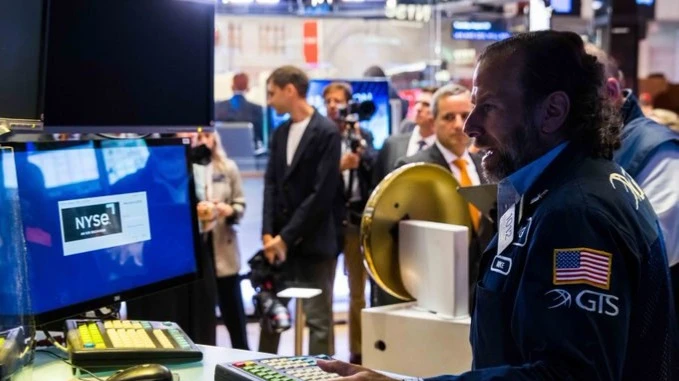
Photo: X / NYSE
All three major U.S. stock indexes opened lower on Friday following Thursday’s sharp tech selloff. The broad-based S&P 500 lost 0.6%. The tech-heavy Nasdaq Composite, coming off its worst day since June, retreated another 0.5%. The blue-chip Dow Jones Industrial Average dropped 1.2%. The VIX, known as Wall Street’s fear gauge, continued to climb, rising 7% and crossing above 20 points, a level reflecting heightened volatility.
The selloff in AI stocks eased somewhat, giving investors a reprieve in the final trading session of a volatile week, Bloomberg notes. They remained reluctant to make big bets, however.
Meta shares, which fell 7% on Thursday, dropped another 1.6% at the open. Investors are concerned that growing corporate debt and rising interest rates will weigh on hyperscalers and other companies benefitting from the AI boom. CoreWeave, which has become the poster child for aggressive borrowing to fund data center development, plunged 10% on Thursday and opened Friday’s session down 0.5%.
Chip stocks were on the rebound, with Micron Technology and AMD gaining 2.0% and 1.2%, respectively.
Situation in the oil market
Rising oil prices are also weighing on stocks and keeping investors cautious, CNBC reported. Amid growing fears of new escalation in the U.S.-Iran conflict, futures for international benchmark Brent crude pushed 1.8% higher on Friday, topping $115 per barrel. U.S. benchmark West Texas Intermediate futures jumped 2.2% to $101.60 per barrel.
The market was reacting to reports that the U.S. and Israel may be drawing up plans for renewed strikes on Iran. Iran’s army chief said the country’s armed forces were fully prepared for “asymmetric warfare,” CNBC reported.
Iran’s Islamic Revolutionary Guard Corps stated on Thursday that four vessels in the Persian Gulf had been struck and caught fire, CNBC reported, citing Iran’s Tasnim news agency. It also claimed that three other vessels had hit mines in the Strait of Hormuz. U.S. President Trump said Tehran was “making up fake hits, mines, and everything else, because more oil is coming through the Hormuz Strait now than it did even prior to the beginning of the conflict.”
On Friday, the UAE closed some beaches after detecting an oil spill from a tanker in the Persian Gulf north of Dubai, Bloomberg reported. Meanwhile, Saudi Aramco told employees to evacuate its Dhahran headquarters and work remotely following a series of attacks by Iran-backed Houthi rebels from Yemen, sources told Reuters.
What analysts say
“Equity markets are likely to calm only once U.S. hyperscalers can show that surging AI revenues justify the buildout,” said Wolf von Rotberg at Bank J Safra Sarasin. “The bar has certainly risen, with credit markets showing increasing signs of stress and a decreasing willingness to fund additional capex.”
Investors’ reluctance to take on risk is likely to persist through at least the first half of November, BofA strategist Michael Hartnett reckons. Markets have yet to fully price in a Democratic victory in both chambers of Congress in the midterm elections. Such an outcome would end the current low-tax, low-regulation regime, weighing on corporate earnings growth, Hartnett believes. “We stay tactically risk-off until mid-Nov,” the strategist warned in a note to clients. “Expect down-in-yields, down-in-stocks, down-in U.S. dollar trade.”
“When you have these big corrections like the one we saw over the last few days, particularly overnight, in semiconductor stocks, I think it is a good opportunity to buy them,” Mark Matthews, head of Asia research at Julius Baer, told Bloomberg TV. “Demand still massively exceeds supply.”
Yardeni Research head Ed Yardeni described the extended rally in AI stocks as a “bubble” but said some deflation could be healthy. “Taking some air out of the AI bubble is a good thing. I don’t think it’s going to burst and create problems for the economy,” the market veteran argues.