"We do not accept the language of force": Iran's president in New York pushed back against Trump's threats
The outlook for the conflict is of paramount importance to the oil market

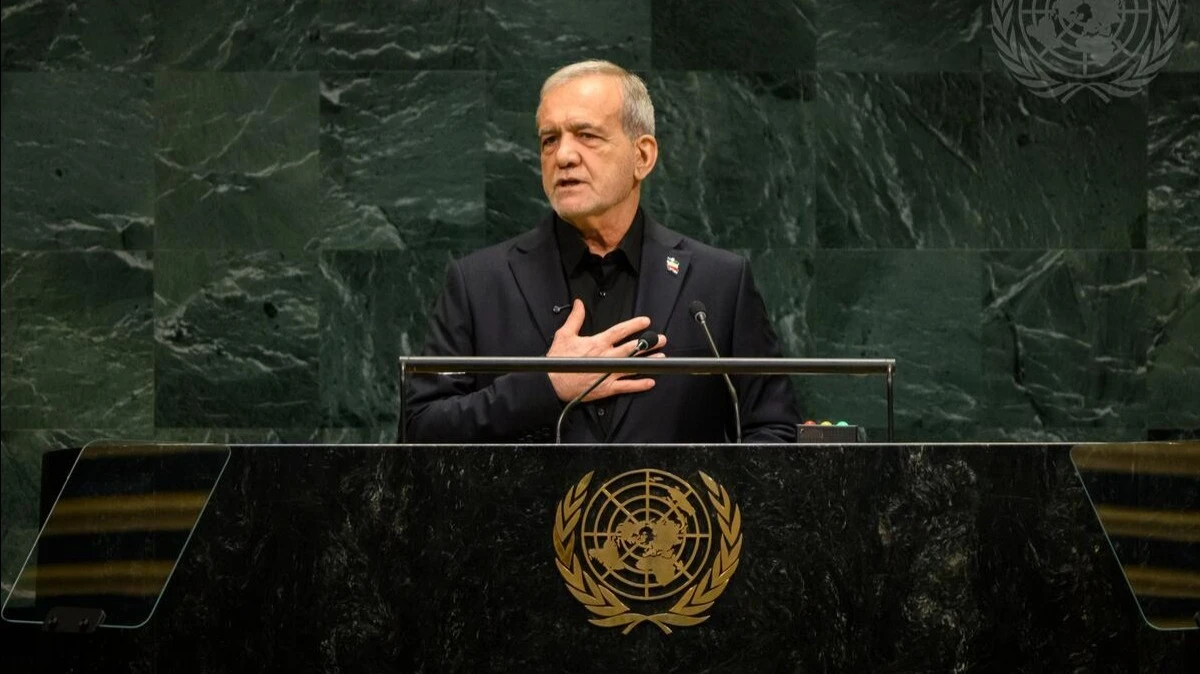
Iranian President Masoud Pezeshkian addressed the UN a day after Donald Trump had threatened his country from the same podium / Photo: UN Photo/Loey Felipe
Iran will not allow free navigation in the Strait of Hormuz as long as sanctions against it and the U.S. naval blockade remain in place, said Iranian President Masoud Pezeshkian in a speech at the UN General Assembly in New York. Politika cites Bloomberg. Pezeshkian’s remarks underscore the difficulty of reaching a peaceful agreement between Washington and Tehran, despite attempts to resume negotiations, the agency notes.
Details
“We are ready for negotiations, but we do not accept the language of force,” Pezeshkian said (as quoted by the Financial Times). According to him, Tehran is not interested in developing nuclear weapons but will not renounce its right to peaceful nuclear energy for economic development, Bloomberg reports. U.S. President Donald Trump is demanding an end to Iran’s nuclear program.
Peseschkian spoke at the UN podium a day after Trump’s speech. The U.S. president said that the United States had two options in this conflict: to reach an agreement on Iran’s nuclear program or to launch a full-scale bombing campaign against the country. Trump also claimed that Tehran would agree to a deal after the U.S. midterm elections in November, after which “oil prices will plummet.” Later, the U.S. president reported “very good” talks between the American and Iranian delegations on the sidelines of the General Assembly.
Oil Price Fluctuations
The course of the U.S.-Iran conflict is of critical importance to the crude oil and petroleum products markets. Hopes for progress in the negotiations led to a drop in oil prices to a two-week low on September 22, despite Trump’s threats against Iran.
But on Wednesday, September 23, the price of Brent crude jumped by nearly 4% and once again exceeded $103 per barrel. Among the reasons was a new attack on a vessel in the Strait of Hormuz: a cargo ship caught fire after being struck, Bloomberg reports, citing the UK Maritime Trade Operations (UKMTO).
At the same time, diesel futures in Europe jumped 7% following Trump’s statement that he supports a ban on diesel fuel exports from the U.S., the agency reports. The U.S. has become a major supplier of diesel amid shortages caused by disruptions to oil refining in the Middle East and Russia. In August, Europe imported 506,000 barrels of U.S. diesel per day, the Financial Times reported, citing data from Kpler.
“It would be a disaster. Europe will try to replace [supplies from the U.S.] by raising prices, but Latin America will also be competing for those same barrels. This is a vital resource for their economies, so countries like Brazil cannot afford to be without it,” said Eugene Lindell, head of refined products analytics at FGE NexantECA, in an FT report. He doubts that the Trump administration will impose a complete ban. But if that happens, the expert expects that the governments of other countries and the International Energy Agency will quickly release new volumes from their strategic reserves.
The loss of U.S. diesel will not lead to a shortage at gas stations, since it accounts for only 20% of Europe’s demand, but prices will rise sharply because they “are very sensitive to the availability of imports,” added Benedict George, head of European petroleum products analysis at Argus Media, according to the FT.
This article was AI-translated and verified by a human editor