A Left or Right Turn: What Investors Are Watching Ahead of the French Presidential Election

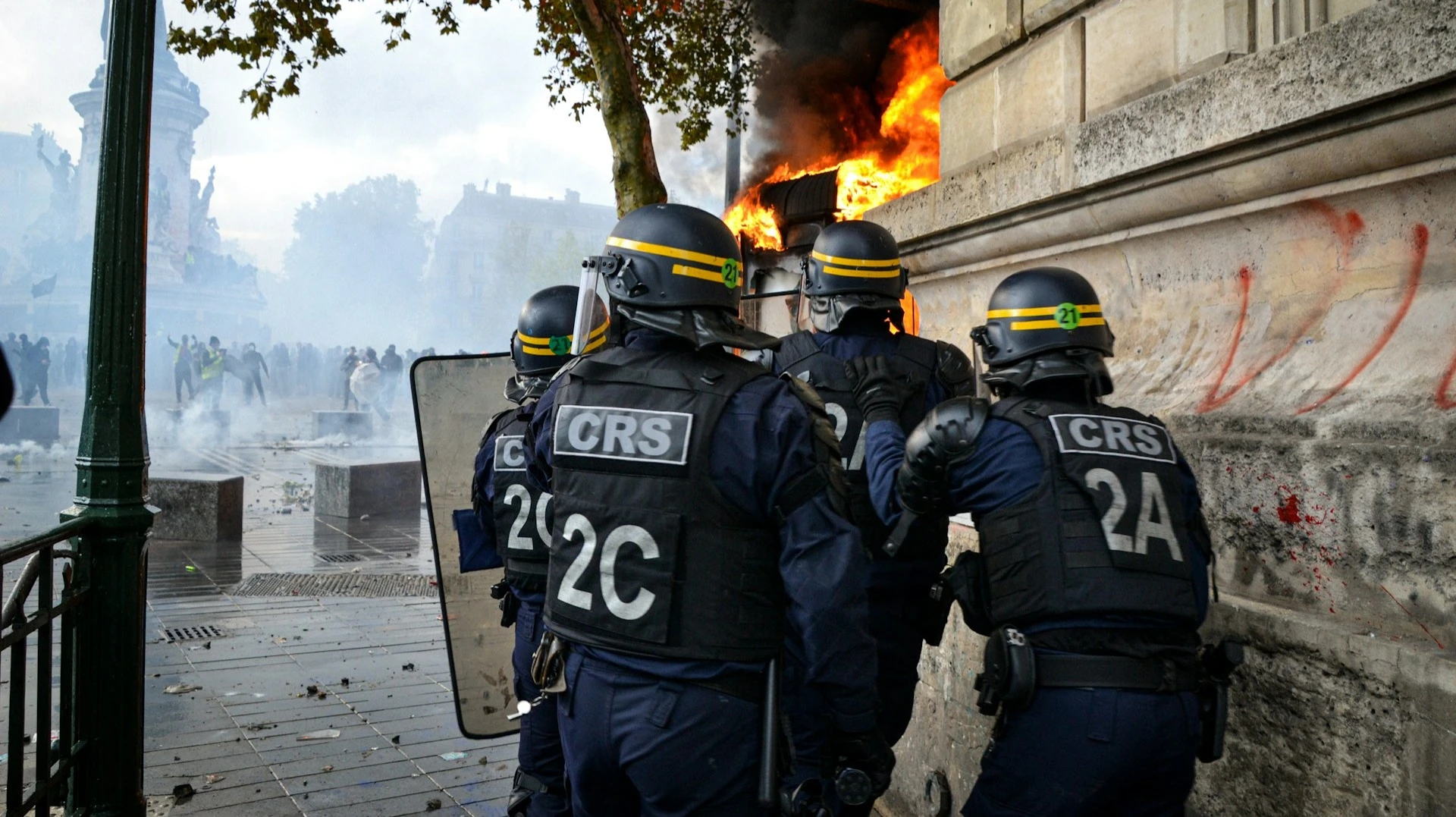
Nationwide demonstrations in France have escalated into riots. Photo: Unsplash / Pierre-Louis Mièze
Far-right politician Marine Le Pen and her rival from the opposite political camp—far-left candidate Jean-Luc Mélenchon—have capitalized on the protests in France over the rising cost of living. Both are vying for voters’ support in the upcoming French presidential election, scheduled for April 2027. They propose different solutions to help France emerge from its debt and economic crisis. What can investors expect from each of them?
From Student Protests to Looting and Riots
In September of this year, protests began in France by students and government employees; the former were dissatisfied with the shortage of teachers and the poor condition of schools, while the latter opposed the government’s proposals to freeze salaries and limit pension adjustments.
A peculiar form of protest also unfolded in the markets. Investors staged a sell-off of French government bonds. They were “protesting” the rise in public debt and the budget deficit, as well as the uncertainty surrounding the government’s plans to cut spending.
On Wednesday, October 21, the yield on 10-year French bonds reached 5% for the first time since 2002.
Nationwide demonstrations eventually escalated into riots—with property damage, looting of stores, and cars set on fire. According to Reuters estimates, the initial negative impact of these events on France’s GDP could amount to 0.1–0.2 percentage points. In 2025, the country’s GDP totaled just under €3 trillion.
In a research note dated October 20, Bloomberg Intelligence points out that, in addition to direct costs, potential short-term economic consequences include a decline in consumer confidence and spending, delayed investment decisions, and a blow to the tourism sector, which plays an important role in the French economy. Overall, analysts warn that the social unrest of recent weeks, if it continues, will act as a drag on the French economy.
Investors are also not encouraged by the possibility of political fragmentation in the country following the presidential election, which will not make the process of cutting budget spending any easier, according to Moody’s Ratings analysts cited by Reuters. The agency is set to update France’s rating on October 23—it currently stands at Aa3, but with a negative outlook. As the publication notes, this means that the next step will most likely be a downgrade of the country’s rating. Fitch, for its part, maintained its A+ rating with a stable outlook on August 28. On September 18, Scope Ratings downgraded France’s rating to A+ but changed the outlook from negative to stable.
The Campaign on Riots and Public Finances
Jean-Luc Mélenchon, leader of the far-left party “Unbowed France,” and Marine Le Pen, head of the far-right party “National Rally,” took advantage of these protests.
Both plan to run in the French presidential election and enjoy strong voter support, according to Helsingin Sanomat, which cites public opinion polls. The unrest is polarizing voters and bolstering support for both candidates with radical views, the publication notes.
According to Polymarket data as of October 20, the market estimates Le Pen’s and Mélenchon’s chances of winning the election at 46.5% and 11%, respectively. Odds on Le Pen have been rising since September 28, increasing from 38.4%. Meanwhile, the market viewed Mélenchon’s chances more optimistically nearly a month ago—at 14%. According to the WSJ, citing a poll by Toluna Harris Interactive, Le Pen would easily defeat Mélenchon in the second round of the election, winning 67% of the vote to his 33%.
Helsingin Sanomat summarizes the candidates' positions in simple terms as follows: Mélenchon wants to take money from the rich, and Le Pen wants to take it from immigrants.
Le Pen wants to restrict foreigners’ access to social benefits, housing, and jobs in favor of French citizens. A key principle of her platform is “national priority,” which she intends to enshrine in the Constitution. Among her proposals is an additional fee of €1,000 per year on employers who hire workers who are not citizens of the EU, the EEA, or Switzerland.
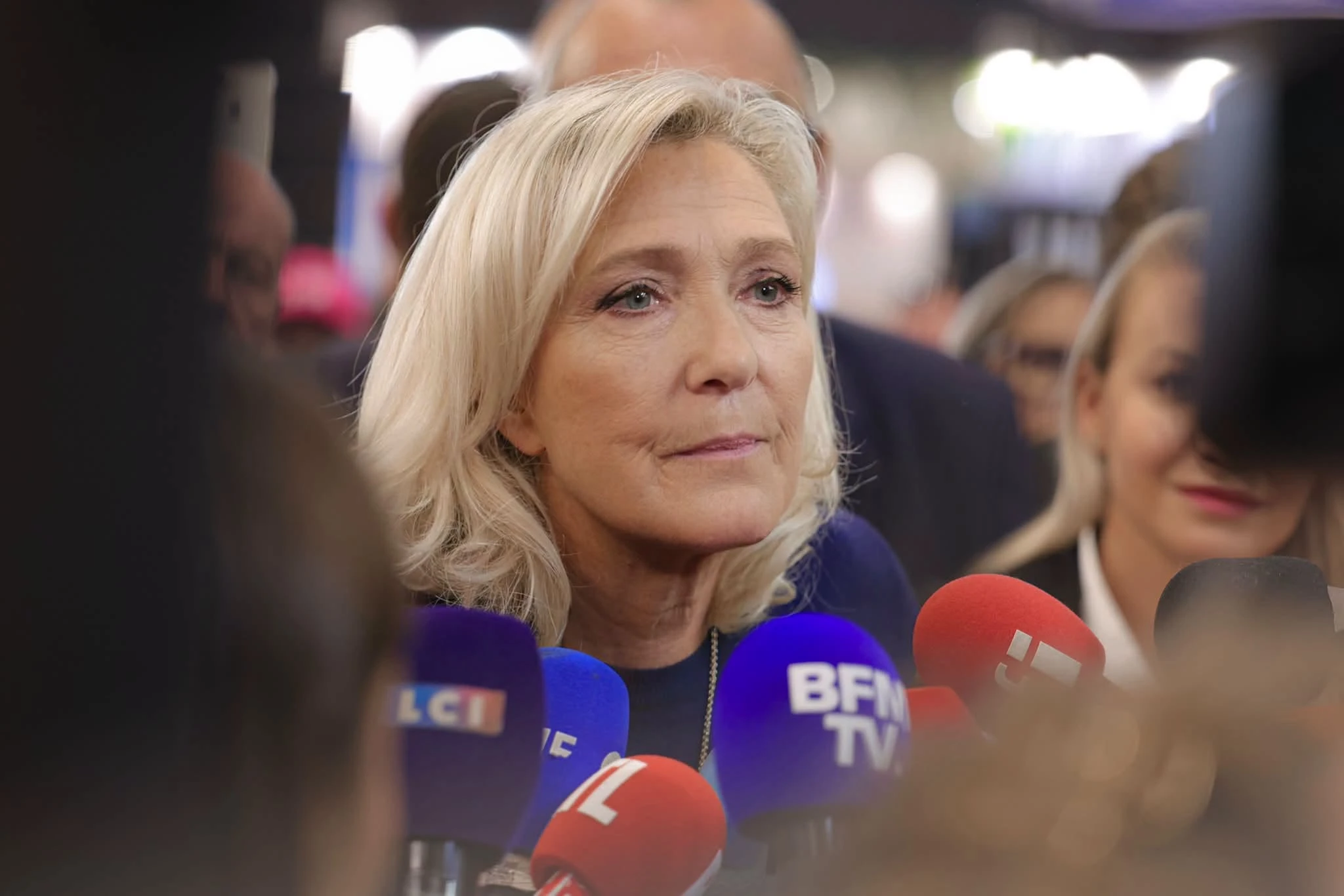
Marine Le Pen. Photo: Facebook / Marine Le Pen
Furthermore, based on her statements, she believes the country needs a budget adjustment of €140 billion by 2032 compared to 2026. She proposes enshrining a “golden rule” in the Constitution to limit France’s budget deficit and reduce it to less than 3% of GDP by 2030 and less than 2.5% by 2032. By the end of 2026, the deficit is expected to stand at 5.4% of GDP.
She also proposed cutting corporate production taxes by €20 billion, introducing tax credits for small businesses to invest in automation, and replacing the tax on large real estate holdings with a 30% tax on financial assets to boost investor confidence, according to Reuters.
In an interview with the Financial Times, Le Pen stated that the EU is waging an energy war against Russia, which will cost Europe dearly, and promised to stop providing financial aid to Ukraine during the first six months of her potential presidency, since “France can no longer afford such expenses”. Another point in her plan is to reduce France’s contributions to the EU budget.
Melenchon, for his part, according to the WSJ, wants to raise the minimum wage, set price caps on fuel and essential goods, lower the retirement age to 60, and introduce a wealth tax for individuals with a net worth of at least €100 million. He also proposes large-scale investments in “green” technologies to restructure the economy. According to the WSJ, one of Mélenchon’s most controversial ideas is his proposal to freeze or cancel €488 billion in French bonds held by the Bank of France, although this measure would significantly reduce France’s debt-to-GDP ratio and ease pressure on its finances.

Jean-Luc Mélenchon. Photo: Facebook / Jean-Luc Mélenchon
“The high school students’ protests are a real godsend for Mélenchon,” said Olivier Costa, a research professor at Sciences Po in Paris and the National Center for Scientific Research. According to him, the 75-year-old politician is trying to portray himself as a candidate of the youth. He has joined student marches, drawing parallels between them and the storming of the Bastille at the start of the French Revolution.
However, Mélenchon's strategy of appealing to young people may not pay off.
As Bloomberg Intelligence notes in a research note dated October 20, citing a Sciences Po study, a generational divide regarding democracy is deepening in France. Contrary to popular belief, young people are not losing their political engagement or interest in politics. However, they have a different understanding of the role of the state and express their political views within that framework, according to Sciences Po analysts. Young people are showing a decline in confidence in democracy’s ability to govern effectively and meet citizens’ expectations. This “could pave the way for new forms of radicalism characterized by polarization at both extremes of the political and party spectrum,” the researchers suggest.
In addition, Bloomberg Intelligence notes that recent outbreaks of violence could weaken Jean-Luc Mélenchon's position and boost support for Marine Le Pen.
What's Happening with Public Finances
At the end of the summer, France's National Institute of Statistics and Economic Studies (INSEE) revised its forecast for the country's GDP growth this year from 1% to 0.5%.
By mid-summer 2026, France's national debt stood at €3.6 trillion, or 119% of the country's GDP.
Servicing this debt is currently the largest item of budget expenditures, and these costs are rising. In addition, social obligations are also increasing. As a result, by the second quarter, the level of expenditures was approximately €4.5 billion higher than at the end of 2025. At the same time, despite an increase in revenue from VAT and social security contributions, total revenue remained approximately €1.9 billion below the level recorded in the fourth quarter of 2025.
Unless government policy changes, France’s budget deficit will continue to rise rapidly due to increasing spending, which will inevitably fuel the growth of public debt, warn the authors of a report by the Mission for Transparency in Public Finances. This is a special expert group established by the French government in May 2026. The report was published in July of this year.
France’s public finance problems did not arise overnight. As Olivier Garnier, an associate economic expert at the Montaigne Institute, points out, the country’s public debt-to-GDP ratio remained below 60% until the early 2000s. But after the global financial crisis of 2008–2009, it jumped to over 80%, and then, during the pandemic and the energy crisis linked to the conflict in Ukraine, it spiked a second time. According to data from the French Ministry of the Economy, the public debt-to-GDP ratio stood at 97.9% in 2019, reached 111.9% by the end of 2022, and now stands at nearly 120%.
"The Worst-Case Scenario"
Analysts at Natixis CIB previously noted that the risk specific to France is already largely reflected in government bond market prices.
According to Reuters, investors are becoming increasingly concerned about France's ability to "restore its fragile finances."
Furthermore, it appears that they do not approve of any of the platforms put forward by the potential frontrunners in the presidential race.
In Le Pen’s case, investors and economists may be concerned about the feasibility of her plans, which include simultaneous tax cuts and spending reductions, as well as a possible deterioration in France’s relations with Brussels. In the case of Mélenchon, on the other hand, concerns center on a potential increase in spending and a greater burden on business and capital.
“The markets are far more concerned about a possible victory by Le Pen than by Mélenchon,” said Emmanuel Roman, CEO of the asset management firm Pimco, in an interview with Le Monde on October 7, 2026.
He explained that he considers the likelihood of Mélenchon's election to be very low, while he estimates Le Pen's chances to be above 50%. At the same time, he stated that the markets would react extremely negatively to a Mélenchon victory as well.
"A showdown between Mélenchon and Le Pen in the second round of the presidential election is the worst-case scenario," said Philippe Pouletti, head of the Paris-based venture capital firm Truffle Capital.
Natixis CIB predicts that, until the election results are known, volatility in the French market will remain high, and the markets will continue to be sensitive to political developments. If the government fails to cut budget spending sufficiently or if political uncertainty increases, yields on French government bonds could rise further.
This article was AI-translated and verified by a human editor