AI agents are creating a new market. How can investors profit from it?
Meta, OpenAI, and other major technology and financial companies are actively developing a new sector—the agent economy

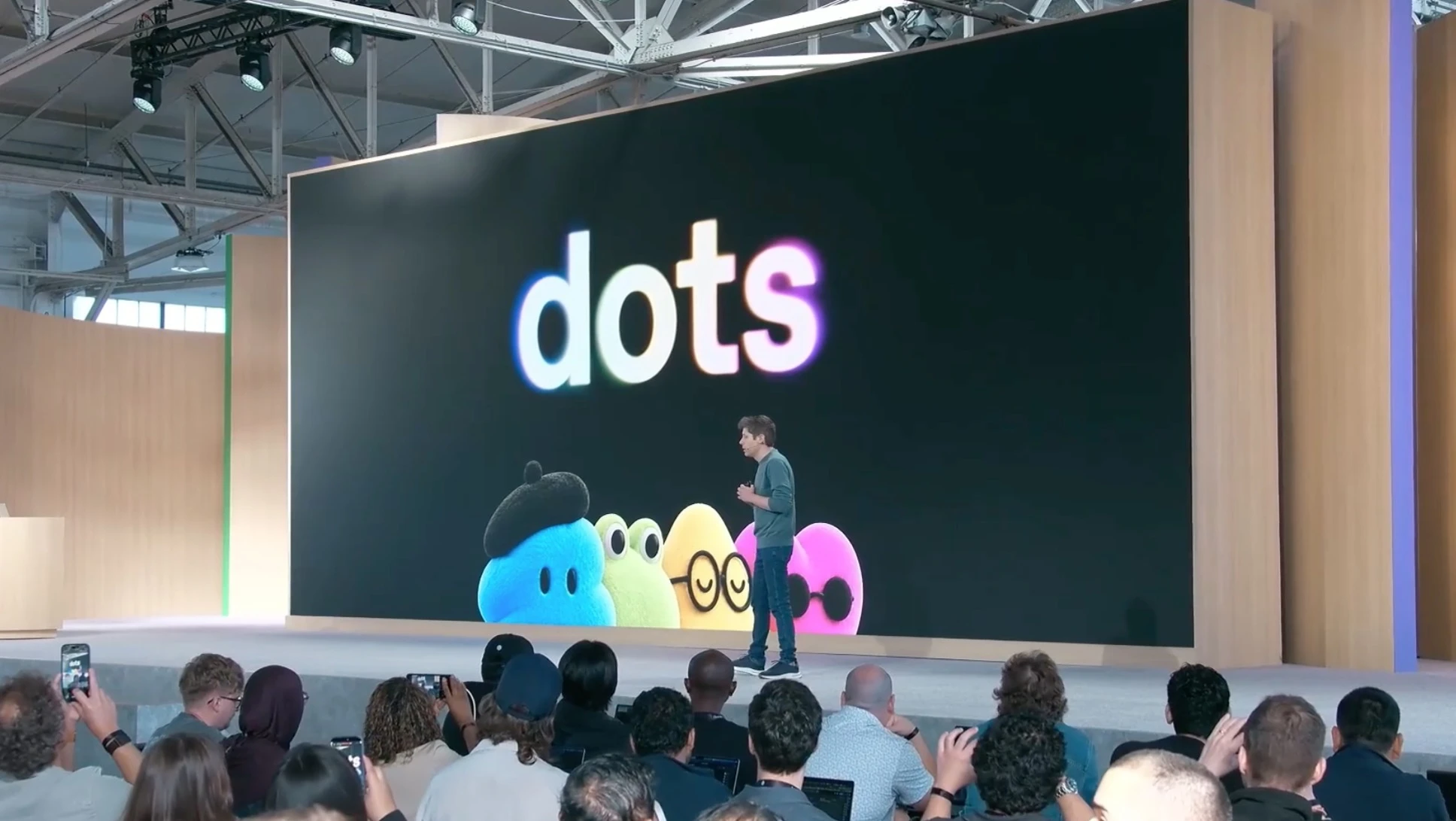
On September 29, OpenAI CEO Sam Altman unveiled the Dots AI agents. Meta had previously launched Muse. Photo: a screenshot from the OpenAI presentation
September was full of news from the world of the agent economy. Meta introduced Muse, an AI agent capable of managing schedules, making purchases on marketplaces, finding customers, and helping to organize business processes. OpenAI released the Dots line of agents—they can program, create and send invoices, interact with apps, work in messaging apps, and more. The brokerage Robinhood has allowed retail investors to connect AI agents to monitor trades and execute transactions by launching a corresponding service within its app.
For investors, the emergence of AI agents signals the emergence of a new sector of the economy. Evgeny Shatov, a partner at Capital Lab, explains when this market will reach full capacity and how to profit from it.
What AI Can Do
It has been nearly four years since the first public version of ChatGPT was released. During this time, the AI chatbot has become just as commonplace a tool for work as Google Search once was. The number of ChatGPT users has surpassed one billion, and the number of companies using AI in their operations is growing every day.
And while everyone has already grown accustomed to intelligent chatbots that have replaced the first level of technical support, businesses are still only just preparing for the introduction of full-fledged AI agents that will replace not only individual employees but entire departments.
AI agents are capable of working independently with software and databases, performing specific actions—such as sending emails or booking hotels—as well as more complex, specialized tasks, such as searching for new office space.
However, there are still many obstacles and questions standing in the way of implementing such smart assistants. Can we trust the final result? Who is responsible for any errors? How can we configure the agent’s operations so as not to compromise the organization’s cybersecurity? Furthermore, not all processes within organizations are formalized and stable, especially when it comes to multi-step tasks. This means that agents’ work still needs to be reviewed, and certain aspects of their activities need to be monitored—including for potential leaks of sensitive data.
Agent to Agent
To fully realize the economic potential of generative AI, two conditions must be met: first, consumers and businesses must widely adopt AI assistants and agents. This process has been underway for several years. According to a McKinsey study published in August of this year, 40% of companies worldwide with revenue exceeding $1 billion reported scaling up their use of AI agents, compared to just 27% a year earlier. About one-third of respondents reported that they had decided against purchasing at least one app or paid feature in a program because they were able to do what they needed themselves—using AI agents to generate code.
Second, these agents must interact with one another to facilitate transactions. The technical infrastructure for such interaction is already largely in place, and the first solutions are already in use.
However, there is not yet a fully-fledged “agent market” where independent AIs from different companies can freely find one another, negotiate, and conduct transactions on behalf of users.
The technical foundation is generally understood to consist of two main protocols: MCP (Model Context Protocol) from Anthropic, which standardizes how agents connect to data and tools, and A2A (Agent2Agent) from Google, which allows AI agents from different systems to communicate with each other and exchange tasks. Both are already supported by major technology companies, including Microsoft, AWS, Salesforce, and SAP.
However, issues related to commerce and trust remain unresolved: agent identification, verification of their authority, spending limits, legal liability, payments, and dispute resolution.
To this end, separate industry standards are being introduced—proposed by companies such as Google, OpenAI, Stripe, Visa, and Mastercard. However, this market remains highly fragmented, so a fully-fledged autonomous “agent economy”—where AI independently finds counterparties, negotiates, and executes transactions—has not yet taken shape. But the infrastructure for it is already being actively built.
Market Outlook
According to Gartner , by 2030, AI agents could transform the enterprise SaaS market: approximately 20% of spending on such software—or $234 billion—could be at risk of restructuring. Instead of traditional enterprise applications, people will increasingly opt for new AI tools capable of improving task efficiency.
Goldman Sachs expects that by 2030, the customer service software market could grow by 20–45%—thanks to AI tools and agents—reaching $780 billion. This corresponds to an average annual growth rate of approximately 13%, starting this year.
The Andreessen Horowitz report outlines scenarios in which AI agents could replace marketers, financial professionals, or sales managers (and the market seems to believe this: following the release of Meta’s Muse, shares of financial and brokerage firms fell). For example, using accounting software, financial management systems, and payment processing platforms, an AI agent can perform financial reconciliations, process invoices, detect fraud, and prepare budgets and financial reports that comply with regulatory requirements.

An NBER (National Bureau of Economic Research) study states that AI has not yet led to widespread job losses, but in professions where it can perform core tasks, hiring of new employees in the U.S. is already declining sharply. This primarily applies to software developers, as the latest versions of tools from OpenAI and Anthropic can handle most programming-related tasks.
Who will be able to profit from the transition to an agent-based economy?
Numerous studies have already been conducted on this topic, and most experts tend to agree that the bulk of the profits will most likely go not only to the developers of the models, but also to those who control the “decision-making points” and the infrastructure for transactions between agents.
For example, McKinsey believes that as search and shopping shift to AI interfaces, profits may be concentrated among platforms that control the data, recommendations, and the purchase itself. Analysts estimate that in the coming years, AI interfaces could be involved in 10–35% of online purchases—from product search to checkout.
In the advertising sector, this means a potential shift of part of the economy away from traditional advertising networks, agencies, and intermediaries toward AI platforms that manage the entire chain, from user intent to purchase.
The main beneficiaries could be companies that control the entire chain—from the user's request to the purchase.

One such example is Amazon. The company controls the AI agent, product catalog, payments, logistics, and advertising all at once. This spring, it merged the shopping assistant Rufus with Alexa+ into Alexa for Shopping. The agent can compare products, track prices, and place orders on its own. Amazon is also testing ads directly within conversations.
Google uses a similar model: the search giant links search queries to its own UCP order placement standard and displays commercial ads in AI Mode.
Meta doesn't have its own e-commerce infrastructure on the scale of Amazon's, but its AI agents help advertisers create ad content, set up targeting, and optimize campaigns—in other words, they do the work that agencies used to do.
Payment infrastructure companies such as Visa, Mastercard, and Stripe are already seeking to establish key positions in AI agent identification, payment authorization, fraud prevention, and dispute resolution.
Language model providers and cloud service providers will also benefit from the shift toward an agent-based economy, since AI agents require far more calls to resource-intensive LLMs than a typical chatbot.
For investors, this primarily involves three cloud giants: Microsoft with Azure, Amazon with AWS, and Alphabet with Google Cloud. Each of them stands to gain in two ways. First, they sell computing power to run the agents. Second, they are partnered with leading model developers: Microsoft is a major shareholder in OpenAI, Amazon and Alphabet have invested in Anthropic, and Alphabet also has its own family of models, Gemini. OpenAI and Anthropic themselves remain private companies for now, so the main way to participate in their growth on the stock market is through these partners.
Prospects for Government Regulation
Will regulatory agencies stand in the way of the transition to an agent-based economy? Individual countries may well slow down the adoption of AI, especially when it comes to finance, healthcare, security, and other sensitive areas. In the U.S., for example, the major players in the AI sector are trying to agree on voluntary restrictions.
But, by all accounts, it is already very difficult to stop the process itself. Therefore, rather than expecting the agent economy to come to a halt, we should expect it to become more heavily regulated: in some cases, human confirmation of actions will be required; in others, verification of the agent’s actions; and in still others, additional security systems.
Moreover, regulation itself could create another large market centered on AI security, control, and agent monitoring.
This article was AI-translated and verified by a human editor