OpenAI has released a suite of AI assistants called Dots. They are seen as a response to Meta's Muse agent.

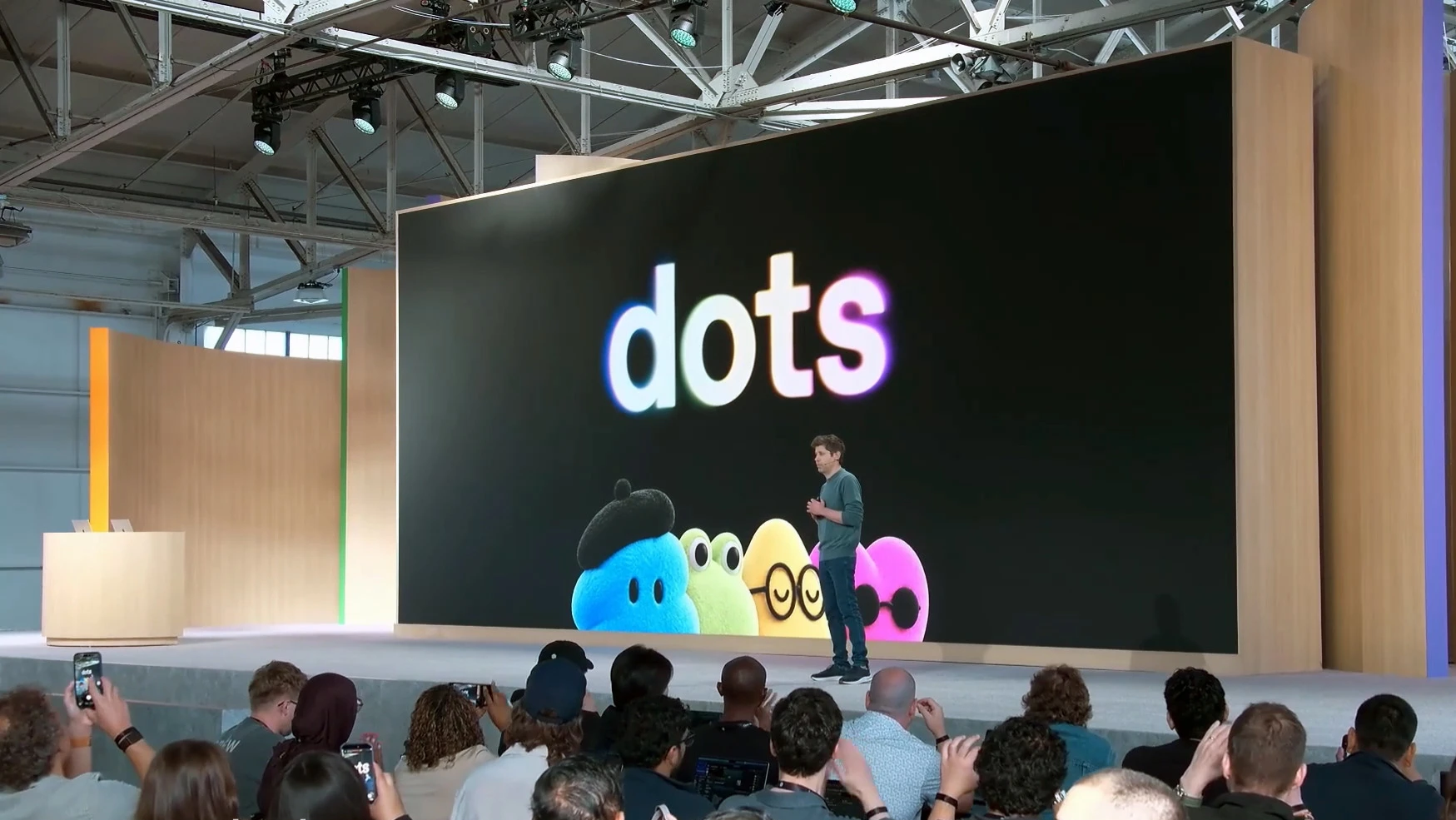
OpenAI CEO Sam Altman introduced the Dots family of AI agents, which will be able to perform tasks on behalf of users / Photo: still from the OpenAI presentation
Following the successful launch of Meta Platforms’ AI assistant Muse earlier this month, OpenAI has released its own response, according to Business Insider. At its annual developer event, DevDay 2026, the company unveiled Dots, a swarm of AI agents capable of independently performing tasks on behalf of users. The new product brings the startup into the growing market for AI-powered digital assistants, notes Bloomberg. In addition, the company’s CEO, Sam Altman, hinted that it will one day create a wearable device for interacting with AI.
Details
Dots agents are capable of controlling a computer and retrieving information from various connected applications to conduct research, prepare documents, and develop software, OpenAI announced on September 29. The company immediately made the new service available to paying users. In the initial phase, each account will have access to one “dot,” which will serve as an assistant. Over time, the AI giant expects that users will be able to manage multiple such agents simultaneously.
"Dots assistants will help users 'make their day better, work more productively, and maybe even get home earlier,'" said OpenAI CFO Sarah Fryar in an interview with CNBC. "It's the kind of assistant that can give you a pat on the back," she noted.
With Dots, you can assign tasks and interact with them via text or voice through ChatGPT, as well as through Slack or Microsoft Teams. In the future, it will also be possible to send messages to agents directly from your phone, the company said.
“It’s like an AI assistant that’s always there to back you up,” said OpenAI CEO Sam Altman during the presentation. He specifically highlighted the security measures: users will be able to set their own permissions to determine what information the service can access. “This allows you to give your Dot exactly as much responsibility as you’re willing to grant it,” Altman emphasized.
The company also announced that it is testing specialized Dots for corporate clients, specifically for email marketing, accounting, and legal analysis.
Dots runs on the GPT-6 version of the Astra model and is entering an increasingly crowded market for AI agents, which already includes services from Meta, SpaceX, and new startups, such as Instinct. In particular, Muse has gained popularity among consumers thanks to its ability to perform tasks such as online shopping and adding important dates from emails to the family calendar, according to Bloomberg. Meta’s AI agent Muse “seems like a good product,” Altman noted in an interview with CNBC, but he emphasized that he does not feel threatened by Mark Zuckerberg’s company, as he has complete confidence in Dots.
“I’m really surprised by how much this has changed my life,” Business Insider quotes Altman as saying. “I feel like I’ve finally regained some of my focus. I no longer feel as dependent on my phone as I used to. This is exactly how I’ve always wanted to work with AI.”
What else did the company announce?
OpenAI is revamping its subscription lineup: the company is launching a premium plan priced at $500 with higher usage limits and faster request processing speeds. At the same time, some limits for the $200 plan will be lowered.
Bloomberg reports that OpenAI is now working to lower the cost of using many of its models in order to attract more customers, while also gauging how much users are willing to pay for a subscription.
“When we launched the $200 plan, everyone thought we’d lost our minds—that no one would ever pay that much per month,” Fryar, the CFO, said in an interview with CNBC. “But we’re seeing more than just a willingness to pay more. In the consumer segment, they’re increasingly switching to a pay-as-you-go model [via API].”
Altman also unveiled an updated version of the Sol 6.1 AI model and ChatGPT Space, a collaborative workspace for teams to work with AI. At the same time, he announced the launch of the OpenAI Marketplace, which will allow customers to allocate funds already provided for in their contracts with the company toward partner products, according to Business Insider. In total, OpenAI announced more than 20 major innovations, the publication summarizes.

"Something worth waiting for" may soon be on the horizon in the world of AI devices, Altman hinted in an interview with CNBC. Former Apple designer Jony Ive is developing a wearable device for OpenAI, though there have been no official announcements yet. Meta has already unveiled its version of a “Tamagotchi” for the Muse agent.
“I’m not worried that we might not be the first to launch a new device. Developing this kind of equipment is very difficult,” Altman said. “New form factors for computing devices are extremely rare, and the quality standard we want to achieve—to create a device capable of becoming a crucial part of interacting with AI—is very high. This will take time, and we intend to do everything to the highest possible standard.”
Context
Technology companies have been trying for many years to create popular personal AI assistants—with varying degrees of success, notes Bloomberg. Today’s most advanced chatbots already fulfill this role to a large extent, particularly thanks to their growing ability to handle complex tasks. Now, AI giants are betting that more intuitive interfaces and integration with third-party apps will significantly expand the use of such services.
Like Meta, OpenAI has a massive audience that could help drive widespread adoption of a new product. On Tuesday, OpenAI announced that ChatGPT is now used by more than 1.2 billion people each week—up from 1 billion this summer.
The creator of ChatGPT is seeking to increase revenue and expand the use of its more advanced AI tools, while facing increasingly intense scrutiny over security concerns. A day before the conference, OpenAI announced that it had scrapped plans to release the GPT-6.1 Astra version, citing increased risks following a series of recent incidents involving unauthorized cyberattacks using AI. OpenAI describes the new GPT-6.1 Sol model, unveiled on Tuesday, as “close to Astra” in terms of capabilities.
This article was AI-translated and verified by a human editor