Amazon's stock price has fallen to a record low. Should you buy the company's stock?
Rosenblatt believes the threat to Amazon's online business posed by AI agents is exaggerated

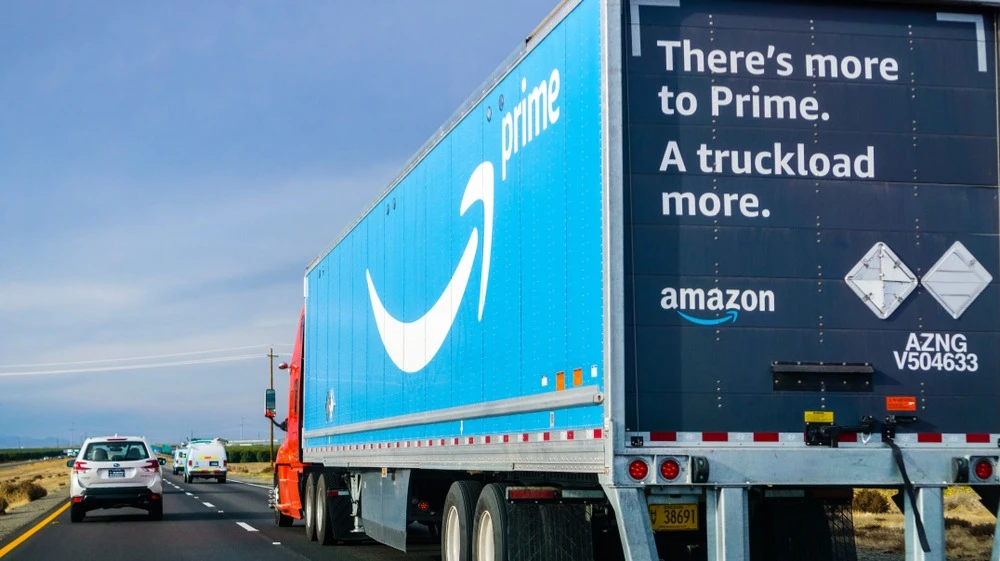
While Amazon’s stock is falling, shares of other “Magnificent Seven” companies are hitting record highs amid the AI frenzy / Photo: Sundry Photography/Shutterstock.com
Investors have regained interest in AI company stocks, but Amazon is not participating in this rally: The company’s P/E ratio has fallen to 20, an all-time low since it went public, noted Yahoo Finance Executive Editor Brian Sozzi, citing TrendSpider’s calculations. A lawsuit filed by U.S. authorities against Amazon’s advertising business and concerns about AI infrastructure costs are likely holding the stock back, Sozzi writes.
A Low P/E Ratio with Inflated Earnings
"Nvidia is trading at an all-time high. Its competitor, AMD, has just set a new record. Microsoft and Google have gained slightly over the past month. Meta’s stock jumped 23% amid the hype surrounding the AI agent Muse,” writes Sozzi. “Compare this growth to Amazon, whose stock has fallen 2.4% over the past month.”
Among the “Magnificent Seven” companies, only Alphabet has a lower P/E ratio than Amazon—17.7, according to Sozzi, citing data from Yahoo Finance AlphaSpace. This ratio reflects the relationship between the stock price and earnings over the past 12 months. Meanwhile, Amazon’s net income nearly tripled in the second quarter, reaching $62.6 billion.
However, the total included $53.4 billion in non-operating income, primarily from investments in Anthropic, according to the company’s report. Amazon owns stakes in the private AI startups Anthropic and OpenAI and is required to reflect the increase in their value in its quarterly financial statements. Microsoft and Alphabet reported similar paper gains in the second quarter. “The reported profits [of all three companies] were significantly inflated by the revaluation of their stakes in OpenAI, Anthropic, and SpaceX,” Gil Luria, an analyst at D.A. Davidson, told CNBC.
Two Threats
In early September, the U.S. Federal Trade Commission (FTC) and 22 states filed a lawsuit against Amazon. According to them, the company’s advertising practices have caused approximately 1.2 million advertisers to overpay $20 billion since 2019. The regulator claims that Amazon failed to disclose its reserve price mechanisms, which drove up costs for advertisers and consumers. Amazon responded by saying that advertisers derive greater value from the platform. Investors have adopted a wait-and-see approach: they fear that advertising, which currently generates substantial profits for Amazon, may become less profitable in the future, writes Sozzi.
Another risk involves AI assistants. Amazon recently banned Meta Platforms’ Muse agents from automatically browsing products and making purchases on its retail platform, according to Investor’s Business Daily. However, Scott DeWitt of Rosenblatt isn’t concerned about this: “As personal agents and AI shopping assistants shorten the path from product search to checkout, concerns are emerging that Amazon’s marketplace advertising model could be completely displaced. We believe this argument is flawed, and this isn’t the first time Amazon has faced pressure due to long-term shifts in consumer behavior.”
Demand is growing faster than expected
Spending on online shopping in the U.S. has been accelerating for the fourth consecutive quarter, which has come as a surprise to many investors, according to Bernstein. “It’s hard to argue with the improving metrics, but the reasons behind them are less clear, which makes the discussion of growth trajectories for 2027 interesting,” Bernstein analyst Nikhil Devnani wrote to clients on September 28.
At the same time, Amazon’s expenses are rising: following the second-quarter results, the company announced that it would significantly increase its capital expenditures this year—to approximately $220 billion. “We now estimate Amazon’s capital expenditures at $320 billion in 2027 and $370 billion in 2028. Accordingly, based on our new estimates, free cash flow in each of those two years will turn negative by approximately $50 billion,” warned Evercore ISI analyst Mark Mahaney, as quoted by Yahoo Finance.
Wall Street Expects Stocks to Rise by a Third
On September 30, Rosenblatt Securities raised its price target for Amazon shares from $335 to $360, and on October 2, New Street raised its target from $350 to $385, according to MarketScreener. Both firms maintained their “buy” rating.
The consensus rating for Amazon remains the same. According to FactSet, it has not changed over the past three months. Not a single analyst recommends selling the tech giant’s stock. The average target price calculated by the service is $332 per share—which implies 32% upside potential relative to the closing price on October 5.
This article was AI-translated and verified by a human editor