"Buffett in a Skirt": How Hetty Green Built an Empire on Crises and Saved Wall Street

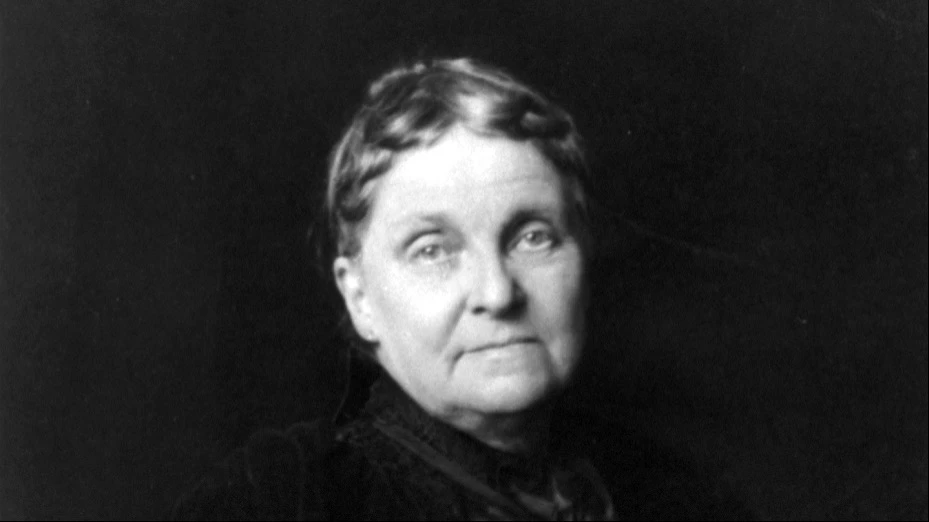
Hetty Green made her fortune during crises; she adhered to the principles of value investing even before Benjamin Graham was born—he was the one who systematized them. Illustration: Hollinger & Rockey, Public domain, via Wikimedia Commons
July 3 marked the 110th anniversary of the death of Hetty Green, the “Witch of Wall Street.” Even before Benjamin Graham was born, she adhered to the principles of value investing, which he himself later systematized. What lessons can modern investors learn from Green’s legacy?
Cassandra at the Beginning of the 20th Century
In 1907, at the height of the banking panic in the United States and as the Dow Jones Industrial Average had fallen by nearly half from its 1906 peak, Wall Street’s wealthiest people gathered at the mansion of financier and banker John Pierpont Morgan. Morgan urged them to provide funds to prop up the banking system. The only woman at the meeting was Hetty Green.
Green claimed that she had foreseen the panic of 1907 several years before it began, when wealthy financiers started coming to her wanting to offload their assets—from mansions to cars—and the New York Central Railroad Company sought a large loan. Green concluded that the financial system was becoming increasingly vulnerable and began building up her cash reserves. When the crisis hit, people from all over the country were coming to Hetty for money. She lent to banks at 6% per year, although, as she put it, she could have charged as much as 40%. At the height of the panic, Green lent the New York City government $1.1 million.
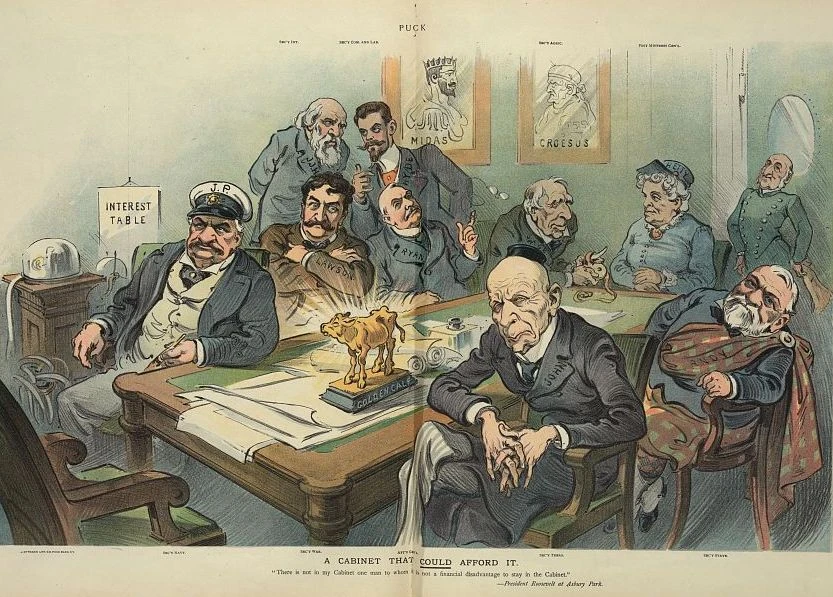
Cartoon from *Puck* magazine: Hetty Green is the only woman in a fictional U.S. “cabinet,” where the roles of politicians are filled by America’s wealthiest people. Source: J. S. Pughe, Public domain, via Wikimedia Commons
The media estimated her net worth at $100 million. Adjusted for consumer inflation, that would be about $3 billion today. According to Forbes’ calculations, Apple CEO Tim Cook has the same amount. But if we assume that Hetty’s fortune was roughly 0.2% of the size of the U.S. economy at that time, that share would now be “worth” $61.77 billion. In other words, she would rank between Dieter Schwarz, owner of the retail company Schwarz Group (No. 31) and Herman Larrea Mota Velasco, co-owner of the copper mining company Grupo México (No. 32 on the Forbes Real-Times Billionaires list as of July 8).
And one thing is for sure: if Hetty Green had lived in our time, her name would have been mentioned alongside those of Warren Buffett and other investment gurus. In an era when business and big money were run by men, she managed her own finances.
The Beginning: How Hetty Green's Fortune Was Forged
Hetty Green (née Robinson) was born into a family that actively invested in trade with China and owned a massive whaling fleet. There is an interesting fact connected to the foundation of her family’s wealth: Charles Slack, in his book *Hetty. The Genius and Madness of America’s First Female Tycoon, recounts that in 1860, at a ball, she met the Prince of Wales—the future King Edward VII of Great Britain—and introduced herself to him as the “Princess of Whales,” Princess of Whales. The prince appreciated the joke and asked her to dance.
In one interview, Green recalled that she had to learn the basics of investing from a young age:
My grandfather’s eyesight was failing, and so was my father’s. As soon as I learned to read, I took on a daily responsibility: to read the financial news from around the world aloud to them. That’s how I learned what stocks and bonds are, why markets fluctuate, and who are called “bulls” and “bears.” Even as a child, I would read stock market reports and trade announcements to my father, and he would explain everything I didn’t understand. In addition, I had to keep precise records of my personal and household expenses. Later on, all of this proved to be very useful: it helped me develop the habit of taking a responsible approach to money and my affairs at an early age.
At the age of 30, she inherited nearly $6 million from her late father. Despite her family’s objections, Hetty used the money to purchase greenbacks—Treasury notes issued during the U.S. Civil War to cover government expenses. The notes were not backed by gold, so the market viewed them with skepticism: their price fluctuated with news from the front. In July 1864, one gold dollar was worth 2.58 greenbacks. After the war, some investors still doubted that the American financial system would recover quickly. Hetty, however, bought up greenbacks in the U.S. and the U.K., counting on the country to recover and confidence in government money to return. Her strategy paid off: after the U.S. economy stabilized, the government bought back the banknotes from citizens at face value. Green earned $1.25 million.
"The Intelligent Investor" Before Benjamin Graham
In the 19th century, the largest fortunes in the United States were built primarily on industry and infrastructure: Carnegie made his fortune in steel, Rockefeller in oil, and the Vanderbilts in steamships and railroads.
Hetty Green grew her fortune in other ways. She invested in the stocks of railroad companies and other businesses, government bonds, and real estate, particularly in Chicago. In the final years of her life, she increasingly shifted from direct investments in companies to making loans backed by solid collateral, while also maintaining a substantial cash reserve to buy assets that had fallen in price during crises and to extend credit to those in need of liquidity. She took the same approach in real estate: she bought low, waited for demand to return, and sold high.
She carefully examined every transaction and did not fall for offers with abnormally high returns.
“Before making an investment decision, I seek out all the information I can about it. There’s no secret to building a large fortune. All you need to do is buy low and sell high, act prudently and carefully, and be persistent,” she said.
Hetty Green’s investment strategy—seeking out high-quality companies, avoiding overvalued stocks that rise on the back of speculative fervor, and conducting in-depth analysis of companies—seems to be straight out of Benjamin Graham’s book *The Intelligent Investor*, the “bible” of value investing. But Green had already begun investing and making money before Graham was even born.
“Hetty Green was the Warren Buffett in a skirt of her time,” wrote her biographer, Janet Wallach. “Like Buffett, she believed that financial crises present excellent opportunities for investors.”
Hetty Green's Corporate Wars
Hetty Green even made money off corporate takeovers. In 1886, a group of investors from New York was buying up shares in the Georgia Central Railroad Company in order to break up the business and gain control of the Savannah–New York steamship line. The company’s Georgia-based owners tried to fend off the takeover. Green, however, amassed a block of shares large enough to influence the outcome of the shareholder vote: she bought 6,700 shares of Georgia Central at $70 per share. At first, the New Yorkers offered to buy them back at $115 per share, but Hetty negotiated a price of $127.50 and sold the shares, securing her influence in the battle for Georgia Central.
Hetty wasn't afraid to take on even the most influential figures. For example, she took on Collis Huntington, one of the wealthiest American entrepreneurs of his time, who was part of the “Big Four”—the businessmen who built the western section of the first transcontinental railroad in the United States.
In 1887, Huntington attempted to reorganize the Houston and Texas Central Railroad on terms that were unfavorable to holders of the old securities. Small investors were powerless to act. Hetty held a large block of the company’s stock worth more than $1.25 million, and she refused to accept Huntington’s plan. When rumors spread in the market that Green did, in fact, support the reorganization, Houston and Texas Central’s stock rose to $40. This benefited Huntington above all: he had acquired a significant portion of his stake at around $10 per share. But then Green announced that there would be no deal, and the price plummeted to around $10.
For nearly a year, Hetty refused to support the reorganization, leaving Huntington’s plans in limbo and causing the stock price to fluctuate. In the end, he had to strike a deal on her terms. Huntington considered Hetty a personal enemy and called her “nothing more than a pawnbroker who’d made it big.”
Hetty Green retained her independence in managing her own fortune even after marriage. In 1867, when she married millionaire Edward Green, she entered into a prenuptial agreement with him that divided their estates. Subsequently, she repeatedly bailed her husband out of debts resulting from his risky speculations and extravagance.
Scrooge in a Skirt
The nickname “The Witch of Wall Street” didn’t come about solely because of her personality: “When Mrs. Green reappeared in New York, she was in mourning (following the death of her husband—Oninvest). For many years afterward, she was rarely seen on the street without a thick black veil. Perhaps it was this attire—no less than her personality and lifestyle—that led people to start calling Hetty the Witch of Wall Street,” writes her biographer Boyden Sparks.
The newspapers certainly reported on Green’s financial successes, but they preferred to discuss her stinginess: They wrote that she wore dresses until they fell apart at the seams, didn’t use hot water, and haggled over every cent in stores and cheap restaurants. While the wealthiest Americans were building mansions on Fifth Avenue, Hetty Green rented furnished rooms to avoid paying property taxes and rode public transportation.
That said, journalists also wrote about instances when she spared no expense: for example, in 1908, The New York Times reported that 74-year-old Mrs. Green paid $300 for a course of 21 rejuvenation treatments at a beauty salon—enough money to support an average American family for nearly a year.
It's hard to tell now what in these stories is true and what is fiction. Green herself claimed that she was a victim of the press.
“I’m not a cruel woman, but because I don’t have a secretary to publicize every good deed I do, people call me secretive, mean, and stingy,” she told reporters. “I am a Quaker and try to live in accordance with the tenets of my faith. That is why I dress simply and live a quiet life. I wouldn’t want any other way of life.”
What Hetty Green Taught Us
Hetty Green's story shows just how important a part of investment success can be the willingness to defy expectations—both market and social.
In an era when women were dependent on men, Green managed her own fortune. She refused to conform to the rules. In the marketplace, she relied on her own judgment and was willing to haggle over the terms of a deal. Amid the wealthiest Americans, who surrounded themselves with luxury, she lived modestly.
Hetty Green died on July 3, 1916, after suffering several strokes.
“The woman whose extraordinary business acumen enabled her to amass a fortune estimated at $100 million and made her name known in markets around the world met her death just as she had lived—fiercely and without fear,” — wrote The New York Times.
Almost all of her money went to her children. Her son Ned and daughter Sylvia used part of the funds for education, healthcare, and charitable projects. After their mother’s death, they donated more than $84 million to hospitals, libraries, universities, and private schools in the United States.
In 1922, Ned helped Dartmouth College launch an experimental radio station. Later, together with his sister Sylvia, he provided funding for the construction of Hetty Green Hall at Wellesley College. Sylvia also helped establish the Rockingham Memorial Hospital.
Ned's son was also eager to spend his inheritance: he collected antique books, rare stamps, and coins, and amassed a large collection of erotic art. He bought a large yacht for $1 million; two years later, it ran aground on a rock and sank.
This article was AI-translated and verified by a human editor