Concrete or a Presentation: How to Profit from Kazakhstan’s Investments in AI

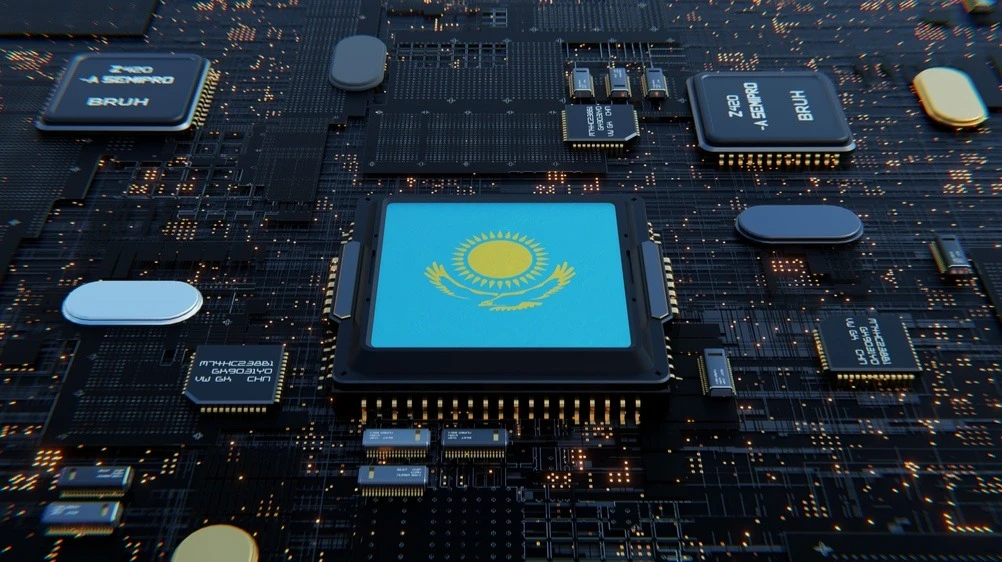
While the major powers keep each other in check, Kazakhstan is selling its neutrality to everyone. Photo: Shutterstock.com
In the space of a year, Kazakhstan has gone from being a spectator in the global AI race to a participant. In November 2025, a $2 billion memorandum of understanding was signed with NVIDIA: Freedom Holding, together with the new Ministry of Artificial Intelligence and Digital Development, is building a sovereign AI hub at a 100 MW facility, with OpenAI and Coursera announced as educational partners. In May 2026, the ministry, Kazakhtelecom, and the Emirati company Presight reached an agreement on a supercomputer cluster. In June, a “data center valley” was announced in the Pavlodar region: $10 billion in agreements with NVIDIA and Firebird, with the first phase—125 MW—valued at $5 billion. UBTECH’s first overseas plant is under construction in Almaty: the company promises to begin assembling humanoid robots in the first quarter of 2027. In May, air taxis took to the skies for the first time in Central Asia in Alatau City, and a memorandum was signed with the American company Joby Aviation for the purchase of vehicles worth approximately $300 million. Finally, the SKAI AI system was introduced to the board of directors of Samruk-Kazyna.
Second Export Circuit
The economic logic behind this shift is clear and appealing. Kazakhstan is attempting to leverage its fundamental advantages—namely, cheap energy, available land, and its location between China and Europe—to build a computing export industry. The government estimates the potential revenue from the “data center valley” at a minimum of $3 billion per year. For an economy where foreign exchange earnings are still dominated by oil, this is an attempt to build a second export stream—and to do so quickly. A data center can be built in two to three years; the same cannot be said for factories. The second advantage is geopolitical arbitrage. American chips, Emirati capital, Chinese robots: while the great powers keep each other in check, Kazakhstan sells its neutrality to everyone. The third advantage is the “regulatory showcase” effect. The region’s first test flight of an air taxi took place in Alatau City not because of any special aerodynamics there, but because it was permitted there. Light-touch regulation is becoming just as much of an asset as an oil well. There is also a less obvious advantage: knowledge transfer is built into the packages. Alongside the UBTECH plant in Almaty, an engineering and research center is being built, and the agreement with NVIDIA includes OpenAI, Coursera, and American universities. If these provisions aren’t just left on paper, the country will gain what it has lacked most of all—a school.
Respect for Risk
Now, let’s talk about what might be troubling about this seemingly well-oiled system. First—physics. Since the fall of 2021, Kazakhstan has been facing an electricity shortage: during evening peak hours, the shortfall reaches 1.3 GW, with the gap filled by imports from Russia. Against this backdrop, a campus with a capacity of one gigawatt has been announced in the Zhambyl Region. President Tokayev himself compared the power consumption of such a facility to that of a steel mill. Until new generation capacity is built, every megawatt for data centers competes with a megawatt for cities and businesses, and the cost of this competition will be reflected either in electricity rates or in the budget. The second issue is demand. It’s not enough to just generate computing power; it needs to be sold. The domestic market is small, and exports are limited by the capacity of major communication lines and the willingness of global clients to host their workloads in a jurisdiction sandwiched between Russia and China. Third is the status of the agreements. A significant portion of the high-profile figures consists of memoranda of understanding rather than binding contracts with delivery schedules. The gap between them is measured in years. The scale of the commitments also demands a prudent approach to risk: the announced $10 billion alone represents about 3% of GDP, and part of the burden will fall on the budget, either directly or through the quasi-state sector. Fourth is the workforce: the UBTECH plant and data centers need thousands of engineers, who will have to be trained or brought in. Fifth is the risk of “window-dressing” digitalization. The SKAI case is telling: the fund announced the region’s first digital board member with voting rights, but parliament later clarified that the system has no voting rights, and under the new law, AI is not a legal entity at all. The Investors’ Association warned of the risk that the board’s decisions could be challenged, and the matter even reached the Prosecutor General’s Office. When technology is implemented before the legal framework is in place, corporate risks are borne not only by state-owned companies but also by their minority shareholders.
How can I make money?
What should a private investor do about all this? The honest answer: there are almost no direct public investments in “Kazakhstani AI,” but there are plenty of indirect ones.
The most obvious proxy is Freedom Holding; it is the company building the hub with NVIDIA. It’s important to understand that, in doing so, you’re primarily buying into Timur Turlov’s brokerage and banking ecosystem, with its own concentration risks. The AI option comes as a bonus, and the stock could lose a double-digit percentage in a month. The second category consists of infrastructure beneficiaries in the local market. “Kazakhtelecom” is part of a cluster with Presight and owns the backbone network, without which the export of computing power would be impossible.
KEGOC (Kazakhstan’s national transmission grid operator—Oninvest) stands to benefit from any grid expansion scenario: a regulated dividend-paying business, which is the most conservative way to play this sector. Power generation is also a winner if tariffs allow for monetizing new demand. Kaspi is a different story altogether; it’s a bet on the application of AI in fintech, not on construction.
The third category consists of global stocks: NVIDIA, UBTECH, and Presight on the Abu Dhabi Stock Exchange. We need to be realistic here: for these companies, Kazakhstan is just a line item in the financial statements, a number after the decimal point. It makes no sense to buy UBTECH just for the sake of its Almaty plant; you should only buy it if you believe in humanoid robotics as an asset class.
The fourth option—which, in my view, is the most interesting—is the primary market. Bond issuances and IPOs by infrastructure operators on the AIX will almost certainly emerge in connection with the “Data Center Valley” and Alatau City. Foreign-currency-denominated infrastructure debt is a way to participate in the construction without assuming the full equity risk. People often ask specifically about real estate in Alatau City. This is the most speculative part of the story: the city currently exists mainly on paper in the master plan, there is no liquidity, and the time horizon is a decade. Such a purchase is closer to a lottery ticket than to an investment.
The practical rules are simple. The portion of such investments in the portfolio is venture capital—that is, the kind you don’t mind having tied up for five years. The tenge currency risk is still very much present. And most importantly, invest based on facts, not press releases.
I would keep an eye on three indicators: whether the memorandums are being converted into binding contracts and agreements for the supply of electricity; whether actual shipments of chips—which require U.S. export licenses—are taking place; whether the first export contracts for computing services have appeared. Kazakhstan’s strategy itself is rational: not building these facilities would have guaranteed that the country would remain a raw materials-based economy. But between a signed piece of paper and a functioning gigawatt-scale campus lie years of construction and new power plants. In this scenario, investors are rewarded for their patience and their ability to distinguish between concrete and presentations. This, of course, is not individual investment advice.
This article was AI-translated and verified by a human editor