Much Ado About Nothing: Does Kazakhstan Need a Factory to Produce Humanoid Robots?

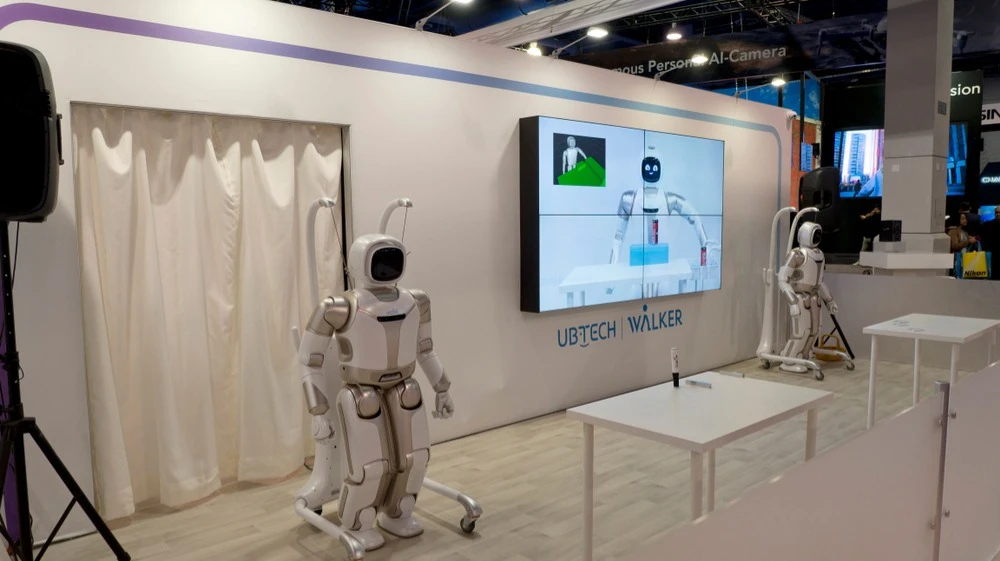
China's UBTECH is the first company in the field of humanoid robotics to go public on the Hong Kong Stock Exchange. Its industrial Walker S is already in use at automobile plants, but that isn't what drove the company's growth / Photo: Polina MB / Shutterstock.com
In July in Shanghai, in the presence of President Tokayev, the Almaty City Administration, Nero Robotics, and Zhou Jian, founder of the Chinese company UBTECH, signed an agreement regarding UBTECH’s first overseas plant.
Almaty will begin manufacturing robots—both humanoid and educational, as the project is publicly described. Production is set to begin in the first quarter of 2027; in addition to manufacturing, an engineering center and training programs for specialists have been promised. The investment amount has not been disclosed, and this is no accident: in the official list of Shanghai agreements, the document is listed as a cooperation agreement, not an investment contract. The scale, however, can be estimated based on similar cases: the existing NERO robotics plant was valued at 1.5–2.4 billion tenge (about $3–5 million), while UBTECH’s capital expenditures for all of 2025 totaled about $85 million across four facilities in China. We are apparently talking about amounts in the single-digit or, at most, double-digit millions of dollars—a project on a different scale than, for example, the AgiBot hub in Astana with its stated $200 million budget.
What exactly is being built?
Let’s start with the facts, because a figure is already circulating about the project that needs clarification. In January 2026, the government reported an annual production capacity of about 25,000 “units,” 80 jobs, and contracts signed to supply AI labs—the buyer of which has not been publicly named; the discussion centered on educational and service robots.
Let’s focus on the word “kits.” These are hardly full-size humanoids. Otherwise, the figure would be pure fantasy: the entire global market for humanoids in 2025 is estimated by IDC to be around 18,000 units. A “kit” here is more like an educational construction set: a computing module, a camera, sensors, and motors, from which a student assembles a robot and, without even realizing it, develops their own skills in programming, computer vision, and mechanics. The UBTECH UGOT kit can be assembled in seven configurations and is programmed in Python. An honest question for the project, therefore, should not be “how will you outpace the global market,” but rather “what is the product lineup of the kits?”
The participants are not random. NERO Group is an Almaty-based manufacturer of digital meters for water, heat, and gas: housing casting, circuit board soldering, calibration, and proprietary software. The meter business isn’t just a hype—it’s actually a testing ground for robotics: the same electronics, software, and service, just without eyes or legs. One detail remains to be clarified: in early reports, the partner was referred to as NERO Group, while the July agreement lists Nero Robotics; the connection between the two names has not been publicly explained.
UBTECH—a Shenzhen-based company and the first in the field of humanoid robotics to list on the Hong Kong Stock Exchange (December 2023); its industrial Walker S is already in operation at auto plants, but that wasn’t what drove the company’s growth. As early as 2024, humanoids accounted for less than 3% of revenue, and it wasn’t until 2025, when mass production of the Walker S2 began, that they became the main revenue driver—accounting for 41% according to the annual report published in March 2026. The rest still comes from logistics vehicles, consumer electronics, and educational kits. What we have here is not a “humanoid factory,” but a company with several product lines—and that’s normal: the histories of companies, like those of people, rarely begin with what they became famous for.
How the industry, of which Kazakhstan is a part, is structured
Most robots in operation do not resemble humans and do not claim to: a manipulator welds a car body; a cart transports containers. If the task is repetitive, a specialized machine is almost always cheaper than a humanoid. The point of a human-like form lies elsewhere. For centuries, we’ve built the world to fit our own anatomy—doors, stairs, shelves, tools—and a humanoid is interesting not because it resembles us, but because it fits into our world like a key into a lock, without requiring us to rebuild the workshop.
The humanoid robot has a second job—not a physical one, but a social one. This fall, the Salamanca School District in New York State is hiring the robot Sally as an assistant for programming classes.
Silicone skin, facial expressions, chestnut-colored hair—and a complete inability to walk; the model exists from the waist up.
The district paid about $58,000—not for legs it doesn’t have, but for a face: a teenager is more likely to talk to someone who looks at him and frowns at the right moments. An industrial humanoid adapts to our world; an educational one adapts to us.
For now, this versatility comes at a very high cost. However, according to IDTechEx’s forecast, the average price could drop from $114,700 in 2024 to approximately $37,000 by 2030, and the first widespread adoption is expected not in schools and homes, but in auto plants and warehouses—where lighting, floor surfaces, and routes are consistent. Moreover, making the machine cheaper does not in itself ensure profitability: a cheap robot that waits half a day for an operator costs more than a human—the cost of ownership includes not the hardware, but downtime. The key factor in this industry is the number of hours a robot can operate reliably on its own.
The second thing to keep in mind is that robotics is a continuation of the current stage of AI through different means. The previous wave taught models to respond—with text, images, or code. The current wave is teaching them to act.
Interacting with a modern AI agent is no longer like a game of “ping-pong,” where you’re tied to the table and have to return every shot; it’s more like the role of a chess team captain: others play the games, while you move from board to board, offering advice.
A robot is the same architecture brought into the physical world, where errors have weight and speed; the industry calls this physical AI. Cameras and sensors at the input, a plan in the model, and safe actuator movements at the output. From this, the entire value chain is evident: the model and data, the control system, the computer, the sensors, the actuators and gearboxes, design, integration, assembly, and service. Assembly isn’t the most valuable link in this chain, but neither is simply tightening screws: integration tailored to local customers and maintenance can become a standalone area of expertise.
For Kazakhstan, a partnership with a Chinese company makes perfect sense: in the race between the two AI hubs, the U.S. has the edge in models, capital, and computing power, while China excels at integrating AI with manufacturing. According to IFR data for 2024, China accounted for approximately 54% of new industrial robot installations worldwide.
Who will pay?
Let me ask the question that immediately comes to mind: Is an industry being born in Kazakhstan—or is it just assembly? For a traditional business project, such a question is merely a matter of curiosity. As long as entrepreneurs are risking their own money, the project isn’t obligated to prove to anyone that it’s creating a national industry.
Questions arise whenever individual incentives, cheap financing, and guaranteed procurement come into play—especially if the buyer turns out to be the government or a quasi-state-owned company, that is, when demand is dictated from above. There is a standard industrial policy justification for such support, and it’s useful to recognize it for what it is: the argument goes that a company leaves behind more than it takes—engineers, suppliers, expertise—and the market itself won’t pay for these externalities, so the government steps in to cover the difference.
And here it is important to note: the government is already involved in this project. The plant is being built in the “PIT Alatau” special economic zone, and resident status in this zone translates to tangible financial benefits: a zero corporate income tax rate, no property tax or land tax, and exemption from customs duties on imported equipment. The budget appears to be the likely buyer of the educational kits: the Almaty City Administration is a party to the agreement and has pledged to support the project; contracts for the supply of AI labs have already been signed—though the buyer has not been named—and, starting September 1, 2026, a pilot program to introduce AI in schools will begin by presidential decree.
Will it have an effect?
Now let’s apply the argument about externalities as intended. If we are to pay at all, it should be only for what a company creates but cannot appropriate—for engineers capable of innovating the product, not just assembling it; for university laboratories. For local suppliers and established operations—note that this is entirely different from a “localization percentage.” A percentage refers to quantity, while the effect refers to qualitative changes.
Economists have been testing the argument about these effects for decades, and the main conclusion is sobering: “knowledge spillovers” are not a law of nature, but rather a possibility that materializes under certain conditions. Economists Eduardo Borenstein, José De Gregorio, and Jeon Wa Lee, in an article published in the Journal of International Economics, demonstrated that foreign investment accelerates growth only where human capital has already been accumulated—there is simply no effect below a certain threshold. It is no coincidence that the most famous review of this literature is titled “Much Ado About Nothing?”
And we already have a case study—the auto industry. In 2025, a record 171,000 cars were assembled in the country; but the depth of the industry grew much more slowly than its volume. The problem lies in the method: most cars were assembled using the large-assembly method, from ready-made vehicle kits with bodies that had already been welded and painted abroad. Small-assembly production—which involves in-house welding and painting, that is, the first real stages of processing—accounted for less than one-tenth of production until recently.
And most importantly—risk allocation. The fate of such programs is determined not by the amount of money, but by the screening process: who selects the projects, who risks their own money, and who is held accountable for mistakes. The contrast within government policy itself is telling: for the billion dollars from the National Fund, the government is now building a screening process involving international managers who are risking their money and reputation; for AI labs, there is no such screening process in sight—only a contract with an unnamed buyer.
Therefore, the questions regarding the right incentives are simple: how much do private partners invest, and what do they stand to lose if the project fails; are the incentives time-limited; and is the government able to withdraw from the project without bailing it out for the sake of prestige? Lee Kuan Yew summed up the rule for state-owned enterprises in a single sentence: either become profitable or shut down. Singapore created enterprises but did not exempt them from this test—successful ones were spun off from government ministries and listed on the stock exchange, while unsuccessful ones were not revived. This test is not cruelty, but the only known way to distinguish the creator of value from the one who merely talks about it.
The Almaty plant has a clear initial rationale: an experienced local manufacturer, a prominent Chinese partner, demand from the education sector, and early entry into the physical AI market. And there are still open questions: the breakdown of the 25,000 kits, the buyers of the shipments, the parties’ contributions, and the terms of support. Assembly is a standard first step; everyone who’s at the top now started there. The main risk is calling that step a staircase and paying for the climb without checking whether anyone is actually going up.
This article was AI-translated and verified by a human editor