Dow Hits Record High, Chipmakers See Sell-Off: Investors Return to Old Economy Stocks

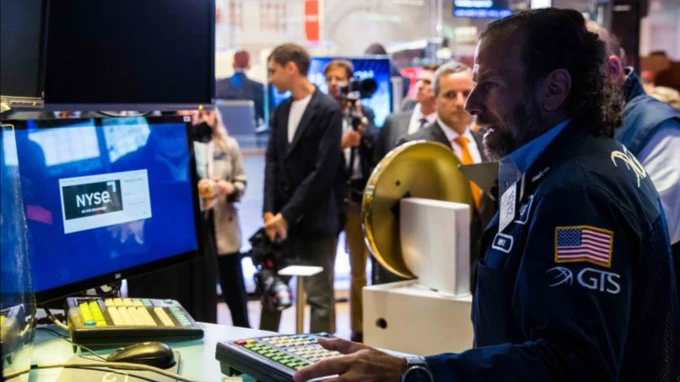
Photo: X / NYSE
The rotation of capital out of tech companies that began the day before continued on July 2: chipmakers’ stocks fell for the second day in a row, along with the Nasdaq Composite. At the same time, investor interest shifted back to defensive, “old-school” stocks, according to MarketWatch: shares of McDonald’s, Johnson & Johnson, and Boeing surged in the afternoon. Against this backdrop, the Dow hit another record high at the close. Thursday was the final trading day of the week in the U.S. On July 4, U.S. stock exchanges will be closed in observance of Independence Day.
Details
— On June 2, the S&P 500 broad-market index gained 0.01 points and closed at 7,483.24 points, virtually unchanged from the previous day. For the week, the S&P 500 rose 1.7%.
— The Dow Jones Industrial Average, a blue-chip index, rose 1.14% on Thursday and closed at a record high of 52,900.07 points. For the week, the DJIA rose 1.9%.
— The Nasdaq Composite, a technology sector index, fell 0.8% during the day, dropping to 25,832.67 points. For the week, the index was up 1.87%.
— The Russell 2000 Small- and Mid-Cap Index fell 0.61% to 2,994.1 points. It lost 0.07% over the week.
— Brent crude oil futures rose 0.03% on Thursday to $71.59 per barrel, while WTI crude oil futures fell 0.16% to $68.47 per barrel.
— On Thursday, the dollar weakened by 0.51% against a basket of other world currencies, falling to 100.87 points.
— The price of gold rose 1.19% to $4,131.1 per ounce.
— Bitcoin rose 2.4% over the past 24 hours, reaching $61,350.
What Affected Stock Prices
The Nasdaq Composite technology sector index remained under pressure following a sell-off in chipmaker stocks that began the previous day. The VanEck Semiconductor ETF, which provides exposure to the semiconductor industry, fell 4.5%. The decline was led by Teradyne, which lost 13.6%, and KLA, which fell 11.5%. Nvidia shares fell 1.4%, while shares of Micron—the top-performing semiconductor company on the Nasdaq in the first half of the year—plummeted 5.5%. Tesla shares also plummeted 7.5% following the release of strong delivery data, approaching their worst day of the year, according to MarketWatch. Investors may have taken profits after the strong report, as the company’s stock had been rising prior to the release of the delivery data, notes Gene Munster, managing partner at Deepwater Asset Management. He also suggests that the rise in demand for electric vehicles in the second quarter was linked to higher gasoline prices in the U.S. amid the war.
A rotation of capital out of chipmaker stocks led to the Dow Jones Industrial Average’s 20th record close in 2026. On Thursday, ahead of the long weekend, investors actively bought “safe-haven” stocks (in the S&P 500, for example, Moderna shares, which rose 10%, were among the top performers), as well as stocks from the so-called “old economy”: McDonald’s (+4.1%), Johnson & Johnson (+3.6%), and Boeing (+3.6%) rose significantly in the final hour of trading. The Dow Jones was also boosted by a weaker-than-expected U.S. nonfarm payrolls report for June, according to CNBC. Last month, the number of jobs increased by 57,000—less than the 115,000 expected by economists surveyed by Dow Jones. Meanwhile, the unemployment rate fell to 4.2%. Economists had forecast that it would remain at 4.3%. Following the release of this data, yields on 2-year U.S. Treasury bonds fell, and the U.S. dollar weakened against a basket of global currencies—market participants expect that, under these conditions, the Federal Reserve will refrain from raising interest rates, CNBC reports.
What People Are Saying in the Market
"The market is still just trying to figure out how the Fed will make decisions under Chair Kevin Warsh. But this [employment] report takes some of the pressure off the central bank and reduces the likelihood of an imminent rate hike,” Bradford Smith, a portfolio manager at Janus Henderson Investors, told CNBC. “True, Warsh warned at his first press conference that initial employment estimates are often revised and only become truly indicative after some time—when they’ve already become ‘history in hindsight.’” However, Smith notes that against the backdrop of slowing “oil inflation,” even moderate weakness in the labor market will likely allow the Fed to “leave rates unchanged at least at its next meeting.”
This article was AI-translated and verified by a human editor