Investors Won't Share in the Profits, Risks, or Impact on the Workforce: Key Points About Anthropic's IPO



Anthropic goes public with a warning to investors that its technology poses existential risks / Photo: Samuel Boivin / Shutterstock.com
Anthropic, one of the largest players in the artificial intelligence market, filed its prospectus for an initial public offering on October 26. Oninvest has compiled what we learned from this document and what Wall Street is saying about it in this article.
3:15 p.m. CET: Anthropic will list its shares on the Nasdaq Global Select Market. Shares will be offered as part of the offering by both the company itself and some of its shareholders. The size of the offering, as well as the potential price of Anthropic’s shares, will be disclosed at a later date. Goldman Sachs and Morgan Stanley, along with 20 other banks, are acting as underwriters for the IPO. The shares will trade under the ticker symbol ANT.
15.2 CET: In the first six months of 2026, Anthropic reported a net loss of $80.7 billion on revenue of $16.3 billion. A year earlier, during the same period, the loss was $13 billion on revenue of $1.2 billion. The net revenue retention rate from existing customers reached approximately 900%, and 79% of third-quarter revenue came from customers outside the top five.
The company’s primary source of revenue is a pay-as-you-go model for AI systems. Revenue in this segment grew from $288 million (75% of the total) in 2024 to $3.8 billion (83%) in 2025 and to $13.1 billion (80%) in the first half of 2026.
Anthropic’s largest expense category iscomputing power and infrastructure costs. In the first six months of 2026, these costs totaled $8.9 billion—a 283% increase from the previous year. At the same time, their share of revenue continues to decline. Since the end of 2025, the company has entered into new agreements for the supply of computing power with minimum commitments totaling approximately $417 billion, some of which are set to run for up to 20 years.
Anthropic's total debt as of June 30 was $6.2 billion. The company increased the limit on its revolving credit facility from $3.25 billion to $15 billion, maturing in 2031, and acknowledges that it may raise additional debt to finance its needs. Once it receives an investment-grade rating from at least two of the three major rating agencies, this line of credit may become unsecured.

15:27 CET: Anthropic’s prospectus is over 300 pages long , a third of which is devoted to risks—including “existential” ones. The company notes that its AI models are capable of behaving in “unintended, inconsistent, or autonomous ways.” Without adequate safeguards, the technology could pose “catastrophic or existential risks to humanity”—including attempts to “resist shutdown” and “conceal or distort information.”
The security of modern AI models has been in the spotlight in recent months following a series of high-profile incidents involving the hacking of systems by swarms of autonomous AI agents. Anthropic itself announced earlier this year that its new AI model, Mythos, had become so powerful and dangerous that it decided not to release it to the public.
15. 35 CET: The total compensation for Anthropic co-founder and CEO Dario Amodei in 2025 amounted to $17.96 million, according to the IPO prospectus. The vast majority of this amount came from compensation in the form of stock and options. Amodei’s base salary was $654,167.
His sister Daniela, who is also one of the company’s co-founders, ranked second among the company’s executives in terms of compensation: in 2025, she received $16.4 million. Her base salary was the same as her brother’s.
Effective July 1, 2026, their annual salaries were raised to $1.38 million.
15:39 CET: Anthropic may launch its IPO campaign the week of November 9, according to Bloomberg. According to its sources, Anthropic expects the offering to match or exceed the record-breaking SpaceX IPO in terms of size. Elon Musk’s space company raised $75 billion in June and became one of the most valuable publicly traded companies in the U.S., with a valuation of $1.77 trillion.
As early as September, Anthropic was targeting a valuation of over $2 trillion, but later, after disclosing its latest financial results, it began discussing a valuation closer to $1.5 trillion with investors, Reuters reported.
3:45 p.m. CET: Only two companies are explicitly mentioned in the prospectus as Anthropic's competitors—OpenAI and Google.
"We compete directly with companies that develop cutting-edge artificial intelligence models for third-party software developers and enterprise customers, including OpenAI and Google, as well as with major technology companies that have significant financial resources and are investing in the development of state-of-the-art models.”
The company also noted that it competes with a “wider range of AI model providers,” including developers of models with open weights and open source code.
3:46 p.m. CET: Among the risks to its business listed in the nearly 100-page prospectus, the company cited the geographic concentration of advanced chip manufacturing in Taiwan, specifically at the facilities of Taiwan Semiconductor Manufacturing Company (TSMC).
According to Anthropic, its operations could be adversely affected by any restrictions or delays in shipments, such as: natural disasters in Taiwan, potential disruptions to production and exports due to geopolitical tensions with China, disruptions to power grids or other critical infrastructure, as well as trade restrictions.
3:50 p.m. CET: Anthropic warned investors that moratoriums on the construction of new data centers in the U.S. could slow the growth of its business. As of last month, 16 states were considering such restrictions, partly due to rising electricity prices. According to the company’s assessment, the moratoriums could delay or halt the construction of facilities necessary for the development of its computing infrastructure. To reduce its reliance on U.S. capacity, it plans to build data centers abroad.
4:03 p.m. CET: Anthropic cited the inability to address threats related to artificial intelligence safety as one of the risks to its business. The company noted that it regularly has to decide whether a particular model is safe enough to be released to the market. However, there are no guarantees that the safeguards put in place will prove sufficient or that Anthropic will be able to correctly determine which capabilities of the models need to be restricted.
“These decisions have particularly serious consequences, as the potential scale of harm caused by AI models—whose behavior does not align with their intended goals or that are used for purposes other than those for which they were designed—increases as the capabilities of AI systems evolve. Many stakeholders, including researchers and policymakers, have expressed concern that sufficiently advanced AI systems could pose a catastrophic or even existential threat to society if their development and deployment are not carried out responsibly.”
"Our safety-first approach is intended, in part, to mitigate these risks; however, there is no guarantee that our efforts will be successful or that other companies in the AI industry will implement similar safeguards."
In September, Anthropic CEO Dario Amodei called for a slowdown in the development of the most advanced AI models to reduce the likelihood of “catastrophic harm.” He warned that in as little as 6 to 12 months, AI agents could become so powerful that they would be capable of taking over the entire internet and causing hundreds of billions of dollars in damage. His call was supported by OpenAI CEO Sam Altman and Elon Musk.

11:11 a.m. CET: An image from the prospectus in which Anthropic illustrates how the company's growth and the use of its product reinforce each other, creating long-term competitive advantages:
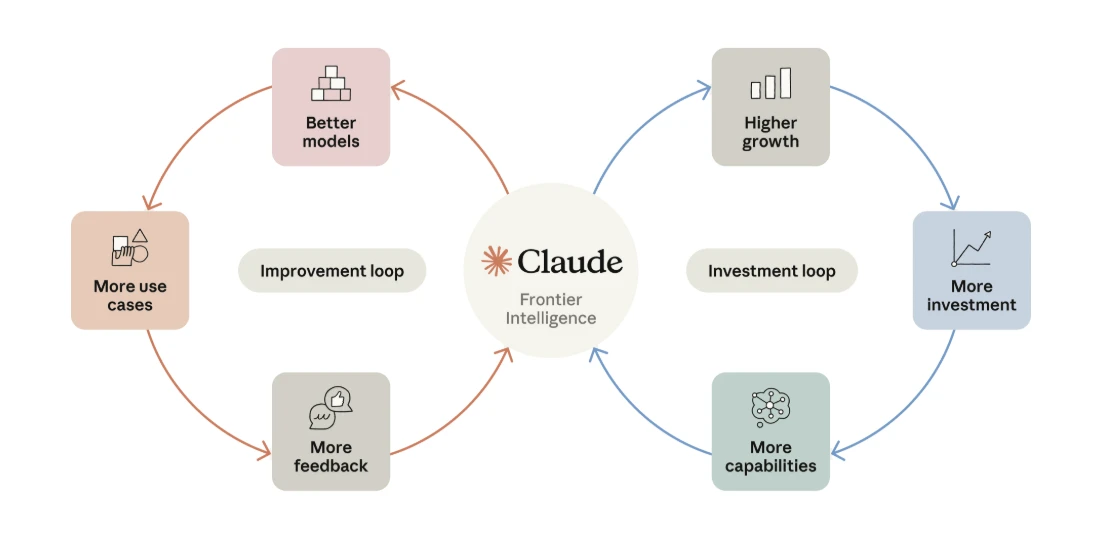
The smarter AI models become, the more actively customers use the product, and the more information Anthropic receives about complex tasks, errors, and user needs. Wider adoption leads to revenue growth, which in turn leads to increased investment in computing power, research, and hiring specialists. With more resources, it becomes easier to build more powerful models and develop new features.
16:28 CET: Anthropic has no plans to share profits with shareholders “for the foreseeable future”—the only way to recoup money will be to sell shares that have risen in value, according to the prospectus. Anthropic intends to spend all of its profits on business expansion rather than on dividends.
"Therefore, shareholders should rely solely on the sale of their common shares following a potential increase in their market value as the only way to realize a return on their investment in the future."
4:45 p.m. CET: What we know about Anthropic's founders:
Each of the seven co-founders owns approximately 240 million shares—which together represent about 10% of the company. According to the prospectus, all seven will sell shares as part of the IPO, but it is not yet known how many. To ensure they retain 50.1% of the voting rights, Anthropic will issue a separate class of shares (Class F).
Who are the co-founders:
- Dario Amodei — Chief Executive Officer;
- Daniela Amodei, his sister, is president and chair of the board of directors;
- Tom Brown — Director of Computing Resources;
- Jared Kaplan — Director of Research;
- Sam McCandlish — Chief Architect;
- Chris Ola — Head of Research on the Interpretability of Artificial Intelligence;
- Jack Clark — Director of the Anthropic Institute.
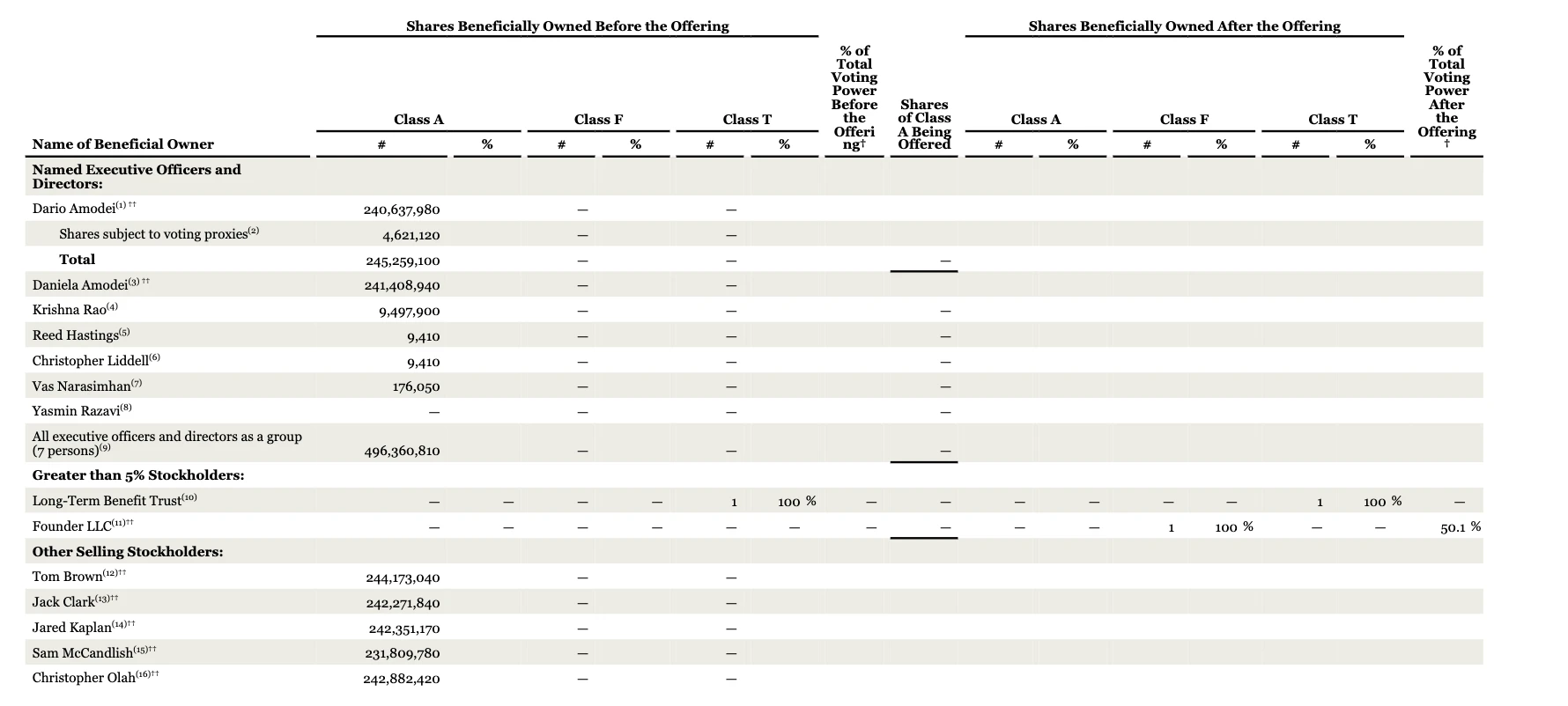
As of October 26, Forbes magazine estimates the net worth of each of Anthropic’s founders at $15.5 billion. All seven have pledged to donate 80% of their Anthropic shares to charity—while still being able to participate in decision-making thanks to their Class F shares.
5:30 p.m. CET: Artificial intelligence can transform knowledge work by significantly increasing the productivity of workers in this sector, according to Anthropic. According to data cited in the prospectus, in 2025, knowledge work generated more than $40 trillion in economic value for the global economy. The company sees its mission as increasing this value and accelerating economic growth.
"We believe that AI will significantly expand people's capabilities and increase the overall potential of the global economy in this area, including by accelerating scientific discoveries and helping companies grow. Knowledge workers are at the forefront of these transformations."
"Although it is still too early to predict the full impact of cutting-edge AI on the economy, IDC estimates that investments in AI-based solutions and services will generate a cumulative economic impact of $22.5 trillion in the global economy by 2031. We believe this impact could turn out to be even greater.”
5:40 p.m. CET: What Analysts Are Saying
The IPO will cement Anthropic’s status as a benchmark for valuing leading artificial intelligence companies. However, its success will not necessarily benefit all AI companies equally, says IPOX analyst Lucas Mühlbauer. We’ve compiled Wall Street’s initial reactions to the prospectus in this article:
6:00 p.m. CET: David Einhorn, a well-known investor who heads the hedge fund Greenlight Capital, released a third-quarter letter in which he stated that it is impossible to predict Anthropic's future prospects.
"We have no idea what Anthropic will be like or whether it will even exist 10 years from now."
An investor cast doubt on the $30 trillion valuation of Anthropic’s potential market, which was reported in the media a month ago. Einhorn speculates that the company is basing this figure on the salaries of people whose jobs could be performed by artificial intelligence in the future. However, even if AI were to replace all of these workers, that does not mean the developers would generate $30 trillion in revenue. Furthermore, Einhorn points out that last year, 191 technology companies from the S&P 1500 index—which tracks the performance of approximately 1,500 U.S. companies, plus Amazon, Meta, Google, and Tesla, collectively generated $4 trillion in actual revenue.
“There was a time when we had a Securities and Exchange Commission that investigated such statements, which were used to manipulate stock prices, and top corporate executives had to consider the possible consequences of their words. Of course, those days are long gone, so charismatic corporate leaders can apparently say whatever they want, leaving it up to market participants to judge for themselves just how exaggerated these figures are.”
Einhorn is one of the most closely watched investors on Wall Street. He rose to fame in 2008 after taking a short position against Lehman Brothers a few months before its collapse. Einhorn publicly accused the bank of using misleading financial statements.
6:20 p.m. CET: U.S. stocks are rising today— Anthropic’s prospectus has sparked a new wave of interest in the artificial intelligence sector, according to Bloomberg. Investors are also bracing for earnings reports from major tech companies—Alphabet, Microsoft, and Amazon. The Nasdaq 100 Index is up 1.2%. The broad-market S&P 500 index is up nearly 0.9%. The Dow Jones Industrial Average is up 0.3%.
That wraps up our online session. Thank you for your attention!
This article was AI-translated and verified by a human editor