Nvidia shares are trading at a significant discount, according to BofA. Is it time to buy?
The chipmaker's stock is valued lower than Microsoft's and Apple's

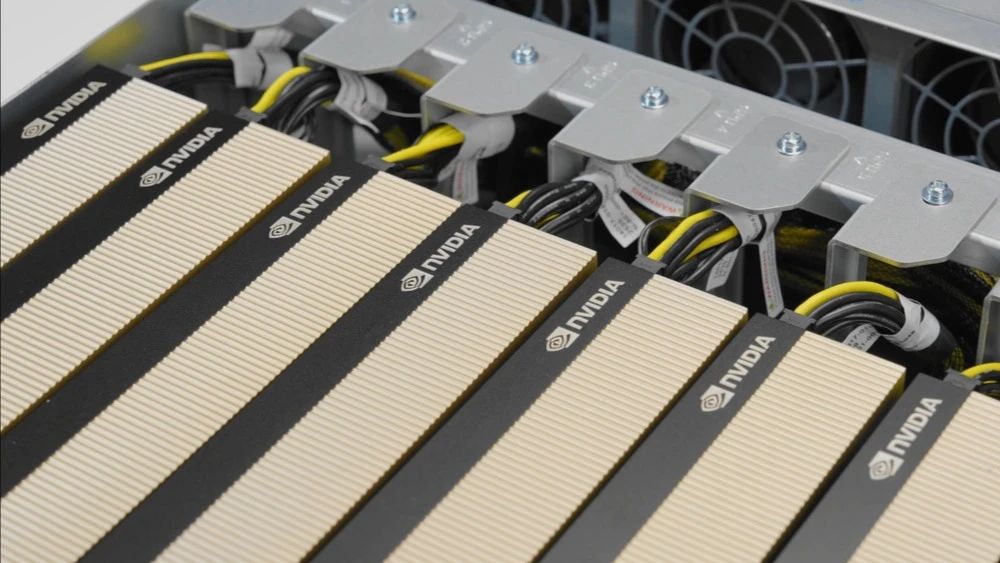
Shares of the leading supplier of AI chips have risen by just 8% since the start of the year / Photo: harhar38 / Shutterstock.com
According to Bank of America, Nvidia’s stock has significantly underperformed the market, and investors should take advantage of this “attractive” buying opportunity. Despite the company’s dominant position in the AI chip market, its stock has risen by only 8% since the beginning of the year, while the iShares Semiconductor ETF has gained 94% over the same period. During trading on July 9, Nvidia’s stock fell 0.6%.
Details
Bank of America analyst Vivek Arya has reaffirmed his “buy” rating on Nvidia shares with a price target of $350, according to Benzinga. Arya notes that Nvidia shares are trading at a discount to companies such as Microsoft and Apple, “despite comparable capabilities in the AI space and similar pressure from memory costs,” MarketWatch reports. According to Dow Jones Market Data, Nvidia’s forward P/E ratio—which measures the stock price relative to projected annual earnings—stands at 18.7. This is nearly half the average over the past ten years (36.9). This multiple is also near its lowest level in the past 11 years, MarketWatch notes.
In a note to clients published on Wednesday, Arya explains that investors are concerned about rising memory costs for AI chips and their potential impact on Nvidia’s gross margin. However, according to the analyst, the market is overestimating the pressure associated with rising HBM (High Bandwidth Memory) prices and underestimating Nvidia’s ability to raise prices. He also highlights the scale of the business and the existence of $119 billion in contracted component supplies.
The analyst believes that Nvidia will be able to more than offset the rising cost of HBM memory, as the price of the next-generation Rubin platform could turn out to be significantly higher than that of Blackwell. He expects the company to maintain its gross margin at the mid-70% range.
Investors are also concerned about Nvidia’s ability to withstand competition from companies that produce their own application-specific integrated circuits (ASICs), such as Google and Broadcom, which are jointly developing tensor processing units (TPUs). Arja notes that Google’s TPUs have been around for more than ten years, and during that time, Nvidia’s revenue from graphics processing units has grown 700-fold. He predicts that, in the long term, Nvidia will capture about 65–70% of hyperscalers’ investments in AI infrastructure.
Arya expects Nvidia's quarterly earnings report in August to reassure investors that the company still has "strong competitive advantages in products, pricing, and the supply chain."
What People Are Saying in the Market
Since hitting an all-time high on May 14, Nvidia’s stock has fallen 13.5%. Nvidia has experienced similar downturns in the past and has quickly recovered its losses, notes Michael Bailey, an analyst at Fulton Breakefield Broenniman. “We’ve seen this before: a fairly sharp decline was followed by an equally rapid recovery,” he noted in an interview with Bloomberg.
Nvidia’s business, however, has not suffered. The company controls 97% of the market for AI server chips, up from 95% a year earlier; demand for equipment for new data centers remains strong; and its earnings forecast for the past three months has risen by 13%. Sales and profitability have not declined—which is why Randy Hair, an equity analyst at Huntington Bank, believes the stock is undervalued. “The stock follows earnings,” he says, and he expects Nvidia’s share price to resume its upward trend in the coming months.
Most Wall Street analysts agree with Hayr: of the 66 analysts who cover Nvidia, only three recommend holding the stock and one recommends selling it. The average price target of $313.4 implies a 54% upside—the highest potential among the “Magnificent Seven” tech giants.
This article was AI-translated and verified by a human editor