One thing in words, another in deeds: Wall Street’s “eternal bear” has been accused of hypocrisy
Jeremy Grantham, one of Wall Street's most respected veteran investors, might have invested in SpaceX, a company he had criticized

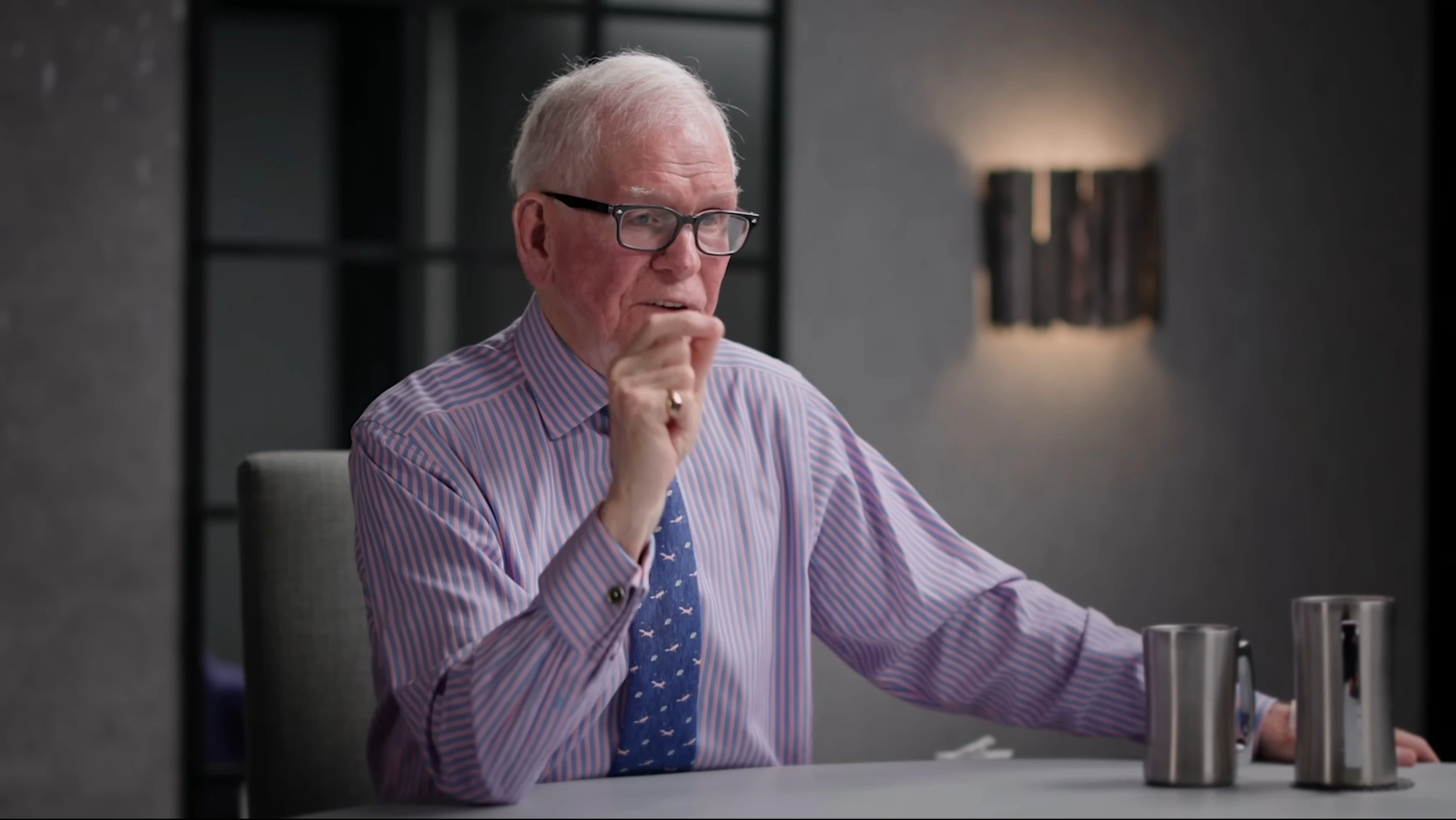
Jeremy Grantham's warnings about an AI bubble and a financial crash haven't stopped him from investing in high-risk securities / Photo: YouTube / @TheDiaryOfACEO
Jeremy Grantham, an 87-year-old investor and one of Wall Street’s most influential skeptics, has found himself at the center of a scandal due to a discrepancy between his statements and his investment priorities. Grantham has warned about a bubble in AI and criticized the U.S. tech sector and Elon Musk’s SpaceX. Yet his fund’s money is managed by portfolio managers who are betting on such companies.
Details
Financial analyst Thomas Brazil examined the tax returns of the Grantham Foundation, to which Grantham had transferred 90–95% of his fortune, and concluded that nearly 70% of the “eternal bear’s” assets are invested in venture capital funds and companies whose shares are not traded on the stock exchange. According to MarketWatch, Brazil made a name for himself trading in creditors’ claims against bankrupt companies, and has recently also been involved in claiming refunds of paid taxes. His exposé on X quickly went viral.
According to Brazila’s calculations, the accuracy of which was confirmed by MarketWatch, the Grantham Foundation has approximately $782 million in assets. Approximately $536 million is invested in venture capital funds and private companies, $115 million in publicly traded stocks, $78 million in cash, $32 million in other investments, and $20 million in accounts receivable. “This isn’t some sleepy index fund, but a complex institutional portfolio focused on selecting active managers, private markets, and cutting-edge technologies,” the financier noted.
Where Did the "Eternal Bear" Go?
Among the venture capital funds in which Grantham’s company has invested, Brazil mentioned Thrive, Lux Capital, Founders Fund, and other leaders in the U.S. private equity market. “These are not run-of-the-mill asset managers. They are among the world’s best investors in AI, software, robotics, biotech, climate innovation, semiconductors, defense, and cutting-edge technologies,” the financier wrote. He found that several of them had “significant exposure” to SpaceX—whose IPO Grantham had mocked —or to the space sector.
A list of Grantham’s direct investments in startups—from Fervo Energy and Zap Energy to QuantumScape, Oxide Computer, Via Separations, and Carbon Ridge—doesn’t look like the portfolio of an investor who is “hiding under the bed” waiting for a crash, Brazil noted. Even the publicly disclosed portion of the fund’s portfolio doesn’t look conservative—ranging from shares in drug developer Recursion Pharmaceuticals to the risk management platform Riskified (both of which actively use AI), he added.
Do your words match your actions?
Brazil does not claim that Grantham is a poor investor. On the contrary, he wrote that he considers the portfolio well-thought-out and that he himself would “gladly” own many of these assets. His complaint lies elsewhere: the portfolio’s structure, he says, runs counter to the investment guru’s public calls to hold index funds and steer clear of the U.S. tech sector, artificial intelligence, and SpaceX.
Brazil summarized his conclusion as follows: “From the top down (when evaluating the market as a whole—Oninvest), he is a ‘perennial bear.’ From the bottom up (when it comes to selecting specific assets—Oninvest), he pays top-tier venture capitalists for access to cutting-edge technologies. These two narratives don’t quite add up.” After that, MarketWatch reports, a debate broke out on social media over whether Grantham should be considered a hypocrite.
What the "Eternal Bear" Says
Grantham himself has previously pointed out this apparent contradiction, MarketWatch notes. He has repeatedly praised the American venture capital industry and stated that the most talented entrepreneurs begin their journey by raising capital from specialized funds. “This is undoubtedly the most dynamic part of American capitalism,” he said in a 2021 interview.
In his memoir, *The Making of the Eternal Bear: The Dangers of Long-Term Investing in a World of Short-Term Perspectives*, published in early 2026, Grantham wrote that the hype surrounding ChatGPT had created a “bubble within a bubble,” only temporarily preventing the stock market from crashing. When both bubbles burst, investors will face either perpetually low returns or a severe bear market followed by a return to normal, Business Insider quoted him as saying.
This article was AI-translated and verified by a human editor