Oninvest Index: Small-cap data center stocks rose 48%. What will drive this growth?


By 2030, global data center capacity will nearly double, and the market will grow by an average of 14% per year, according to a JLL forecast / Photo: Shutterstock.com
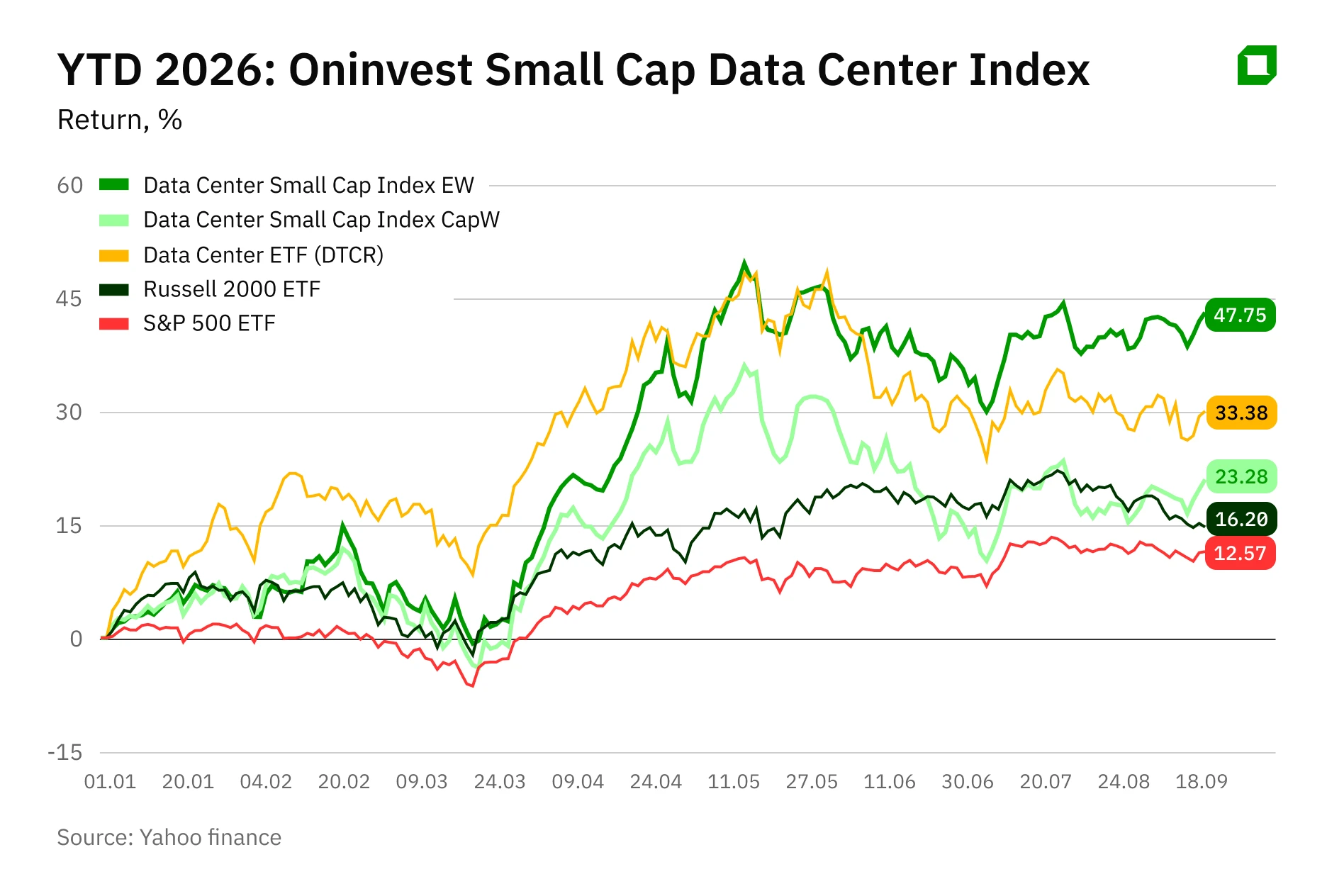
The AI boom has sparked a large-scale data center construction boom and increased demand for a stable power supply. The Oninvest equally weighted index, which includes 50 small-cap stocks related to the sector, has risen 48% since the beginning of 2026 and outperformed the Russell 2000. However, investors are now questioning whether future AI-driven revenues will justify the trillion-dollar infrastructure spending. Oninvest analyst Aldiyar Anuarbekov highlighted two factors that could support the sector’s growth and named three potential beneficiaries.
Growth Drivers and the Main Risk
According to estimates by JLL, an international consulting firm that advises on the construction and financing of data centers, global investment in new facilities and their equipment could approach $3 trillion by 2030. Between 2026 and 2030, approximately 100 GW of new capacity could be added globally—roughly double the current installed capacity.
Nuclear power plants, power grids, and data centers require significant investment long before revenue is generated. Consequently, doubts about the return on investment in AI are now causing investors to take a more cautious approach to evaluating energy projects based on projections of future demand from data centers.
Small companies that have already gained access to local and regulated demand and are able to quickly utilize their existing infrastructure stand to benefit. Through the end of 2026, the growth of small data center operators could be driven by two factors:
— Demand for local and certified infrastructure
In France, the government and its operators are required to store sensitive data in a certified cloud, while India’s IndiaAI program purchases capacity from providers with infrastructure located within the country. Such requirements give local operators an advantage. For example, the European Commission selected a consortium that includes the French company OVHcloud to create a sovereign cloud for EU institutions. The maximum contract value is €180 million over six years (OVHcloud’s share has not been disclosed). This demand gives local operators an advantage: American hyperscalers can only compete for such contracts if they comply with localization, security, and certification requirements.
— Rate Hikes Amid a Server Memory Shortage
Counterpoint Research forecasts that by the end of 2026, widely used DDR5 RDIMM server modules could cost twice as much as they did in early 2025, as manufacturers prioritize memory for AI accelerators. Operators that managed to purchase components and build capacity at previous prices may be able to raise rates faster than their own costs are rising. OVHcloud has warned that it expects the cost of memory to increase ninefold by September compared to last year. This has already led to rate increases for customers.
However, this same factor remains the main risk: customers may reduce their consumption or switch to competitors. Companies that have yet to purchase equipment and build capacity will face rising capital expenditures and lower potential returns.
Therefore, the investment case depends on three conditions: regulatory advantages must translate into actual contracts; rate increases must offset rising component costs; and capacity expansion must not lead to excessive debt growth or the issuance of new shares.
What the Oninvest Index Revealed
Oninvest has compiled an index of 50 companies with market capitalizations ranging from $11 million to $2.5 billion—the Data Center Small Cap Index. It covers 15 countries and five sectors: data center and cloud operators, server manufacturers and system integrators, power supply and construction service providers, network infrastructure, and cooling.
The index has two versions: an equally weighted version, in which each security accounts for 2%, and a market-capitalization-weighted version. In 2025, the former rose by 20.28%, while the latter fell by 8.37%. In the first half of 2026, they gained 45.14% and 28.42%, respectively. For comparison: the Global X Data Center and Digital Infrastructure ETF rose 44.46% over the same period, the Russell 2000 ETF rose 22.56%, and the S&P 500 ETF rose 10.09%. Since the beginning of 2026, the two versions of the Oninvest index have gained 47.75% and 23.28%, respectively. The gap between them shows that it was not the largest companies in the sample that grew the most, but rather the smaller ones.
Oninvest has identified three stocks that could benefit from demand for local infrastructure in three different jurisdictions: the European Union, the United States, and India.
OVHcloud (ticker symbol: OVH)
The French company OVHcloud operates 46 data centers and more than 500,000 servers. Its advantage over American hyperscalers lies not in scale, but in its European jurisdiction and certification for handling sensitive data. In September, OVHcloud received SecNumCloud certification from the French agency ANSSI for its first certified pay-as-you-go public cloud—the SNC Cloud Platform.
In the third quarter of fiscal year 2026, which ended on May 31, OVHcloud’s revenue grew organically by 6.9% to €289.6 million. The public cloud—the fastest-growing segment—grew by 20.2% to €65.6 million. In the first half of the year, adjusted EBITDA increased by 5.9% to €227.2 million, with a margin of 40.9%. Net debt stood at €1.13 billion.
The main risk is the business’s high capital intensity. In the first half of the year, OVHcloud’s capital expenditures, excluding acquisitions, reached €238.5 million, or 42.9% of revenue. The company brought forward a portion of its investments from future periods to purchase equipment in advance, lock in prices, and secure supplies amid a component shortage. In addition, on August 26, the company announced the departure of CFO Stéphanie Bénier without naming a permanent successor.
On September 17, 2026, BNP Paribas upgraded OVHcloud’s rating by two notches: from “underperform” to “outperform” and raised its target price from €7 to €22, which is approximately 22% higher than the closing price on September 21. The bank attributes this reversal to high demand and rising server prices: a shortage of computing power will allow the company to raise prices for servers and accelerators. BNP Paribas expects organic growth to accelerate to 12–13% in 2027–2028, up from its previous forecast of 8–9%. At the same time, the bank raised its capital expenditure forecast to 44% of revenue in 2027, up from its previous expectation of 36%.
According to Market Screener, four analysts recommend buying the company’s stock, the same number recommend holding it, and two recommend selling it. The average price target is €13.5, approximately 25% below the stock’s closing price on September 21. The stock has already priced in a significant portion of these expectations, and its further upside potential depends on whether the annual financial results, to be released on October 20, confirm BNP Paribas’ thesis regarding price growth and accelerator utilization.
Rackspace (RXT)
The U.S.-based company Rackspace helps large enterprises migrate applications and data to the cloud and manage them—both in its own data centers and on Amazon, Microsoft, and Google platforms. The company is now seeking to transition from a traditional cloud service provider to an AI infrastructure operator in regulated industries.
In the second quarter of 2026, its revenue grew by only 1% year-over-year, to $670.1 million. But an important shift occurred within the business: revenue from the private cloud increased for the first time after five quarters of decline, UBS noted in its report—by 5.5%, to $263.3 million, while revenue from the public cloud fell by 2.3%, to $406.8 million. The net loss rose to $67.5 million from $54.5 million a year earlier.
The company is focusing on private AI infrastructure, where the customer controls the location of and access to their data. Rackspace plans to deploy up to 30 MW of AMD-based computing power by 2028. In February 2026, it announced a partnership with Palantir. In September, the company also joined the NVIDIA Cloud Partner program and introduced the Institutional Sovereign Pod: an infrastructure built on NVIDIA Blackwell accelerators and running Palantir software, designed for regulated companies and government organizations.
In August, UBS reaffirmed its Neutral rating with a price target of $5.3, based on a multiple of approximately 1.5 times 2028 revenue. The main risk is the debt burden. As of June 30, the company had approximately $2.79 billion in debt, excluding finance leases, with $111 million in cash. In July, Rackspace launched a share offering program of up to $250 million. It is not required to use the entire amount, but new offerings could dilute the stakes of existing shareholders.
Another risk is investor confidence in management. During a special conference call on July 9, Rackspace lowered its revenue forecast for 2026 from $2.6–2.7 billion to $2.45–2.55 billion: the company decided to redirect some of its resources to AI projects. The stock fell 33.6% over the course of the day. Investors later filed a class-action lawsuit, alleging that the company failed to disclose in advance the scale of the pivot and its potential impact on revenue.
According to MarketWatch, Rackspace shares have three “hold” ratings from Wall Street analysts. The average price target is $4.77, implying an 18% increase from the closing price on September 21.
E2E Networks (E2E.NS)
An Indian cloud provider that rents out computing power based on NVIDIA accelerators. The company's servers are located in India, in data centers in Noida and Chennai.
In the first quarter of fiscal year 2027, which ended on June 30, 2026, E2E’s revenue increased 4.3-fold year-over-year to 1.568 billion rupees (approximately $16.4 million). EBITDA reached 1.179 billion rupees, with a margin of 75.2%. Net income totaled 439 million rupees (approximately $4.6 million), compared with a loss of 28 million rupees (approximately $0.3 million) a year earlier. The company attributes the growth to the launch of the B200 cluster and an increase in the utilization rate of its fleet, which reached approximately 5,100 accelerators.
On August 31, E2E reported on a term sheet (a preliminary document outlining the terms of a deal) worth approximately 10 billion rupees (about $104.8 million): The company is to supply NVIDIA Blackwell accelerators to an Indian customer in the sovereign AI sector by June 2029.
Risks — High end-to-end (E2E) capital expenditures: 8.7 billion rupees for the quarter — more than five times quarterly revenue. Therefore, the key question for investors is not whether there is demand, but whether the company will be able to finance its expansion and maintain high utilization rates for its accelerators after new capacity comes online. An additional risk is regulated rates in government programs, which cap the price of the service.
This does not constitute a personalized investment recommendation.