'Our brand character is fun, bold, premium', says Sixt CFO in interview with Oninvest

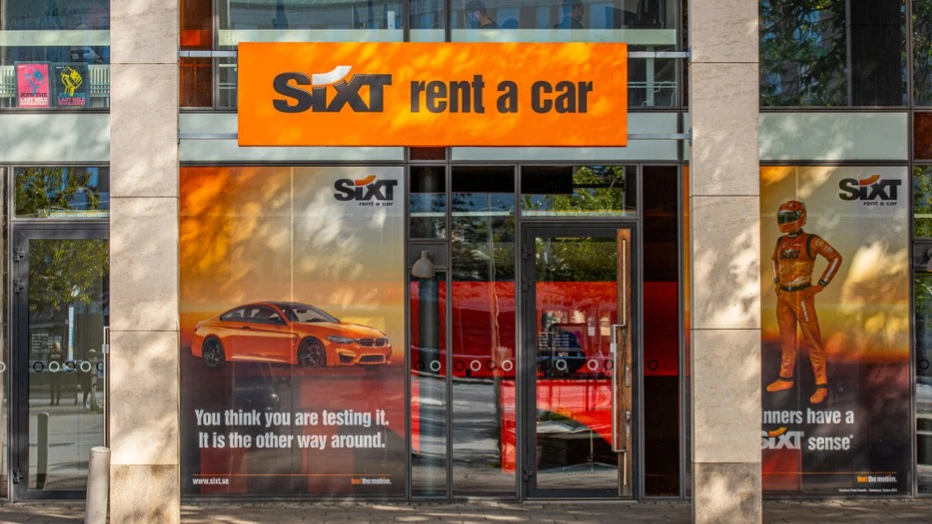
Sixt offers a wide selection of premium cars / Photo: Trygve Finkelsen / Shutterstock.com
Over more than a century, Sixt has evolved from a small German car rental shop into an operator of an entire international mobility ecosystem. In addition to traditional car rentals, the company is engaged in car sharing, rides with drivers, premium passenger transfers, electric vehicle charging, and van and truck rentals – all within a single app. Sixt CFO Franz Weinberger spoke with Oninvest about what is driving the company's growth today, how Middle East tensions are affecting the business, and which advantages help Sixt to compete in the global market.
About the business
In Germany, Sixt has become synonymous with car rentals. “The brand is so ingrained in German culture that Germans say ‘S as in Sixt’ when verbally spelling a word, as Americans say ‘X as in Xerox,’” writes the industry publication Automotive Fleet.
Sixt is known for its wide selection of premium-segment vehicles, including BMW, Audi, Mercedes-Benz, and Volvo, as well as Porsche and Maserati. Premium vehicles account for around 58% of the company’s fleet. This allows Sixt to maintain higher prices and achieve increased margins: customers are willing to pay more for exclusive models and a high level of comfort.
Sixt’s history began in 1912 with three cars. The large-scale development of the business started in the 1970s, when the third generation of the Sixt family, led by Erich Sixt, took over management. In the 1980s, the company expanded rapidly in its home German market, focusing on broad airport presence and corporate clients. In 1986, Sixt went public on the Frankfurt Stock Exchange, and in the 1990s, after strengthening its leadership position in Germany, it began international expansion.
Over the last decade and a half, the company has transformed into a full-fledged mobility service provider: it has gone beyond car rentals, rolling out car sharing, truck rentals, electric vehicle charging, and car subscriptions. Today, the Sixt network includes around 2,300 branches worldwide, approximately 200 more than last year.
Sixt remains a family business: the Sixt family’s holding company, Erich Sixt Vermögensverwaltung GmbH, owns 58.3% of the group’s shares. Erich Sixt himself has served as chair of the supervisory board since 2021, while the positions of co-CEOs are shared by his sons, Alexander and Konstantin. How does Sixt's status as a family-owned company influence the business?
Family ownership allows us to think in generations rather than in quarters, which is reflected in a conservative balance-sheet philosophy with an equity ratio around 30%, and a deliberately tight fleet.
SIXT reported approximately 9% revenue growth to EUR4.3 billion and around 20% profit growth for 2025. How did the business perform in the first quarter?
We delivered another record first quarter with revenue of EUR929 million – the 19th consecutive record quarter – and for the first time above EUR900 million. Revenue increased 12.6% on a constant-currency basis, while pretax earnings turned positive at EUR2.1 million versus a EUR17.6 million loss a year earlier, representing a turnaround of roughly EUR20 million in the seasonally weakest quarter. Growth was carried by all segments: Europe (outside of Germany) up more than 16%, Germany at nearly 12% and North America grew around 9% in local currency. The key drivers were our consistent investments in our brand as well as our new loyalty program Sixt One, our international network, and technology, combined with disciplined, very tight fleet planning that lifted utilization.
How is the current conflict between the U.S. and Iran affecting demand and your operational performance? What proportion of your business is exposed to the Middle East? Have you maintained your outlook for 2026?
Our outlook is unchanged: we continue to expect a group revenue of between EUR4.45 and 4.60 billion and a pretax margin in the area of 10% for the full year. The first quarter played broadly in line with our base case assumptions, so there is no reason to revisit the framework as of today. Of course, the macroeconomic and geopolitical uncertainties have increased, due to the conflict in the Middle East.
Our direct exposure, however, is very limited because we operate in the affected countries exclusively through franchise partners, so the direct financial impact at group level is rather low. The more relevant effect is the indirect demand drag from these source markets. We will see how this plays out during our important summer season and if this can be cushioned by, for example, stronger leisure demand within Europe.
High fuel prices and inflation could put pressure on demand. How is Sixt managing these risks?
Typical bookings happen only a few days or weeks before the rental begins. We manage this by running a tight fleet, sized inside demand with holding periods well under one year, which lets us scale capacity up or down and react to demand shifts rather quickly.
What are the main structural differences in your business between Europe and North America today?
The most important difference is the fleet risk structure: in Europe more than 90% of infleeted vehicles are non-risk thanks to manufacturer buyback agreements, whereas the U.S. market is structurally risk-heavy because U.S. manufacturers do not have captive dealer networks. The other major difference is market maturity – we hold around 40% share in Germany and 18% across Europe, but only 3.5% in the U.S., which is why North America remains our most important growth market.
Your advertising has long been known for its bold, sometimes provocative tone, including political humor. Recently, it appears more restrained. What is behind this shift?
I'd actually challenge that premise. Our brand character – fun, bold, premium – hasn't changed at all. Our social media team always has an eye on current events and is ready to react fast in our signature ironic tone – but only when it truly fits our brand and products. That goes for viral trends just as much as for political topics. A recent example: when Chancellor Friedrich Merz was in the news, we posted a photo of a Mercedes-AMG SL63 with the line "So poliert man sein Image auf." (“This is how you improve your image” in German).