Quantum small caps lost most of their 1H gains in July. Is the rally over?

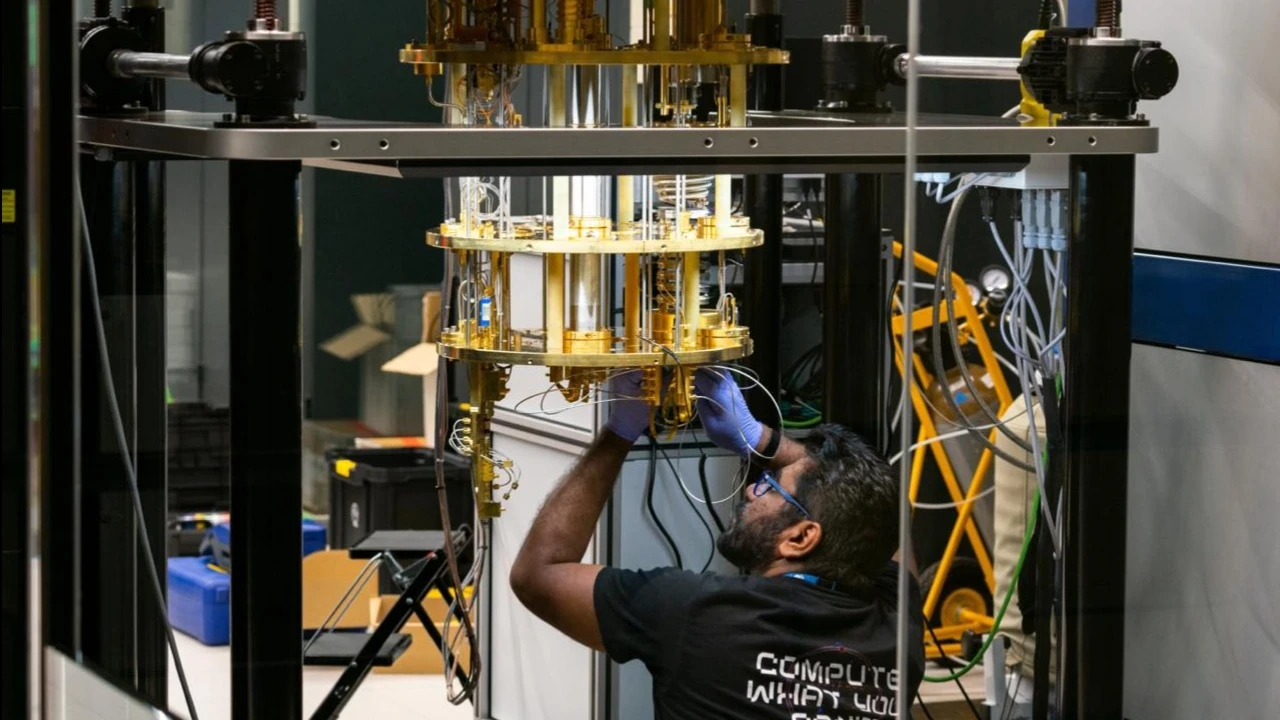
Investment in quantum technology start-ups reached $12.6 billion in 2025, 6.3 times higher than in 2024, according to McKinsey / Photo: Germanru / Shutterstock.com
Quantum technology is moving from the laboratory toward early commercialization, but the gap between potential and sales remains enormous. McKinsey estimates that quantum companies’ revenue, which exceeded $1 billion in 2025, could reach $4.4 billion by 2028, while the global market is set to grow to $60-100 billion by 2035. The primary beneficiaries, however, are expected to be companies in the financial, pharmaceutical, chemical, and logistics sectors rather than quantum developers. Investor interest is soaring: investment in quantum startups increased more than sixfold to $12.6 billion in 2025.
The defining event of the first half of this year was not a technological breakthrough but a regulatory decision. On June 22, U.S. President Trump signed two executive orders: the first required federal agencies to adopt post-quantum cryptography by the end of 2030; the second sought to accelerate the industry’s commercialization.
Quantum small caps in 1H26
We updated our Oninvest quantum small caps index in the first half. It now comprises 24 public companies from eight countries. In addition to developers of quantum computers, it includes manufacturers of cryogenic equipment, optics, lasers, and materials; software developers; and companies working in quantum communications, sensing, and post-quantum cybersecurity. Most constituents have one feature in common: the ability to generate revenue today without waiting for fully functional, fault-tolerant quantum computers.
The equal-weight index gained 66.8% in the first half of 2026, significantly outperforming the Russell 2000, which rose 21.9%; the S&P 500, up 9.6%; the Defiance Quantum ETF, up 51.4%; and the WisdomTree Quantum Computing Fund, up 46.1%. The cap-weight index added 40.4%.
The surge in quantum stocks during the first half gave way to a sharp correction in July. As of July 29, the equal-weight index’s year-to-date gain had narrowed to 28.2%, while the cap-weight index was up just 7.5% after July. The stocks came under pressure as investors took profit, rethought investments in firms with negligible revenue, and rotated out of volatile assets.
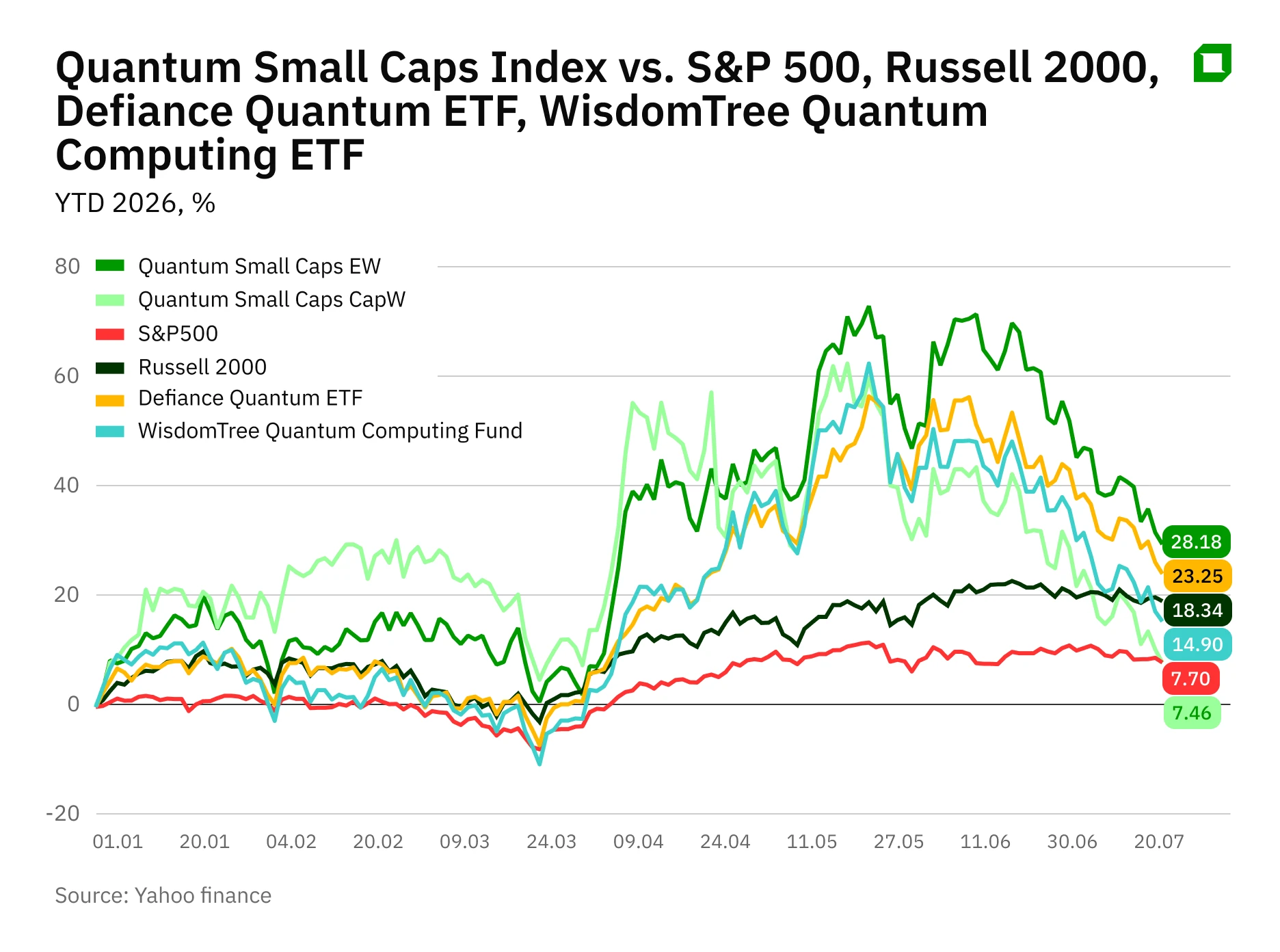
The correction was driven more by macroeconomic than industry-specific factors. On July 23, the yield on the 10-year U.S. Treasury note exceeded 4.7%, its highest level since January 2025. Because the valuations of most quantum companies are based on expectations of cash flows after 2030, the rise in the discount rate hit them harder than the broader market.
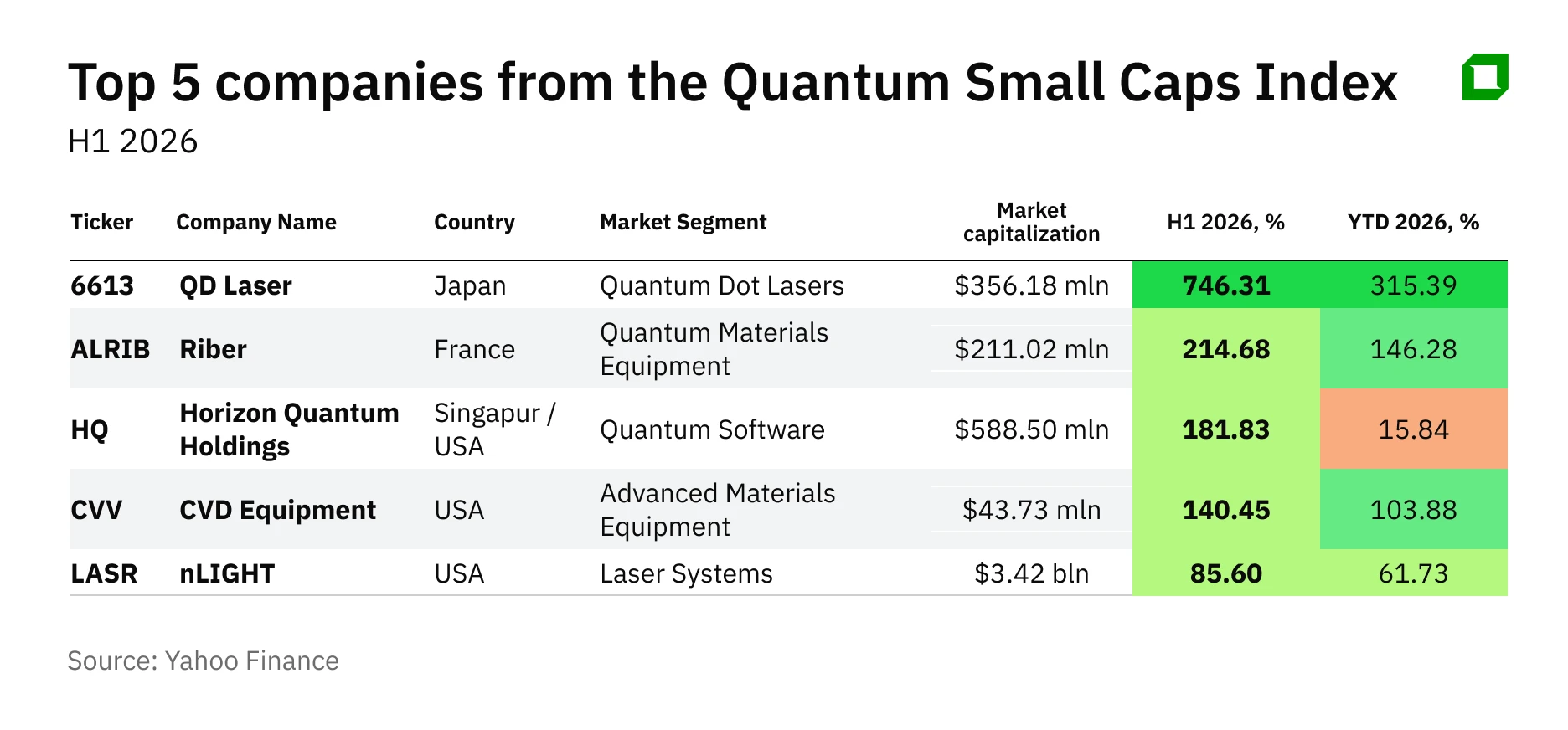
Japan’s QD Laser led the index, with its stock gaining 746.3% in the first half. The rally, however, was driven by demand for its quantum-dot lasers, which are used as light sources for optical interconnects in AI data centers. Other index leaders included France’s Riber and Singapore’s Horizon Quantum, while the UK’s Quantum Blockchain Technologies was the worst performer, losing 47.5%.
Four quantum ideas
Below we look at four stocks from the index that investors should watch moving forward.
Xanadu Quantum Technologies (XNDU)
The Toronto-based company develops PennyLane, an open-source Python library for quantum computing, and is building fault-tolerant photonic quantum computers that, unlike superconducting systems, can operate at room temperature without a cryostat. After merging with a SPAC in March, Xanadu became the first public company focused exclusively on photonic quantum architecture, according to the company.
First-quarter revenue quadrupled to $2.8 million, although the net loss also increased around 70% to $20.6 million. The company had $272.5 million in cash. Key potential drivers include up to $285 million in government support for Project OPTIMISM and an expanded collaboration with Lockheed Martin, which is integrating PennyLane into its engineering training program. The main risks are the need to reduce optical losses to scale the technology and potential shareholder dilution from a planned $300 million share issuance program.
Three Wall Street analysts cover Xanadu, according to MarketWatch data, and all three rate it a “buy.” The average target price is $36.70 per share, implying around 225% upside from the stock’s closing price on Monday.
Quantum Computing Inc. (QUBT)
The New Jersey-based company develops quantum optics and integrated photonics, producing quantum machines and photonic chips based on thin-film lithium niobate.
It was the only one of the four companies to finish the first half in negative territory: the stock declined 5.5% during the period and was down 26.3% year to date. First-quarter revenue increased to $3.7 million from $39,000 a year earlier, although new assets accounted for almost all of the increase. In February, the company acquired photonic-component maker Luminar Semiconductor for $110 million, followed in March by quantum-communications developer NuCrypt for $5 million. The net loss reached $4.1 million on operating expenses of $19.8 million, but the company had $1.4 billion in cash – around 380 times its quarterly revenue – and that reserve currently underpins its resilience. The company will report second-quarter results next Monday, August 10.
A potential driver next year is the transition from prototypes to serial production. In June, Quantum Computing completed its $73.1 million acquisition of NHanced Semiconductors, with up to another $72 million payable, and launched its second foundry.
The stock has five “buy” calls from analysts versus two “hold” ratings. The average target price is $18.30 per share, implying that the stock could more than double from its Monday close.
Horizon Quantum (HQ)
The Singapore-based company develops software infrastructure for quantum computing. Its Triple Alpha development environment allows users to write code once and run it on machines from different manufacturers through an optimizing compiler. Horizon went public on March 20, through a merger with SPAC dMY Squared, raising around $120 million. By the end of the first half, its stock had gained 181.8%, making it the third-best performer in our index. Following the July selloff, its year-to-date gain narrowed to 15.8%.
Revenue remains negligible: the company is deliberately forgoing grants and consulting work, according to a Needham note seen by Oninvest. Its first-quarter operating loss reached $6.5 million versus a $4.7 million loss a year earlier. Horizon is betting on its own infrastructure: it launched its nine-qubit Ember-1 quantum computer in January and plans to receive a 256-qubit IonQ system based on a fundamentally different architecture in 2027.
This will allow Horizon to test its software on different types of quantum machines, but the commercial horizon remains distant. Needham does not expect meaningful revenue before late 2028. It initiated coverage on June 3 with a “buy” rating at a target price of $20 per share, implying around 50% upside from the Monday close.
Oxford Instruments (OXIG)
UK-based Oxford Instruments, founded in 1959 as the University of Oxford’s first tech spinout, manufactures equipment used to produce and analyze semiconductor and quantum chips.
Its stock gained 46.3% in the first half and was up 28.5% year to date, even though the company sold NanoScience, its quantum business that manufactured cryostats, for GBP60 million, or around $81 million, in January. Oxford Instruments retained exposure to the quantum market: quantum applications account for a significant portion of revenue in its other markets segment, while the company supplies equipment to Rigetti’s quantum foundry in California.
In fiscal 2025/26, order intake rose 6.4% to GBP450.4 million, but revenue fell 4.6% to GBP423.2 million, while adjusted operating profit declined 7.3% to GBP73.7 million. The main driver is 28% growth in order intake at the Advanced Technologies division, whose order book already covers most of its planned revenue for next year. However, the conversion of orders into revenue continues to lag, with the division’s margin falling to 2.6%. Views on the stock differ: on May 18, Berenberg downgraded it to “hold” while raising its target price to GBP30 per share from GBP27 per share. On June 10, JPMorgan raised its target price to GBP32 per share from GBP30 per share and maintained its “overweight” rating. The TPs imply around 10% and 17% upside, respectively.
Takeaways for investors
None of these companies is betting exclusively on a single type of quantum processor: Xanadu is developing a photonic architecture; Horizon Quantum provides a software layer compatible with different systems; Quantum Computing Inc. manufactures photonic chips; and Oxford Instruments supplies the equipment needed to produce them. The main question for investors is how the companies turn government programs, contracts, and growing demand into sustainable sales, and whether they can do that before they need to raise more capital and dilute shareholders.
This text is for informational purposes only and does not constitute personalized investment advice.